A8XFn07T1X-

How to Export Food to Dubai in 2026: 5 Steps to Secure a Verified Buyer for Wholesale Fruits and Vegetables

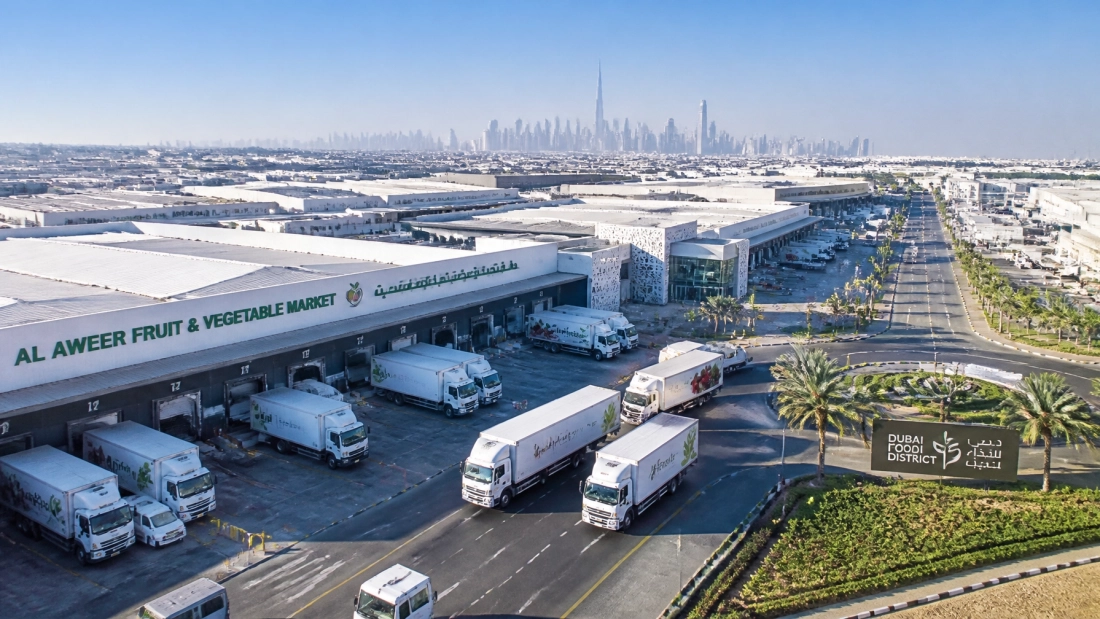
The landscape of food distribution in the UAE has undergone a significant transformation as we move through 2026. With Dubai’s Al Aweer market now handling approximately 7,000 metric tons of produce daily, the demand for streamlined, transparent, and high-volume supply chains has never been higher. For international exporters, the challenge is no longer just "getting the product to the port," but securing a verified buyer who can navigate the complex interplay of new digital regulations, shifting market prices, and the transition toward the upcoming Dubai Food District.

At Mayil Global, we facilitate this transition for global exporters through our specialized 3% commission-based distribution and Cash & Carry wholesale systems. As the UAE Minister of Economy recently confirmed abundant supplies and a stabilization of prices across the sector, the opportunity for reliable exporters to secure long-term market share is at its peak.

Step 1: Comply with the 2026 Digital Labeling and Registration Standards

The primary barrier to entry for food exports in 2026 is regulatory compliance. Dubai has fully transitioned to the Nutri-Mark Front-of-Pack Labeling (FOPL) and digital labeling system. This is no longer a recommendation but a mandatory requirement enforced through the ZAD (National Food Accreditation and Registration) and FIRS (Food Import and Re-export System) platforms.

Exporters must ensure that every shipment features bilingual labels (Arabic and English) that include:

  • Nutri-Mark Score: A digital QR code or visual indicator reflecting the nutritional grade.
  • Detailed Traceability: Clear batch numbers and production dates.
  • Importer Credentials: Specific details of your licensed UAE partner, such as Mayil Global.

Failing to meet these digital standards can result in shipment rejection or significant delays at Jebel Ali Port. By aligning with a verified buyer who manages these registrations on your behalf, you mitigate the risk of non-compliance.

A modern digital food label on a vegetable crate showing a QR code and the Nutri-Mark FOPL system with Arabic and English text in a professional distribution center.

Step 2: Master the Al Aweer Market Dynamics (The Onion Case Study)

Understanding the "spot market" pricing of the Al Aweer market is essential for maintaining profitability. Pricing in Dubai is highly volatile, influenced by daily arrivals and regional harvest cycles.

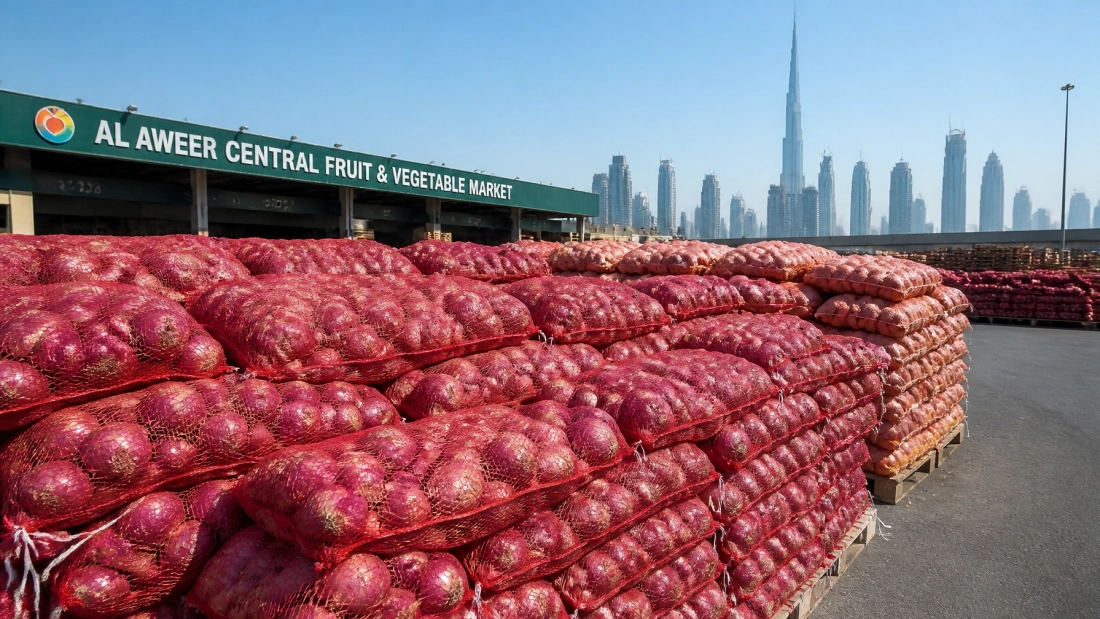
Take the onion trade as a prime example. Since the 20% export duty on Indian onions was removed in April 2025, Dubai has seen a consistent influx, with roughly 403,000 metric tons of Indian onions arriving annually. As of mid-2026, we are seeing the following price bands at Al Aweer:

  • New Red Onions: Trading between 1.40 – 1.60 AED/kg.
  • Old Crop Onions: Trading between 0.30 – 0.50 AED/kg.

Exporters who rely on static pricing models often find their margins eroded. Mayil Global provides real-time market intelligence, ensuring that your shipments are timed to coincide with high-demand windows. Our 3% commission model is specifically designed to provide transparency in these fluctuating environments, allowing exporters to see the exact price their goods fetch on the floor.

Close-up of premium red onions in professional wholesale mesh bags stacked neatly on a pallet inside a modern temperature-controlled warehouse.

Step 3: Utilize the Green Corridor and 90-Day Transit Window

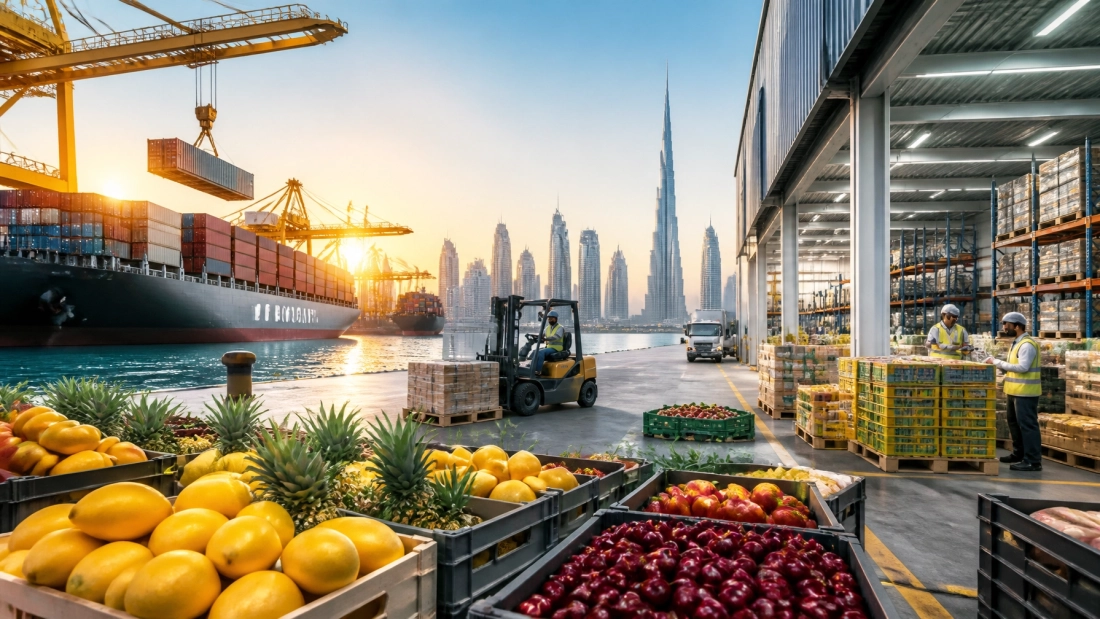
Logistics efficiency is the backbone of a successful export business. Dubai Customs has optimized the "Green Corridor" for perishable goods, drastically reducing inspection times for pre-cleared exporters. Furthermore, the 90-day transit window allows for strategic storage and distribution, provided you have access to high-standard cold chain facilities.

As DP World continues the phased rollout of the Dubai Food District (scheduled for full activation in 2027), the infrastructure in and around Al Aweer has been upgraded to support massive throughput. Exporters must ensure their logistics partner can provide:

  1. Organized Logistics: Seamless movement from port to wholesale floor.
  2. Hygienic Handling: Adherence to strict Dubai Municipality safety standards.
  3. Proper Storage: Temperature-controlled environments to preserve the shelf life of sensitive produce like Pakistani mangoes, which are currently trading 20% higher this year due to premium quality and controlled supply.

For more insights on optimizing your margins through logistics, refer to our guide on exporting watermelons.

Step 4: Secure Immediate Liquidity via the 3% Commission Model

One of the most significant challenges for international exporters is the "liquidity gap": the time between shipping goods and receiving payment. In the traditional wholesale environment, this can take weeks, stalling your ability to reinvest in your next container.

Mayil Global solves this through our 3% Commission & Cash-and-Carry Model. Here is how it functions:

  • The Model: We handle the entire distribution process for a flat 3% commission fee.
  • Immediate Cash: Utilizing our Cash & Carry system, we sell your produce directly to our network of supermarkets, restaurants, and retailers.
  • Transparency: You receive detailed reports on the sales price, minus our 3% commission, ensuring no hidden costs or "middleman" markups.

This model is particularly effective for high-volume commodities like bulk rice and vegetables, where speed of turnover is critical to maintaining freshness and cash flow.

A professional business meeting in a modern Dubai office between a global exporter and a Mayil Global representative reviewing supply chain analytics.

Step 5: Establish a Partnership with a Verified UAE Buyer

The final and most crucial step is selecting a partner that acts as your eyes and ears on the ground. A verified buyer like Mayil Global doesn't just "buy" your product; we manage your brand's reputation in the UAE market.

Our B2B supply network covers the entire UAE, providing a steady and reliable outlet for your produce. Whether you are exporting premium basmati rice or fresh onions, our rigorous quality control and inspection at every stage ensure that your product meets the expectations of the Dubai market.

Why Exporters are Switching to Mayil Global in 2026:

  • Farm-Direct Sourcing Integrity: We respect the relationship between the farm and the market.
  • Strict Quality Control: Multi-stage inspections to minimize wastage.
  • Reliable Supply Chain: Leveraging the latest DP World infrastructure.
  • Financial Stability: Fast settlements through our transparent commission structure.

Conclusion

Exporting food to Dubai in 2026 requires a sophisticated approach that balances regulatory compliance with market agility. By following these five steps: mastering digital labeling, understanding Al Aweer spot pricing, utilizing the Green Corridor, securing liquidity through the 3% commission model, and partnering with a verified buyer: exporters can build a sustainable and profitable business in one of the world's most dynamic food hubs.

Mayil Global is committed to being the bridge between global exporters and the UAE's wholesale market. We are currently accepting new containers of fresh produce, spices, and rice under our 3% commission framework.

Contact Mayil Global today to secure your position in the Dubai Food District transition.
pR4l2HjpqEN

Verified Buyer & Exporter Authority: Exporting Premium Spices to Dubai , Market Insights & 3% Commission Model

The United Arab Emirates stands as a global beacon for the spice trade, serving not only its vibrant domestic market but also acting as a primary re-export hub for the GCC, Middle East, Africa, and South Asia. For international exporters, the Dubai spice market represents a high-yield opportunity underpinned by a 100% import dependency.

As part 5 of our Verified Buyer & Exporter Authority Series, this technical briefing examines the premium spice landscape in Dubai. Following our previous discussions on the 3% commission model and the mechanics of Al Aweer pricing, we now shift focus to the logistical and financial frameworks required to successfully export high-value spices to the UAE.

1. Dubai Spice Market Outlook (2025–2034)

The UAE spice market is currently valued at approximately $951 million in 2025 and is projected to reach $1.45 billion by 2034, maintaining a steady CAGR of 4.87%. This growth is driven by a diverse expatriate population, a booming HoReCa (Hotel, Restaurant, and Café) sector, and increasing industrial food processing requirements.

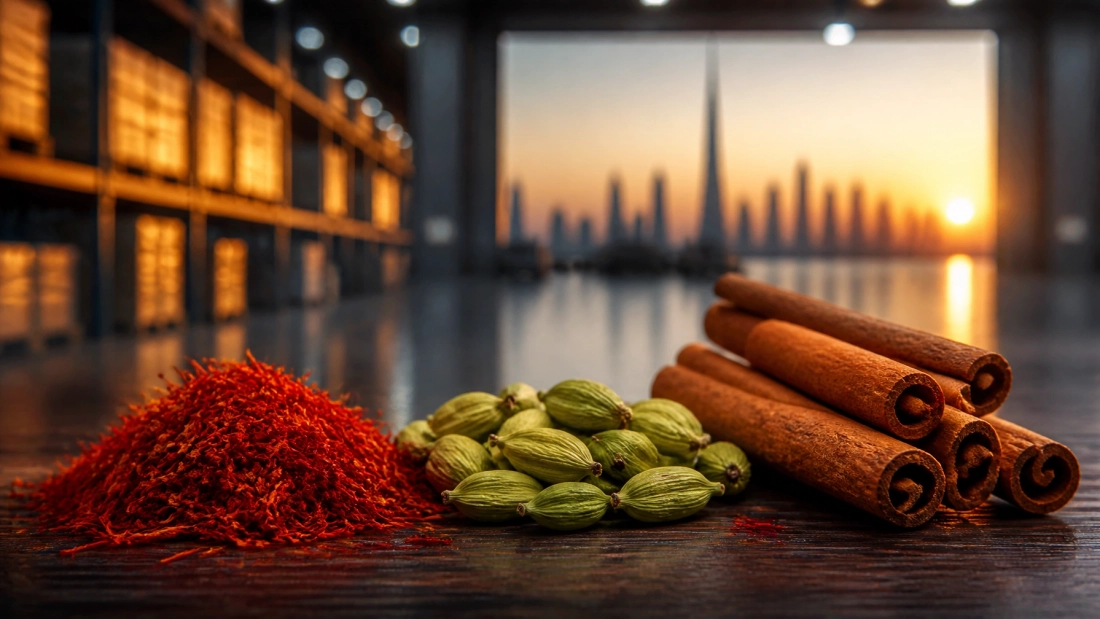
In 2025, the spice trade saw a significant 11.4% year-on-year growth, with total import values reaching approximately $41.69 million for specialized categories. While commodity spices like black pepper and cinnamon dominate volume, the "premium" segment: including saffron, cardamom, and vanilla: represents the highest profit margins for exporters who can meet Dubai’s rigorous quality standards.

Key Demand Drivers:

  • HoReCa Expansion: The continuous opening of high-end restaurants in Dubai and Abu Dhabi creates a non-stop demand for consistent, high-purity spices.
  • Seasonal Volatility: Demand spikes significantly during Ramadan and Eid, requiring exporters to have agile supply chains.
  • Tourism Growth: As a global tourism destination, the UAE’s culinary diversity necessitates a vast array of global spice profiles.

2. The 3% Commission Model: Redefining Export Liquidity

For exporters, the traditional model of selling to middle-men often results in opaque pricing and delayed payments. Mayil Global operates on a 3% Commission-Based Distribution Model specifically designed to provide transparency and immediate liquidity.

Corporate graphic representing the 3% commission model for food export in a modern Dubai warehouse

Under this model, Mayil Global acts as your verified distribution partner in the UAE. Instead of purchasing your goods at a fixed, low-balled rate, we sell your premium spices at the actual market price in Dubai. We then deduct a flat 3% service fee, returning the remainder of the market value to you. This ensures:

  • Daily Liquidity: Immediate cash-and-carry wholesale transactions.
  • Price Transparency: Exporters benefit from real-time market fluctuations rather than being locked into outdated contracts.
  • Operational Excellence: We handle the storage, handling, and distribution to supermarkets and restaurants.

Whether you are importing onions to Dubai or shipping high-value cardamom, this model remains the most profitable path for international exporters.

3. Regulatory Framework and Quality Control

Successfully navigating the Dubai customs landscape requires strict adherence to digital and physical standards. All food imports, including spices, must be processed through established municipal systems.

Digital Registration (ZAD and FIRS)

Exporters must ensure their local partner (such as Mayil Global) has registered the products through:

  • FIRS (Food Import and Re-Export System): The Dubai Municipality’s platform for managing food safety and clearance.
  • ZAD: The federal portal for food tracking and security across the UAE.

Documentation Requirements:

  1. Halal Certification: While pure spices are naturally halal, blended spices or those processed with specific additives require official Halal certification to access the wider GCC market.
  2. Arabic Labeling: All packaging must feature clear Arabic labeling, including ingredients, country of origin, and expiry dates.
  3. Phytosanitary Certificates: Essential for clearing inspection at Jebel Ali Port or Dubai World Central.

For those still learning how to export food to Dubai, understanding these non-negotiable pillars of safety and hygiene is critical for long-term viability.

4. Leveraging the India-UAE CEPA Advantage

The Comprehensive Economic Partnership Agreement (CEPA) has revolutionized the spice trade between India and the UAE. Indian exporters of premium spices like turmeric, cumin, and saffron now enjoy 0% customs duty when providing a valid Preferential Certificate of Origin (COO).

Handshake between businessmen with Indian spices and CEPA agreement documents on the table

This trade agreement significantly lowers the barrier to entry, making Indian spices more competitive against other global suppliers. As a preferred wholesale supplier of premium rice and spices, Mayil Global helps Indian exporters leverage CEPA to maximize their net margins.

5. Step-by-Step Guide for Spice Exporters

To ensure a seamless transition from farm to the Dubai wholesale market, follow this standardized procedure:

  1. Product Inspection: Conduct rigorous testing for aflatoxins and pesticide residues. Premium spices must meet international standards to avoid rejection by Dubai Municipality.
  2. Packaging & Labeling: Use moisture-proof, food-grade packaging. Ensure all labels are compliant with UAE.S GSO 9 standards.
  3. Logistics Coordination: Organize shipping to Jebel Ali Port. Mayil Global’s organized logistics network ensures timely clearance and transport to our temperature-controlled facilities.
  4. Market Placement: Upon arrival, goods are moved through our wholesale fruits and vegetables Dubai network or specialized spice distribution channels.
  5. Settlement: Goods are sold at market rates, and the 3% commission model is applied for immediate payout.

A quality control inspector examining premium black peppercorns in a hygienic warehouse environment

Conclusion: Partnering with Mayil Global

The Dubai spice market is a sophisticated environment that rewards quality, transparency, and reliability. By utilizing Mayil Global’s 3% commission model, exporters can bypass the traditional risks of international trade and secure a stable, profitable presence in the UAE.

Whether you are a global exporter looking for a verified buyer or a local restaurant seeking a reliable wholesale supplier of fresh produce, Mayil Global provides the infrastructure and expertise to ensure your success.

Contact our sourcing team today to discuss your next container of premium spices and join our network of successful international partners.

PfPtUWcKnsk

UAE Export News & Al Aweer Market Update: July 18, 2026

As of July 18, 2026, the UAE’s trade and export landscape continues to demonstrate remarkable resilience and strategic expansion. For global exporters, local distributors, and wholesale market participants, staying informed on shifting regulatory standards and pricing fluctuations at Al Aweer Market is essential for maintaining a competitive edge. This update provides a comprehensive overview of the current export climate, regulatory requirements, and the latest market intelligence.

UAE Export Sector: Strategic Growth and Policy Shifting

The second half of 2026 marks a significant turning point for the UAE’s export trajectory. Following a strategic pivot in hydrocarbon management and a strengthened focus on non-oil trade diversification, the nation is witnessing a robust rebound in trade volumes.

Hydrocarbon Resilience and Global Energy Deals

Recent data indicates a surge in oil exports, which reached 3.94 million barrels per day (bpd) in June 2026. This performance aligns with the International Monetary Fund’s (IMF) outlook, which projects a steady rebound for the UAE’s export sector throughout H2 2026. The shift follows the UAE’s finalized exit from the OPEC framework, allowing for greater production flexibility and the fulfillment of long-term global energy demands.

In a landmark move for the gas sector, ADNOC has finalized a 15-year Liquefied Natural Gas (LNG) agreement with Japan’s Inpex. This deal underscores the UAE’s role as a dependable global energy supplier and ensures long-term revenue stability, which further bolsters the national logistics infrastructure used by all export categories, including the food and beverage sector.

Facilitating Non-Oil Exports

The United States has recently eased export controls on the UAE, granting the nation Country Group A:5 status. This reclassification simplifies the transfer of advanced technologies and dual-use goods, signaling a higher level of trust and cooperation between the two nations. For the broader export community, this move enhances the UAE's position as a high-tech regional hub.

To support small and medium-sized exporters (SMEs), a new $50 million trade finance facility has been launched, backed by Etihad Credit Insurance (ECI) and Abu Dhabi Commercial Bank (ADCB). This facility is specifically designed to provide liquidity and risk mitigation for non-oil exports, ensuring that UAE-based businesses can compete effectively in international markets without the traditional constraints of capital intensity.

Al Aweer Market Analysis: Price Trends and Supply Dynamics

For food exporters and wholesale distributors, the Al Aweer Market remains the primary barometer for fresh produce pricing in the region. Understanding the current wholesale rates is critical for calculating margins and coordinating shipments.

Bustling Al Aweer wholesale market with stacks of high-quality onions, potatoes, and bananas

Current Wholesale Commodity Pricing

As of July 18, 2026, the following wholesale prices are observed at Al Aweer:

Commodity Price Range (AED/kg) Market Trend
Tomato 8.00 – 10.00 Increasing due to seasonal shifts
Onion ~7.00 Stable supply from global sources
Banana 4.00 – 6.00 Consistent demand; steady supply
Carrot 5.00 – 6.00 Slight decrease in premium varieties
Potato 2.50 – 4.00 High volume availability
Cucumber 3.50 – 5.00 Fluctuating based on daily arrivals

Note: These prices are subject to daily fluctuations based on supply chain logistics and international arrival schedules.

Market Outlook for Exporters

The importance of real-time pricing intelligence cannot be overstated for global exporters. Seasonal fluctuations are currently impacting tomato and cucumber supplies, requiring exporters to adjust their procurement strategies. Leveraging the data from Al Aweer allows market participants to identify liquidity gaps and capitalize on high-demand periods. For those looking to optimize their entry into this market, utilizing a 3 percent commission distributor in UAE provides a transparent and efficient pathway to liquidate inventory quickly.

Regulatory Landscape: Compliance Standards for 2026

The UAE government has implemented several unified systems to ensure the highest standards of food safety and consumer protection. Non-compliance with these regulations can lead to significant delays at ports of entry or the rejection of entire shipments.

Professional quality control inspector checking food safety standards in a hygienic facility

Unified Food Safety and ZAD Registration

In 2026, the UAE transitioned to a unified food safety system, centralizing the oversight of all food imports and domestic production. A critical component of this system is the ZAD registration requirement. All food products intended for sale in the UAE must be registered through the ZAD portal, ensuring full traceability from the farm to the retail shelf.

Furthermore, the Ministry of Climate Change and Environment (MOCCAE) now requires pre-approval for all first-time importers. This process involves a rigorous audit of the supplier’s home-country certifications and production facilities to ensure they meet the UAE’s strict safety criteria.

Labeling and Certification Requirements

  • Mandatory Arabic Labeling: All packaged food products must feature clear, accurate Arabic labeling. This includes the product name, ingredients, nutritional information, and expiration dates.
  • Halal Certification: For meat and poultry products, Halal certification from UAE-approved bodies remains a non-negotiable requirement.
  • Nutri-Mark Labeling: The Nutri-Mark system is now active nationwide. This front-of-pack labeling provides consumers with a clear understanding of the nutritional value of products, categorizing them based on health parameters. Exporters must ensure their packaging is updated to reflect these standards to avoid retail non-compliance.

Strategic Distribution with Mayil Global

Navigating the complexities of the UAE export market requires a partner with deep local roots and a global supply network. Mayil Global is positioned as a verified buyer for exporters in the UAE, providing a secure and reliable outlet for high-quality fresh produce.

Fleet of modern refrigerated delivery trucks at a distribution warehouse

The 3% Commission Model for Global Exporters

At Mayil Global, we understand that liquidity and transparency are the primary concerns for international exporters. Our 3% commission distributor UAE model is designed to maximize returns for the shipper. By charging a flat, transparent commission of only 3%, we allow exporters to retain a larger share of the market price. This model is particularly effective for those handling high-volume shipments of tomatoes, onions, and bulk rice.

Verified Buyer Status and Operational Excellence

As a verified buyer, Mayil Global offers more than just distribution. We provide:

  • Farm-Direct Sourcing: Ensuring the freshest produce arrives at the market.
  • Strict Quality Control: Every stage of the supply chain, from inspection to packaging, follows international safety standards.
  • Organized Logistics: Our fleet of refrigerated trucks ensures timely delivery to supermarkets, restaurants, and retailers across the UAE.
  • Market Intelligence: We help our partners leverage Al Aweer price intelligence to time their shipments for maximum profitability.

Whether you are an international exporter looking for a reliable gateway into the UAE or a local retailer seeking a wholesale vegetables supplier, Mayil Global delivers the stability and professionalism required in today’s market.

Conclusion

The UAE export sector in July 2026 is characterized by growth, regulatory modernization, and strategic energy partnerships. By staying informed of the Al Aweer market updates and complying with the latest food safety standards, exporters can thrive in this dynamic environment. Mayil Global remains committed to supporting our partners through transparent pricing, operational excellence, and a relentless focus on quality.

9lbw74rQbKo

Chickpeas, Lentils, and Specialty Grains: How Pulse Exporters Are Thriving in Dubai with Mayil Global’s 3% Commission Model

Dubai has solidified its position as a global epicentre for the trade of pulses and specialty grains. As a primary import and re-export hub, the city serves as a gateway to the broader GCC, Africa, and South Asia. For international exporters of chickpeas, lentils, and specialty grains, navigating this high-volume market requires more than just a logistical partner; it requires a strategic distribution model that prioritizes transparency, liquidity, and margin protection.

Mayil Global is at the forefront of this industry shift, offering a specialized 3 percent commission distributor UAE model. By moving away from traditional, opaque procurement methods, we empower exporters to maintain ownership of their cargo while leveraging our local expertise to capture maximum market value. This article explores how our commission-based and cash-and-carry models are driving success for pulse exporters in the region.

The Pulse Portfolio: Meeting High-Volume Demand in the UAE

The demand for pulses in the UAE is characterized by consistent growth and high consumption rates. Pulses are a dietary staple and a critical component of the regional food security strategy. At Mayil Global, we focus on the high-demand categories that drive the wholesale market.

Chickpeas: Kabuli and Desi Varieties

Chickpeas represent a significant portion of the pulse trade in Dubai. We handle both Kabuli chickpeas, known for their larger size and cream color, and Desi chickpeas, which are smaller and darker. These are essential for the local hospitality sector and the retail market. As a leading wholesale food buyer dubai, we ensure that these products meet the stringent quality specifications required by the Dubai Municipality.

Lentils: Red Split and Green Lentils

Lentils are the highest-volume item in the UAE’s pulse sector, with red split lentils showing a marked increase in demand during peak seasons like Ramadan. Our sourcing network ensures a steady supply of premium red and green lentils, which are processed and packaged according to international safety standards. The efficiency of our distribution network allows these products to move from Jebel Ali Port to the wholesale markets with minimal delay.

Specialty Grains: Quinoa and Bulgur

Beyond traditional pulses, the market for specialty grains is expanding as consumer preferences shift toward healthier, nutrient-dense options. Quinoa and bulgur are no longer niche products; they are now volume drivers in the B2B sector. Mayil Global facilitates the entry of these specialty grains into the UAE market, providing exporters with a platform to reach supermarkets and high-end restaurant chains.

A detailed close-up shot of high-quality Kabuli chickpeas and red split lentils, showcasing uniform size and premium texture.

Disrupting the Supply Chain: The 3% Commission Model

The traditional distribution model often involves middle-men who purchase containers at a steep discount, leaving the exporter with thin margins and little visibility into the final sale price. Mayil Global’s 3% commission framework is designed to rectify this imbalance.

For Exporters: Margin Maximization

Under our 3% commission model, the exporter retains legal ownership of the goods until the final sale is made in the UAE market. Mayil Global acts as the professional sales arm, managing:

  1. Import Clearance: Navigating the complexities of Jebel Ali customs.
  2. Logistics and Storage: Utilizing climate-controlled facilities to maintain product integrity.
  3. Market Execution: Selling directly to wholesalers, retailers, and re-exporters.

Because our fee is fixed at 3% of the final sales value, our incentives are perfectly aligned with the exporter's. We strive to achieve the highest possible market price, as a higher sale price directly benefits both the exporter and the distributor.

Market Transparency and Real-Time Data

One of the primary challenges for international shippers is the "information gap." In many cases, once a container leaves the port of origin, the exporter loses sight of market fluctuations. We solve this by providing real-time updates on price movements in major trading hubs like the Aweer Market. This transparency allows exporters to make informed decisions on whether to liquidate stock immediately or hold for a projected price peak.

Immediate Liquidity: The Cash-and-Carry Model

While the commission model is ideal for maximizing margins over time, we recognize that certain exporters require immediate capital rotation. For these partners, we offer a Cash-and-Carry option.

In this model, Mayil Global purchases the container outright upon arrival and inspection. This provides the exporter with immediate liquidity, allowing them to reinvest in their next harvest or shipment without waiting for the local sales cycle to complete. This is particularly beneficial for those who operate on high-volume, low-latency business models and are looking for reliable bulk rice suppliers dubai and pulse distributors who can move large quantities of stock rapidly.

An organized logistics scene at a Dubai port, representing the efficient global supply chain and distribution network of Mayil Global.

Operational Excellence: The Foundation of Trust

Reliability in food distribution is built on the pillars of quality control and logistical precision. Mayil Global operates with a rigorous framework to ensure that every shipment of chickpeas, lentils, and specialty grains meets the expectations of our B2B clients.

Strict Quality Control and Inspection

Quality control is not a one-time event but a continuous process. Our team conducts inspections at every stage:

  • Farm-Direct Sourcing: We work with trusted global suppliers who adhere to strict agricultural standards.
  • Pre-Shipment Inspection: Ensuring the moisture content, grain size, and purity meet our specifications.
  • Post-Arrival Testing: Re-verifying quality upon arrival in Dubai to ensure no degradation occurred during transit.

Hygienic Handling and Safety Standards

Following the ultimate guide to pulses and grains, we maintain a sterile environment for all our food products. Our packaging facilities follow international safety standards, ensuring that pulses remain free from contaminants and pests. This is a non-negotiable aspect of our operations, as we cater to high-standard buyers in the UAE's hospitality and retail sectors.

Organized Logistics and Timely Delivery

Time is a critical variable in the food industry. Our logistics network is optimized for speed and reliability. Whether it is moving containers from the port or delivering bulk orders to local supermarkets, we ensure that the cold chain (where applicable) and general storage conditions are strictly managed to preserve shelf life.

Targeted Benefits for Local B2B Buyers

For supermarkets, restaurants, and wholesale distributors within the UAE, Mayil Global serves as a dependable source of premium produce. By working with us, local buyers gain several advantages:

  • Consistent Supply: Our global network ensures that we are never "out of stock," even during seasonal shortages.
  • Competitive Wholesale Pricing: By streamlining the supply chain and reducing unnecessary intermediary costs, we pass on the savings to our local partners.
  • Quality Assurance: Buyers can trust that the product they receive has undergone rigorous testing.

Our cash and carry food wholesale model is particularly popular among restaurants that need to manage their inventory with flexibility and speed.

Specialty grains like Quinoa and Bulgur displayed in professional packaging, highlighting the high-quality textures and professional showroom setting.

Conclusion: A Strategic Partnership for Growth

The pulse and specialty grain market in Dubai is competitive, but it offers immense rewards for those who utilize the right distribution framework. Mayil Global’s 3% commission model provides a level of transparency and profit potential that is unmatched in the traditional trading sector. Simultaneously, our cash-and-carry model ensures that liquidity needs are met for high-velocity exporters.

Whether you are an exporter in Canada, India, or Turkey looking for a foothold in the Middle East, or a local UAE retailer seeking a stable supply of high-quality lentils and chickpeas, Mayil Global is your partner for operational excellence.

We invite exporters and B2B buyers to contact our team to discuss how our distribution models can be tailored to your specific volume and liquidity requirements. Together, we can build a more transparent, efficient, and profitable supply chain for pulses and grains in the UAE.


pYx03lDLrvA

Verified Buyer & Exporter Authority Series: How to Export Food to Dubai Through Mayil Global’s 3% Commission Model

Dubai serves as the primary trade gateway for the Middle East, offering a sophisticated infrastructure for the global food trade. For international exporters, the challenge often lies in navigating local market dynamics and securing a reliable distribution partner that prioritizes the exporter's margins. As the first installment in our Verified Buyer & Exporter Authority Series, this guide details how Mayil Global facilitates market entry through a transparent 3% commission-based distribution model and a robust Cash & Carry wholesale system.

The Central Hub: Wholesale Fruits and Vegetables in Dubai

The heart of the region's food trade is the Al Aweer Fruit and Vegetable Market. As the largest wholesale hub in the UAE, Al Aweer dictates the pricing and supply chain flow for the entire country and neighboring markets.

Operating within this high-volume environment requires more than just logistics; it requires real-time market intelligence. Prices in the wholesale fruits and vegetables Dubai market are driven by daily arrivals, produce grading, and seasonal demand. Success for an exporter depends on having a partner positioned directly within this hub, capable of moving large volumes while maintaining the integrity of the cold chain.

Mayil Global leverages its established presence in Al Aweer to ensure that produce is sold at the best prevailing market rates, providing exporters with direct access to the UAE’s extensive network of supermarkets, restaurants, and retailers.

Al Aweer Wholesale Market Hub

Disruption in Distribution: The 3% Commission Model

Traditional distribution models often involve multiple layers of middlemen, each taking a significant margin that erodes the exporter's profit. Mayil Global has streamlined this process by introducing a flat 3% commission model.

How the 3% Model Operates

This model is designed for transparency and operational excellence. Instead of buying at a low fixed price and reselling at a high markup, Mayil Global acts as your dedicated distribution arm in Dubai.

  1. Transparent Sales: We sell your products at the actual market price in the Dubai wholesale market.
  2. Flat Fee: A 3% commission is applied to the gross sales value.
  3. Cost Recovery: Direct operational costs (customs, clearance, handling) are clearly accounted for and deducted from the proceeds.
  4. Full Profit Realization: The remaining balance is remitted to the exporter, ensuring you capture the full upside of market price fluctuations.

By aligning our interests with yours, we prioritize the sale of your goods at the highest possible price point. This 3% commission strategy is a cornerstone of our commitment to building long-term, mutually beneficial relationships with global exporters.

Transparent 3% Commission Model Concept

Securing Liquidity: The Cash & Carry Wholesale System

For exporters, cash flow is the lifeblood of operations. Traditional wholesale often involves long credit terms that tie up capital. Mayil Global’s Cash & Carry wholesale system addresses this liquidity gap by facilitating immediate transactions for local B2B buyers: supermarkets and retailers: who require premium produce daily.

This system ensures that high-turnover items move quickly from our temperature-controlled storage to the buyer, resulting in faster payment cycles for the exporter. Whether you are shipping containers of spices or fresh eggs, our organized logistics and storage capabilities ensure that your product remains in peak condition until the point of sale.

A Step-by-Step Guide: How to Export Food to Dubai

Navigating the regulatory landscape is essential for any successful export operation. To maintain high standards of food safety, Dubai Municipality and federal authorities enforce strict protocols.

1. Appoint a Licensed UAE Partner

Any food shipment entering Dubai must be consigned to a company with a valid food trade license. Mayil Global serves as your authorized importer, managing the legal and administrative requirements for entry.

2. Product Registration (ZAD and FIRS)

All food items must be registered in the National Food Accreditation and Registration System (ZAD) and the Food Import and Re-export System (FIRS). This includes a label assessment to ensure compliance with UAE standards.

3. Documentation Compliance

Exporters must provide original, authenticated documents to avoid detention at Jebel Ali Port or Dubai Airport:

  • Commercial Invoice: Detailing quantities and value.
  • Certificate of Origin: Authenticated by the Chamber of Commerce.
  • Health Certificate: Issued by the competent authority in the origin country.
  • Phytosanitary Certificate: Required for all fresh fruits and vegetables.

4. Labeling Standards

Labels must be in both Arabic and English. Mandatory information includes the product name, brand, ingredients, production/expiry dates, net weight, and country of origin.

5. Logistics and Clearance

Upon arrival, Mayil Global manages the clearance process, including Municipality inspections and sampling. Once cleared, the goods are transported to our facility or directly to the market for distribution.

Strategic Focus: Importing Onions to Dubai

Onions are one of the highest-volume commodities in the UAE. When importing onions dubai, exporters must focus on two critical factors: grading and temperature control.

Dubai's market demands variety, including red, yellow, and white onions. The shelf life and marketability of these products depend heavily on the ventilation and humidity levels during transit and storage. Mayil Global provides specialized handling for onion shipments, ensuring that the produce arrives at Al Aweer without moisture damage or rot.

Exporters utilizing our 3% commission model for onions benefit from our ability to grade the product upon arrival, ensuring that premium batches are priced accordingly to maximize returns.

Fresh Onions Prepared for Export

Quality Control and International Standards

At Mayil Global, our operational philosophy is built on the pillars of safety, hygiene, and international standards. Our products, ranging from premium spices to farm-fresh eggs, undergo rigorous inspection at every stage of the supply chain.

  • Farm-Direct Sourcing: We work with trusted farms to ensure the source is reliable.
  • Hygienic Handling: Our packaging and storage facilities follow strict safety standards to prevent contamination.
  • Organized Logistics: Our logistics network is optimized for the timely delivery of perishable goods, minimizing waste and maintaining freshness.

Conclusion: Partner with Mayil Global

The UAE market presents a significant opportunity for exporters who can navigate its complexities with the right partner. By choosing Mayil Global, you gain more than a distributor; you gain a strategic partner committed to your profitability through our 3% commission model and operational excellence.

For exporters looking to secure their position in the Dubai wholesale market, now is the time to optimize your supply chain.

Ready to start your export journey to Dubai?
Contact Mayil Global today to discuss how our 3% commission and Cash & Carry models can drive your business growth.

pvj5OYMwADx

Basmati Rice & Premium Lentils: Why Dubai Buyers Are Choosing Mayil Global’s 3% Commission Model

Dubai serves as the undisputed epicentre of the Middle East food trade, acting as both a primary consumption market and a high-velocity re-export hub. Within this dynamic environment, the demand for high-quality staples such as Basmati rice and premium lentils remains consistently high, driven by a growing population, a thriving hospitality sector, and a sophisticated retail landscape.

As a premier wholesale food buyer in Dubai, local businesses: including supermarkets, large-scale restaurants, and institutional caterers: require more than just product; they require a supply chain partner that ensures stability, quality, and fiscal efficiency. Mayil Global is meeting this need through a disruptive business strategy: the 3% commission model. By bridging the gap between global exporters and local UAE buyers with unparalleled transparency, we are redefining how bulk commodities are distributed in the region.

The Strategic Importance of Basmati Rice and Pulses in the UAE

The UAE is one of the world's most significant importers of Basmati rice, with the grain being a non-negotiable staple for the large South Asian diaspora and the high-end hospitality industry. Similarly, lentils: specifically red masoor and yellow toor varieties: are essential components of the daily diet and institutional catering menus across the Emirates.

For bulk rice suppliers in Dubai, the challenge is often maintaining a steady supply of premium varieties like the 1121 Steam Basmati or Sella rice, which are prized for their length, aroma, and aging. Mayil Global addresses this by sourcing directly from trusted farms and global exporters, ensuring that the product landing in the Aweer market or Jebel Ali meets the rigorous standards expected by Dubai’s discerning buyers.

Navigating Market Volatility

Price stability is a frequent concern for B2B buyers. Global market fluctuations often lead to unpredictable costs at the retail level. At Mayil Global, we mitigate these risks through:

  • Direct Sourcing: Eliminating unnecessary intermediaries to stabilize costs.
  • Global Supply Networks: Utilizing a diverse network of exporters to ensure a steady supply even during regional harvest disruptions.
  • Inventory Management: Maintaining proper storage and handling to preserve grain quality and manage supply-demand cycles.

Learn more about managing these fluctuations in our guide: 10 things you should know about price stability.

Disrupting Distribution: The 3% Commission Advantage

Infographic showing financial transparency and 3 percent commission model

At the heart of Mayil Global’s operations is our commitment to a transparent and low-margin distribution model. Traditionally, the distribution of food products in the UAE involved complex layers of pricing and high commission fees, which often eroded the margins of exporters and inflated costs for local buyers.

As a leading 3 percent commission distributor in the UAE, Mayil Global offers a model that prioritizes volume and long-term partnership over short-term markups.

Benefits for Global Exporters

For international exporters of rice and lentils, our 3% commission model is a game-changer. It provides:

  1. Maximum Profit Retention: Exporters keep 97% of the gross sale value, allowing them to reinvest in their own production and growth.
  2. Immediate Liquidity: We facilitate rapid turnover and, in many cases, offer cash-and-carry container purchases, solving the common liquidity gaps found in traditional export-import cycles.
  3. Market Transparency: Every transaction is documented, ensuring exporters know exactly where their product is sold and at what price.

Exporters looking to maximize their reach can explore our 3% commission strategy explained.

Benefits for Dubai Wholesale Buyers

Local supermarkets and retailers benefit directly from this efficiency. When distribution costs are kept at a lean 3%, the landed cost of premium Basmati and lentils remains competitive. This allows retailers to offer better value to their end consumers while maintaining healthy operational margins.

Ensuring Excellence: Sourcing, Quality Control, and Logistics

Maintaining the "Premium" label on our rice and lentils requires a rigorous operational framework. Every grain of rice and every batch of lentils undergoes a strict verification process before it reaches our distribution network.

Quality control inspection of Basmati rice samples

Rigorous Inspection at Every Stage

Our quality control process is non-negotiable. It includes:

  • Farm-Level Sourcing: Selecting only the highest-grade crops from reputable origins.
  • Hygienic Handling: Utilizing modern packaging and storage facilities that follow international safety standards.
  • Pre-shipment Inspection: Verifying grain length, moisture content, and purity levels for Basmati rice to prevent adulteration.
  • Continuous Monitoring: Ensuring that storage conditions in our Dubai facilities remain optimal for the long-term preservation of taste and aroma.

Optimized Logistics and Distribution

Efficiency in the supply chain is the backbone of the wholesale trade. Mayil Global utilizes organized logistics to ensure that once a container arrives, it is processed and distributed with minimal delay. This speed is crucial for maintaining the freshness of produce and the reliability of supply for our B2B clients.

Discover how we solve logistics hurdles in our post on how our cash carry model solves export liquidity gaps.

Why Dubai’s Leading B2B Buyers Partner with Mayil Global

In a market as competitive as the UAE, reliability is the most valuable currency. Mayil Global has established itself as a trusted partner for supermarkets, restaurants, and wholesalers by focusing on the pillars of operational excellence.

Modern distribution fleet at a logistics terminal in Dubai

Delivering Consistent Value

  • Professional Corporate Voice: We communicate with the clarity and professionalism expected in B2B transactions.
  • Standardized Operations: Our processes are designed to be predictable and scalable, ensuring we can handle increased demand during peak seasons like Ramadan or Diwali.
  • Client-Centric Benefits: We frame every operational choice as a direct benefit to our clients, whether it's through cost savings, improved hygiene, or faster delivery times.

Building a Future-Proof Supply Chain

The shift toward more transparent, low-commission distribution is not just a trend; it is the future of the global food trade. By choosing Mayil Global, exporters gain a foothold in the lucrative Dubai market with minimal risk, and local buyers secure a supply of premium Basmati and lentils that is both affordable and high-quality.

Whether you are an exporter seeking a reliable 3 percent commission distributor in the UAE or a wholesale food buyer in Dubai looking for consistent product quality, Mayil Global provides the infrastructure and expertise to support your business goals.

We invite you to experience the difference that operational transparency and professional distribution can make. Partner with Mayil Global to secure your supply chain and maximize your growth in the UAE market.

For more insights into our unique model, read: Why our 3% commission model will change the way you export.

sY4cmsNf62B

Verified Buyer & Exporter Authority: Navigating Onion Import to Dubai in July 2026 with Mayil Global’s 3% Commission Model

For international food exporters, the Dubai wholesale market remains one of the most lucrative yet operationally complex hubs in the GCC. As of July 2026, the onion trade, in particular, is navigating a unique set of geopolitical and harvest-driven variables. Successfully importing onions to Dubai requires more than just high-quality produce; it demands an intricate understanding of shifting logistics, real-time pricing at Al Aweer, and a distribution partner capable of providing immediate liquidity.

This installment of the Verified Buyer & Exporter Authority Series provides actionable intelligence for exporters targeting the UAE market during this volatile mid-year period.

The Dubai Wholesale Onion Landscape (July 2026)

The Al Aweer Central Fruit and Vegetable Market serves as the primary pulse for onion distribution in the region. In the current month, we are observing a stabilized but highly specific pricing structure.

  • Pink Onions: Currently trading steadily between 0.75 and 0.85 AED/kg.
  • Premium Red Onions: Maintaining a robust position, with wholesale rates ranging from 1.15 to 7 AED/kg depending on size, origin, and curing quality.

While origin prices in some regions have softened, the landed cost in Dubai is heavily influenced by the current maritime logistics climate. Tensions in the Strait of Hormuz have significantly impacted freight reliability. Container rates for a standard refrigerated unit from major Asian ports to Jebel Ali have surged from a baseline of ~$2,150 to a current range of $8,600–$9,700 per container.

Exporters must factor these "logistics surcharges" into their C&F (Cost and Freight) calculations to remain competitive. Efficiency in clearing and distributing these containers is no longer just a preference: it is a financial necessity.

Sourcing Origins: The Shift in Supply Chains

India continues to be the dominant force in the UAE's onion supply chain, accounting for approximately 59.6% of the total market share. The 2026 Rabi harvest in India has been robust, particularly in the Lasalgaon region, where prices at the origin remain soft at roughly ₹1,100 per quintal.

However, the logistics squeeze in the Gulf has created a bottleneck. While the supply at the source is high, the volume reaching Jebel Ali is constrained by the aforementioned container costs and transit delays. This has opened significant opportunities for secondary sources:

  • Kazakhstan (23.3%): Providing a steady overland and sea-link alternative.
  • Pakistan (16.3%): Leveraging geographical proximity to maintain a consistent flow despite regional maritime challenges.

Exporters from these regions are finding that wholesale fruits and vegetables in Dubai demand a faster turnover to offset the increased cost of transit.

Cargo container ship navigating a maritime strait representing logistical challenges

UAE Regulatory Requirements: Compliance is Non-Negotiable

Navigating the regulatory framework of the Ministry of Climate Change and Environment (MOCCAE) and the Dubai Municipality is the first barrier to entry for any exporter. Failure to meet these standards results in costly re-exports or destruction of cargo.

  1. ZAD/FIRS Registration: All food products must be registered within the ZAD (National Food Registration System) or the FIRS (Food Import & Re-export System).
  2. MOCCAE Import Approval: For first-time imports or new varieties, approval must be secured prior to the shipment's arrival.
  3. Labeling Standards: Arabic labeling is mandatory for all retail-bound shipments. This includes product name, country of origin, net weight, and importer details.
  4. Shelf Life & Health Certificates: Onions must arrive with a minimum of 50–75% of their total shelf life remaining. A valid Phytosanitary Certificate and Certificate of Origin (COO) are mandatory for every consignment.

At Mayil Global, we facilitate this process for our partners. Our team provides comprehensive FIRS registration assistance, ensuring that your documentation aligns perfectly with UAE standards before the container even leaves your port.

Professional quality control inspection of premium Indian red onions

The Mayil Global Advantage: 3% Commission & Cash-and-Carry

The traditional distribution model often leaves exporters waiting weeks for payment, trapping capital in a cycle of "consignment and wait." In a high-freight environment like July 2026, this delay is unsustainable.

Mayil Global operates as a 3 percent commission distributor in the UAE, a model specifically designed to maximize transparency and liquidity for the exporter.

How the 3% Commission Model Works:

  • Transparent Reporting: We provide daily sales reports directly from the Al Aweer market. You see exactly what your produce sold for, with no hidden margins.
  • Fixed Fee Structure: We charge a flat 3% commission on the gross sales value. This aligns our interests with yours; we are incentivized to achieve the highest possible market price for your onions.
  • Daily Liquidity: Our cash-and-carry approach ensures that as produce is sold to our network of supermarkets and retailers, the funds are cleared and reported immediately.

Immediate Cash-and-Carry Container Purchases

For exporters who prefer immediate settlement, Mayil Global offers a cash-and-carry container purchase option. We buy full containers of onions, potatoes, and garlic at agreed-upon market rates, providing you with instant liquidity and removing the market risk from your shoulders. This is particularly beneficial for exporters managing high-interest export credit lines.

Organized wholesale warehouse in Dubai representing Mayil Global's logistics efficiency

Strategy for Success: How to Export Food to Dubai in 2026

If you are looking at how to export food to Dubai this season, your focus must be on speed and partnership.

  • Prioritize Curing: With transit times potentially extended due to maritime shifts, ensuring your onions are properly cured and dried is vital to maintaining grade-A quality upon arrival at Al Aweer.
  • Leverage Local Expertise: Do not attempt to navigate FIRS or MOCCAE alone. Partnering with a distributor that has an established "Importer of Record" status saves time and reduces risk.
  • Monitor Al Aweer Trends: Prices fluctuate daily. Our daily Al Aweer market price updates allow our partners to time their shipments for maximum profit.

Conclusion

The July 2026 onion market presents a landscape of both high risk and high reward. While freight costs have escalated, the consistent demand for premium produce in the UAE remains a constant. By utilizing Mayil Global’s 3% commission model, exporters can bypass the traditional "black box" of distribution, gaining a transparent, reliable, and liquid pathway to the heart of the Dubai food trade.

Secure your margins today. Partner with Mayil Global for professional, farm-to-market distribution in the UAE.

K2x0T1EL12c

UAE Export News & Al Aweer Market Update – July 17, 2026

The United Arab Emirates continues to solidify its position as the premier global gateway for trade and food distribution. As of July 17, 2026, the landscape of UAE export news reflects a period of significant regulatory easing, strategic international partnerships, and robust infrastructure growth. For exporters and food suppliers targeting the Middle East, staying abreast of these shifts is essential for maintaining a competitive edge and ensuring seamless supply chain operations.

At Mayil Global, we monitor these developments daily to provide our partners with accurate market intelligence and reliable distribution services. This report provides a comprehensive overview of the latest export news, Al Aweer market updates, and critical regulatory changes impacting the industry this month.

UAE Export News: Strategic Easing and New Trade Corridors

The most significant development this month is the decision by the US Commerce Department to elevate the UAE to Country Group A:5 export control status, effective July 10, 2026. This reclassification removes long-standing licensing barriers for advanced technologies and dual-use items. While this primarily impacts the tech sector, its secondary effects on the logistics and food processing industries are profound. The designation signals stronger bilateral trade ties and reinforces the UAE’s reputation as a secure, high-standard trade hub, attracting further investment into the country's cold chain and agricultural tech infrastructure.

Expanding Regional Food Security Pacts

Food security remains a top priority for the UAE government. A newly signed food security pact with Syria has established a direct import route for Syrian fruits and vegetables via Iraq. This strategic corridor is bolstered by the Mair Group, which is currently setting up four agricultural processing centers in Syria to ensure that produce meets the UAE’s rigorous quality and safety standards before shipment. This move diversifies the UAE's sourcing portfolio and provides a reliable supply of Mediterranean produce.

New Sourcing Records from India and the Philippines

The UAE's agricultural import sector is witnessing record-breaking variety and volume from Asian markets:

  • Philippine MD2 Pineapples: Regular imports have officially commenced, with 18-tonne shipments arriving biweekly at Khor Fakkan port. These are being efficiently distributed through Dubai’s wholesale networks, including the Al Aweer market.
  • Indian Stone Fruits: For the first time, India has exported Areko cherries and Scentrose plums from Jammu & Kashmir to the UAE. This initiative has proven highly lucrative for Indian farmers, who reported returns 60-120% higher than local sales.
  • Ladakh Apricots: The first 5 metric tonnes (MT) of premium apricots from Ladakh have reached UAE shores. Plans are already in place to scale this to 1,000 MT this season through a strategic partnership with the Lulu Group.
  • Jharkhand Amrapali Mangoes: Marking another debut, women-led farmer groups from Jharkhand have introduced Amrapali mangoes to the Dubai market, achieving 180% higher returns through direct export channels.

To support these burgeoning trade volumes, Etihad Credit Insurance and ADCB have backed a $50 million trade finance facility specifically designed for non-oil exports, ensuring that the financial backbone of the UAE's trade sector remains resilient.

Close-up of premium global produce including mangoes and cherries

Al Aweer Market Updates: Pricing and Expansion

The Al Aweer Central Fruit & Vegetable Market remains the heartbeat of the UAE's food distribution network. Following a tour by the Minister of Economy in March 2026, which confirmed an abundance of goods and a downward trend in prices, the market has maintained a state of stable pricing and high supply.

Current Indicative Wholesale Prices (July 17, 2026)

Market stability is currently driven by supply diversification from India, the Philippines, Indonesia, Syria, and Europe. For those tracking Al Aweer market updates, current price points for key commodities include:

Commodity Packaging / Weight Price Range (AED)
Onions Per kg 1.15 – 1.20
Garlic 3kg Bag 15.00 – 16.00
Ginger 4kg Bag 7.00 – 9.00
Banana (G9) 13kg Box 20.00 – 24.00
Grapes 5.5kg Box 21.00 – 23.00

Note: These are indicative prices and may vary based on specific quality grades and daily supply fluctuations.

Infrastructure: The Dubai Food District Expansion

DP World’s ambitious expansion of the Dubai Food District is proceeding on schedule. Spanning 2.9 million square feet, this project is set to double the size of the current market infrastructure. Phase 1 construction is slated to begin in 2027, with the final development including advanced cold storage facilities, state-of-the-art processing centers, and a dedicated gourmet hall. This expansion will better serve the 2,500+ traders currently operating within the market and solidify Al Aweer's status as a global logistics powerhouse.

Busy and organized Al Aweer Central Fruit & Vegetable Market

Regulatory Updates: Ensuring Compliance in the Supply Chain

To maintain the integrity of its trade hubs, the UAE has implemented several critical regulatory updates that every exporter must follow.

  1. "No Manifest, No Load" Policy: In effect since June 15, 2026, this policy requires a 72-hour National Advance Information Center (NAIC) approval for all shipments destined for UAE ports. Failure to secure this approval will result in cargo being denied loading at the port of origin.
  2. Federal Veterinary Quarantine Law (No. 6 of 2025): This law has tightened controls on the import of all animal products. Exporters must ensure that all health certifications are up-to-date and comply with the latest biological safety standards to avoid delays at the border.
  3. Nutri-Mark Labeling Mandate: All packaged food products must now feature the color-coded Nutri-Mark labels. This transparency initiative helps consumers make informed health choices and is a non-negotiable requirement for retail distribution in the UAE.

Navigating these regulations requires a partner who understands the local legal landscape. For more information on how these rules affect your shipments, read our guide on exporting to Dubai and maximizing margins.

Why Partner with Mayil Global: Your Verified Buyer for UAE Exporters

For international exporters looking to navigate the complexities of the Dubai market, Mayil Global serves as a premier, verified buyer for exporters in the UAE. We understand that the traditional brokerage model, often involving 5-10% commissions and hidden deductions, can significantly erode your profit margins.

The 3% Commission Distributor Advantage

Our flagship 3 percent commission distributor UAE model is designed for transparency and operational efficiency. We offer:

  • Flat-Rate Pricing: A transparent 3% commission with no hidden administrative fees or surprise deductions.
  • Immediate Liquidity: For exporters who prioritize cash flow, our cash-and-carry option allows for the immediate purchase of containers, providing the liquidity needed to fund your next shipment without delay.
  • Operational Excellence: From farm-direct sourcing to strict quality control at every stage, we ensure your produce is handled with the highest standards of hygiene and safety.

Whether you are shipping bulk rice, fresh vegetables, or premium spices, Mayil Global provides the organized logistics and market access required to succeed in the Al Aweer market. Our model is specifically tailored to solve the liquidity gaps often faced by bulk exporters in the spice and rice trades.

Professional logistics manager in a Dubai office overseeing trade operations

Conclusion: Securing Your Position in the UAE Market

The UAE's trade environment in July 2026 is one of immense opportunity tempered by the need for rigorous regulatory compliance. The elevation to A:5 status, the expansion of regional supply routes, and the infrastructure growth at Al Aweer all point to a robust future for food distribution.

However, success in this market depends on choosing the right distribution partner. By switching to a 3 percent commission distributor model, exporters can secure better margins, ensure faster payments, and leverage a global supply network that is built on trust and efficiency.

Are you an exporter looking to enter or expand your footprint in the UAE?
Contact the Mayil Global trade desk today to learn how our verified buyer status and transparent commission model can streamline your operations and maximize your returns.


CYpiFInTJ15

From Orchard to Order: How to Export Food to Dubai Through Mayil Global’s 3% Commission Model

The United Arab Emirates, specifically Dubai, serves as the primary redistribution hub for the Middle East and North Africa (MENA) region. For global exporters of fresh produce, the Dubai market offers immense scale, but navigating its regulatory landscape and pricing volatility requires a sophisticated local partner.

Mayil Global operates at the intersection of international trade and local distribution. We provide a structured gateway for exporters to enter the UAE market through a transparent 3% commission-based distribution model and a robust Cash & Carry wholesale system. This guide outlines the operational requirements, logistics, and strategic advantages of exporting food to Dubai through our established network.

The Three Pillars of Mayil Global Operations

To maintain our position as a leader in food distribution and wholesale, we operate through three distinct business units designed to provide maximum flexibility to our partners:

  1. Wholesale Buyer (Cash & Carry): We act as a direct purchaser of full containers. Our "Cash & Carry" model provides immediate liquidity to exporters by purchasing stock directly at UAE ports or within the Al Aweer Central Fruit & Vegetable Market.
  2. Commission-Based Distributor: We offer a transparent 3% commission model. In this setup, we manage the clearance, storage, and sale of your produce in the local market, returning the gross sales value minus a fixed 3% service fee and operational costs.
  3. Local Market Supplier: We supply a consistent stream of fresh produce to supermarkets, restaurants, and retail chains across the UAE, ensuring that imported goods have an immediate and reliable path to the end consumer.

Navigating the Dubai Market: Insights into Al Aweer

The Al Aweer Central Fruit & Vegetable Market is the heartbeat of Dubai’s produce trade. Prices here are dynamic, fluctuating daily based on global supply, local demand, and the arrival of seasonal harvests from major exporters like India, Pakistan, and Egypt.

Exporters often struggle with the "information gap" in Al Aweer. At Mayil Global, we bridge this gap by providing real-time price updates. Our presence on the ground allows us to monitor daily openings and closings, ensuring your containers are positioned to capture the highest possible margins.

A wide-angle professional photograph of the Al Aweer Central Fruit & Vegetable Market in Dubai. Clean, organized rows of fresh vegetables and fruits in crates are being moved by forklifts.

How to Export Food to Dubai: A Step-by-Step Guide

Successfully how to export food to dubai requires strict adherence to federal and municipal regulations. The process is governed primarily by Dubai Municipality and the Ministry of Climate Change and Environment (MOCCAE).

1. Importer Selection and Registration

Exporters cannot clear goods without a licensed local importer. Mayil Global holds all necessary food trading licenses. We are registered with Foodwatch and the Food Import and Re-export System (FIRS), which are mandatory digital platforms for tracking the lifecycle of food products in Dubai.

2. Product and Label Registration

Every SKU must be registered before it arrives at the port. This involves:

  • Submitting label artwork for approval.
  • Ensuring labels are in both Arabic and English.
  • Listing all ingredients, nutritional data, and shelf-life details in compliance with GSO 9/2013 standards.

3. Mandatory Documentation

For a shipment to clear UAE customs, the following original documents must be provided:

  • Commercial Invoice: Detailing HS codes, quantities, and unit prices.
  • Packing List: Specifying weight, dimensions, and packaging types.
  • Certificate of Origin (COO): Attested by the Chamber of Commerce in the country of origin.
  • Health Certificate: Issued by a recognized government body, certifying the goods are fit for human consumption.
  • Phytosanitary Certificate: Required for all fresh fruits and vegetables to ensure they are pest-free.

Spotlight: Importing Onions to Dubai

Onions represent one of the highest-volume commodities in the UAE’s fresh produce sector. When importing onions dubai, the quality and grading are paramount.

A close-up shot of high-quality red and yellow onions packed in professional mesh bags, stacked neatly on a wooden pallet inside a temperature-controlled warehouse.

The Al Aweer market prices for onions are highly sensitive to the arrival of shipments from India and Egypt. By utilizing our 3% commission strategy for onions, exporters gain:

  • Priority Clearance: We expedite the movement of onion containers to prevent sprouting or quality degradation.
  • Dynamic Sales: Our agents negotiate with bulk buyers in Al Aweer to ensure stock moves quickly, maintaining a high "velocity of capital."
  • Market Intelligence: We advise on the best times to ship based on upcoming holidays (like Ramadan) or regional supply shortages.

The 3% Commission Model: Maximizing Exporter Profits

Traditional export-import relationships often involve "hidden" margins where the importer takes a significant cut of the upside while the exporter bears all the risk. Our 3% commission model is designed for transparency and long-term partnership.

How the Model Operates:

  1. Consignment Shipment: The exporter ships the goods under Mayil Global's import license.
  2. Logistics Management: We handle the port clearance, transportation to our cold storage, and final delivery to the Al Aweer market or B2B clients.
  3. Sale at Market Price: The goods are sold at the prevailing wholesale market price.
  4. Transparent Settlement: We provide a detailed sales statement. The exporter receives the total sales revenue, minus a fixed 3% commission and actual operational expenses (customs duties, transport, and storage).

This model aligns our interests with yours. Because our fee is a percentage of the total sale, we are incentivized to achieve the highest possible market price for your produce.

Ensuring Quality and Safety Standards

At Mayil Global, we do not compromise on hygiene. Our sourcing and logistics chain follows international safety standards. From the moment a container is unsealed at the port to its final delivery to a supermarket, we maintain a strict cold chain.

  • Inspection at Every Stage: Our quality control teams inspect produce for grading, moisture content, and physical defects.
  • Hygienic Handling: We utilize sanitized facilities and organized logistics to prevent cross-contamination.
  • Logistics Efficiency: Our distribution network is optimized for the UAE’s unique climate, ensuring that fresh produce remains fresh even during the peak summer months.

An interior view of a modern, clinical, and high-tech cold storage warehouse in Dubai. Steel racking holds pallets of fresh produce.

Conclusion: Partnering for Success in the UAE

The UAE market for wholesale fruits and vegetables dubai is competitive but highly rewarding for exporters who can navigate the complexities of Al Aweer and municipal regulations. Mayil Global provides the infrastructure, the license, and the market expertise to turn your exports into consistent profit.

Whether you are looking for a reliable Cash & Carry buyer to take over your containers or a commission-based distributor to represent your brand in the Middle East, we offer a professional, B2B solution tailored to your operational needs.

Ready to start your export journey? Contact us today to discuss your next container shipment and experience the transparency of the Mayil Global 3% commission model.


77t9NBSLyDy

Exporting Jasmine Rice and Premium Pulses to Dubai: Why Mayil Global’s 3% Commission Model Is the Smart Choice for Wholesale Buyers

The Dubai food market is a dynamic ecosystem that serves as the primary gateway for the Middle East, Africa, and beyond. As demand for high-quality staples like Jasmine rice and premium pulses continues to rise, the need for a reliable, transparent, and efficient distribution partner becomes paramount. For international exporters and local bulk rice suppliers in Dubai, navigating the complexities of the supply chain requires more than just a logistics provider; it requires a strategic partner that prioritizes liquidity and market access.

At Mayil Global, we have redefined the traditional wholesale model. By implementing a transparent 3 percent commission distributor UAE model, we provide a streamlined path for exporters to reach high-value buyers while ensuring that supermarkets and restaurants receive premium products at competitive prices. This article explores the operational advantages of our distribution strategy and why it remains the superior choice for the global food trade.

The Growing Demand for Jasmine Rice and Pulses in the UAE

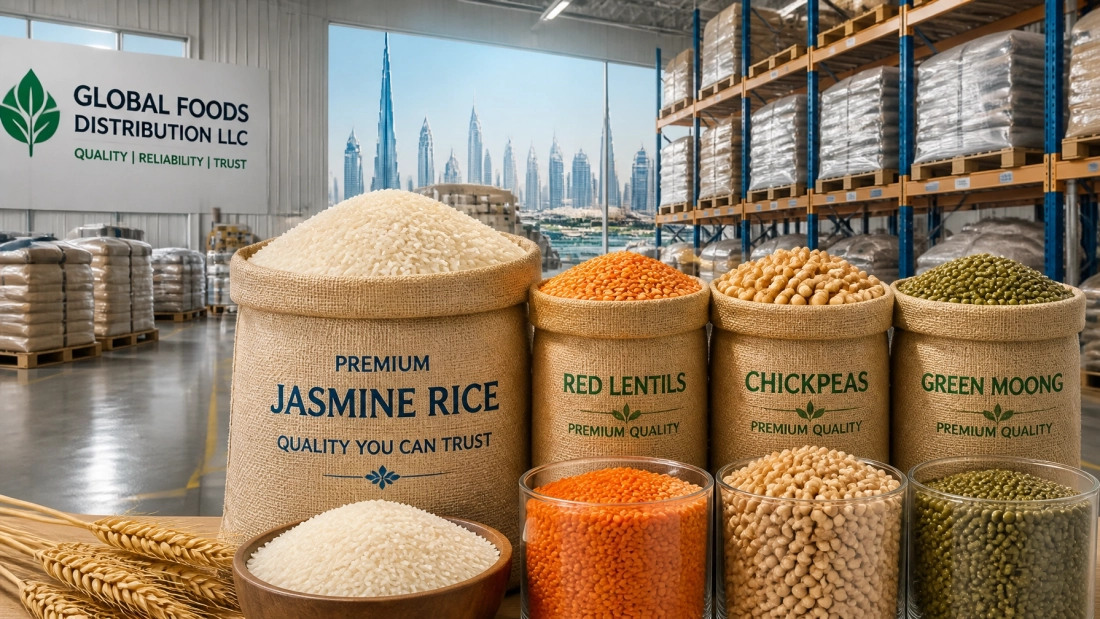
The UAE’s role as a regional trading hub is indisputable. Recent market data indicates that rice imports jumped significantly by 43% in the 2024/25 period, reaching over 1.1 million tons. This surge is driven by a diverse expatriate population and a booming hospitality sector that demands specialized aromatic grains, particularly Jasmine rice.

Jasmine rice, known for its distinct fragrance and soft texture, is a staple in both retail and high-end foodservice. Simultaneously, the market for pulses: including lentils, chickpeas, and beans: remains robust as health-conscious consumers and the South Asian demographic continue to prioritize plant-based proteins. For any wholesale food buyer in Dubai, securing a consistent supply of these high-demand items is critical to maintaining operational stability.

A global food supply network connecting international ports to Dubai

The 3% Commission Model: A New Standard for Transparency

Traditional distribution models often involve multiple layers of intermediaries, each adding a significant markup that can inflate costs and obscure pricing. Mayil Global addresses this inefficiency through our 3% commission strategy.

How the Model Benefits Exporters

Under this arrangement, Mayil Global acts as a dedicated selling agent rather than a traditional trader. We charge a flat 3% fee on the invoice value of the goods sold. This allows exporters to:

  • Retain Pricing Control: Exporters maintain ownership of their goods and have a direct say in market pricing.
  • Maximize Margins: By bypassing high-markup middlemen, exporters keep a larger share of the final sale price.
  • Ensure Predictable Costs: The flat commission structure provides clarity in financial planning and risk management.

The Cash-and-Carry Advantage

For exporters seeking immediate liquidity, we offer a "cash-and-carry" option. This allows for the purchase of entire containers upon arrival in Dubai. This model eliminates market risk for the exporter and provides the immediate capital necessary to reinvest in subsequent shipments.

Rigorous Quality Control and Safety Standards

In the wholesale food industry, quality is non-negotiable. Our sourcing and logistics operations are built on a foundation of strict quality control. From the moment products leave the farm to their arrival at a Dubai warehouse, every stage is monitored.

Rigorous quality control inspection of premium Jasmine rice grains

Our Quality Assurance Process:

  1. Direct Sourcing: We work directly with trusted farms and global suppliers to ensure the authenticity of our Jasmine rice and pulses.
  2. Multistage Inspection: Goods undergo thorough inspections for purity, moisture content, and grain size before being accepted into our inventory.
  3. Hygienic Handling: Our facilities adhere to international safety standards, utilizing modern packaging and climate-controlled storage to maintain freshness.
  4. Traceability: We provide comprehensive documentation that ensures every batch can be traced back to its origin, providing peace of mind for every wholesale food buyer in Dubai.

Streamlining Supply for Supermarkets and Restaurants

The primary goal of Mayil Global is to bridge the gap between global producers and local UAE businesses. We specialize in B2B supply, focusing on the specific needs of:

  • Supermarkets: We provide reliable bulk supply to ensure that retail shelves are always stocked with premium Jasmine rice and high-grade pulses.
  • Restaurants and Hotels: Our logistics network is optimized for timely deliveries, ensuring that high-volume kitchens have the ingredients they need to maintain quality and consistency.
  • Wholesale Distributors: We act as a primary source for other distributors, offering competitive pricing made possible by our lean 3% commission model.

By positioning ourselves as a leading 3 percent commission distributor in the UAE, we enable our partners to offer competitive retail prices without sacrificing product quality.

B2B wholesale distribution of bulk rice and grains in Dubai

Global Logistics and Strategic Advantage

Operating out of Dubai gives Mayil Global a unique strategic advantage. Our organized logistics and global supply network allow us to maintain a steady and reliable supply, even during periods of market volatility.

  • Global Reach: We source from multiple countries, ensuring that supply chain disruptions in one region do not impact our ability to deliver in the UAE.
  • Organized Logistics: Our internal logistics team manages everything from customs clearance to last-mile delivery, ensuring that bulk orders reach their destination in optimal condition.
  • Market Expertise: With deep roots in the Dubai market, we understand the seasonal fluctuations and buyer preferences that drive the rice and pulses trade.

Conclusion: A Partnership Built on Trust and Performance

Choosing the right distribution partner is a critical decision for any exporter or wholesale buyer. Mayil Global offers a combination of operational excellence, price transparency, and rigorous quality standards that is unmatched in the region. Whether you are looking for bulk rice suppliers in Dubai or seeking a reliable path to export your premium pulses, our 3% commission model provides the efficiency and liquidity you need to succeed.

We invite exporters and B2B buyers to explore how our specialized services can enhance your supply chain. At Mayil Global, we don't just move food; we build the long-term relationships that sustain the global food industry.