

Executive Summary: Building Resilience Through Route Diversification
Food exporters supplying Dubai in mid-August 2026 are operating in a logistics environment where route flexibility is a commercial requirement. Global shipping pressures, changing vessel schedules, insurance considerations, and port congestion can affect the timing and cost of importing food into Dubai.
Dubai’s food logistics system remains operational because importers, customs authorities, ports, airlines, and distributors are using multiple entry points and transport modes. Exporters of wholesale fruits and vegetables, onions, rice, and spices can reduce concentration risk by planning alternative sea, air, and land routes before cargo is dispatched.
For exporters searching for a verified buyer for exporters UAE, Mayil Global provides a practical distribution structure. The company supports international and local suppliers through a 3% commission distributor UAE model and immediate cash-and-carry container purchases. These options connect route planning with market access, liquidity, and B2B distribution across the UAE.
Why Dubai’s Food Supply Chain Remains Resilient in August
Dubai’s resilience is based on integration rather than reliance on one port or one transport mode. Food cargo can be redirected through alternative ports, moved under customs supervision, transferred by road, or expedited by air when product value and shelf life justify the additional freight cost.
This integrated system benefits supermarkets, restaurants, retailers, and wholesale distributors that require dependable supply. It also benefits exporters importing onions Dubai, supplying bulk rice, or shipping spices and other food products into the UAE.
The operating priorities are clear:
- Maintaining dependable supply despite changing shipping conditions.
- Using multiple entry points to reduce dependence on a single maritime corridor.
- Protecting product quality through cold-chain control and hygienic handling.
- Accelerating clearance through pre-arrival documentation and customs coordination.
- Connecting cargo with verified B2B buyers immediately after arrival.
Mayil Global reinforces these priorities through farm-direct sourcing, quality control inspections, organized logistics, proper storage, and a global supplier network.

Multi-Port Routing: Using Fujairah, Khor Fakkan, and Jebel Ali
Routing Through Fujairah and Khor Fakkan
Fujairah and Khor Fakkan provide important alternative entry points on the UAE’s east coast. When direct routing into Jebel Ali becomes less suitable because of vessel schedules, congestion, or insurance constraints, containers can discharge at these ports and move overland to Dubai.
Dubai Customs has facilitated the movement of eligible containers from Fujairah and Khor Fakkan to Jebel Ali and Dubai free zones. Under the relevant arrangements, containers can travel under customs control, allowing final clearance to take place after arrival in Dubai rather than requiring standard clearance at the initial discharge port.
For perishable cargo, this structure can reduce unnecessary dwell time at the arrival port. It also provides exporters with a route that combines:
- Sea freight to an alternative UAE port.
- Bonded trucking to Dubai.
- Customs-supervised movement.
- Clearance and onward distribution through Jebel Ali or a Dubai logistics facility.
The route still requires accurate manifests, delivery orders, customs declarations, food safety documents, and suitable transport equipment. It is not a substitute for compliance. It is a supply-chain option for compliant importers and distributors.
Moving Through Oman and the Green Corridor
Dubai Customs’ Green Corridor, developed in cooperation with Oman Customs, has created another alternative route for cargo entering through Oman and moving overland into Dubai via Hatta.
According to Dubai Customs, declarations processed through the corridor increased from approximately 12,000 in March 2026 to nearly 100,000 in April 2026. The initiative supports uninterrupted trade flows through sealed trucks, customs supervision, digital cargo information, and streamlined procedures.
The Smart Green Corridor operating model is especially relevant for food exporters because it supports faster movement of shipments destined for:
- Jebel Ali Port.
- The Jebel Ali Free Zone.
- Dubai’s local wholesale market.
- Re-export destinations across the GCC.
Dubai Customs has also extended the applicable transit period from 30 days to 90 days under the facilitation measures. Exporters should confirm current requirements, eligible cargo categories, and documentation with their customs broker, carrier, and UAE importer before dispatch.
Planning Land-Freight Corridors From Turkey and Egypt
Turkey-Origin Food Cargo
Turkey is an important origin for fresh produce and food products supplied to regional markets. Exporters planning shipments from Turkey should evaluate more than the lowest nominal freight quotation.
A resilient Turkey-to-Dubai plan can compare:
- Mediterranean sea routes combined with regional transshipment.
- Red Sea alternatives followed by road freight into the UAE.
- Sea and land combinations through Oman or UAE east-coast ports.
- Air freight for high-value, highly perishable products.
The correct route depends on product category, packaging, shelf life, insurance, border requirements, and buyer delivery commitments. Tomatoes, leafy vegetables, premium fruits, onions, rice, and spices do not carry the same tolerance for delay. Route selection must therefore be product-specific.
Egypt-Origin Food Cargo
Egypt-origin onions and vegetables can use Red Sea logistics and overland routes through Saudi Arabia when direct maritime access to Dubai is less predictable. This approach creates a longer road leg, but it provides redundancy for bulk and semi-perishable shipments.
Exporters should calculate the complete landed cost, including:
- Sea freight to the selected Red Sea port.
- Port handling and storage.
- Saudi and UAE road freight.
- Border processing.
- Reefer or ventilated transport requirements.
- Insurance and possible route-related surcharges.
- Wholesale distribution and delivery costs in Dubai.
The objective is not simply to find the shortest route. The objective is to secure the most reliable route that protects product condition and supports the final selling price.
Jebel Ali and DP World: Managing Food Import Surges
Jebel Ali remains a central food logistics hub for the UAE and the wider GCC. DP World has reported that essential food imports through Jebel Ali typically rise ahead of Ramadan, with rice volumes increasing by approximately 25% and onions and garlic by approximately 35% compared with an average month.
The strategic importance of Jebel Ali extends beyond seasonal demand. DP World has reported substantial handling of essential goods, expanded refrigerated-container capacity, and investment in agricultural infrastructure. Jafza has also announced a AED 550 million Agri Terminals facility at Jebel Ali Port.
These developments support a more resilient model for importing food into Dubai. Cargo arriving through Fujairah, Khor Fakkan, Oman, or other routes can still connect with Jebel Ali’s cold storage, consolidation, re-export, and distribution infrastructure.
For exporters, Jebel Ali is therefore both a port and a commercial distribution node. Route diversification does not remove Jebel Ali from the supply chain. It allows exporters to reach Jebel Ali through more than one pathway.

Integrating Air, Sea, and Land Logistics
Dubai’s air-cargo system provides an additional contingency for time-sensitive food products. Dubai Customs and Emirates SkyCargo have integrated operations across Dubai International Airport Cargo Village and the Maktoum International Airport Air Cargo Centre.
As reported by Gulf News, imported goods handled through the two facilities increased from 26.6 million kilograms in January 2026 to 48.3 million kilograms in May 2026.
Air freight is not appropriate for every product. Bulk onions, rice, and spices generally require sea or land solutions because of volume and cost. However, air freight can support premium fruits, urgent replenishment, and high-value products where delay would create greater commercial loss than the additional freight cost.
The most resilient plan uses each mode for its correct purpose:
- Sea freight: Bulk products and planned replenishment.
- Land freight: Regional routes, onions, vegetables, and time-sensitive alternatives.
- Air freight: Premium, urgent, and highly perishable cargo.
- Cold storage: Buffer inventory and controlled release into the market.
Using Al Aweer as a Market Signal, Not the Entire Strategy
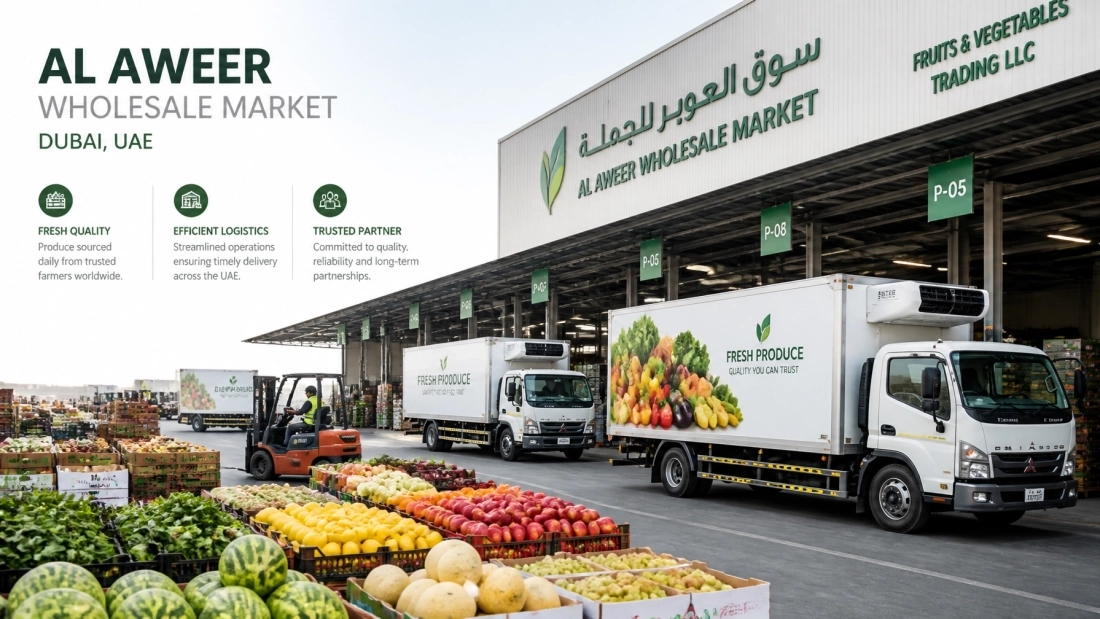
The Al Aweer wholesale market remains an important benchmark for Dubai produce pricing. Recent onion pricing has stabilized at approximately AED 1.95 per kilogram, with a broad reported range of about AED 1.10 to AED 6.67 per kilogram depending on origin, grade, size, packaging, and market conditions.
For exporters importing onions Dubai, this benchmark should support route and margin planning. It should not replace a complete landed-cost calculation. The final commercial result depends on arrival timing, product quality, wastage, transport cost, customs handling, buyer demand, and distribution speed.
Mayil Global monitors market conditions while connecting suppliers to supermarkets, restaurants, retailers, and wholesale buyers. This creates a direct link between logistics decisions and market execution.

How Mayil Global’s 3% Commission Model Supports Exporters
Exporters seeking to understand how to export food to Dubai require more than a shipping agent. They require a UAE distribution partner that can receive cargo, inspect it, place it with B2B buyers, and report sales transparently.
Mayil Global offers two principal structures.
1. 3% Commission Distributor UAE Model
Under the 3% commission distributor UAE model, Mayil Global acts as the exporter’s sales and distribution arm in the UAE. The exporter retains ownership of the consignment while Mayil Global manages market access and B2B sales for an agreed flat commission of 3% on the total sales value.
This model provides:
- Predictable distribution cost.
- Access to verified UAE buyers.
- Transparent sales reporting.
- Support for fresh produce, onions, rice, spices, and other food products.
- Greater participation in market upside when prices improve.
The model is suitable for exporters that want to protect ownership and maximize market returns while using Mayil Global’s local sourcing, logistics, quality control, and distribution infrastructure.
2. Immediate Cash-and-Carry Container Purchases
Exporters prioritizing immediate liquidity can discuss cash-and-carry container purchases. Under this structure, Mayil Global purchases eligible full-container shipments on arrival, subject to product specifications, quality inspection, documentation, and agreed commercial terms.
This option reduces payment-cycle exposure and allows exporters to reinvest capital into the next shipment. It is suitable for suppliers that value speed, defined transactions, and immediate market conversion.
Both models support dependable supply, consistent quality, and long-term commercial relationships. The appropriate structure depends on product, origin, route, volume, packaging, and liquidity requirements.
Exporter Action Checklist for Mid-August 2026
Before dispatching food cargo to Dubai, exporters should complete the following steps:
- Confirm the product specification: Grade, size, packaging, shelf life, temperature, and labelling.
- Compare at least two routes: Jebel Ali, Fujairah, Khor Fakkan, Oman, Red Sea, or air freight where appropriate.
- Validate customs eligibility: Confirm Green Corridor requirements and current transit procedures.
- Prepare complete documentation: Invoice, packing list, bill of lading or airway bill, certificate of origin, health certificate, and phytosanitary certificate where required.
- Protect the cold chain: Define temperature controls from packing house to UAE distribution.
- Calculate landed cost: Include freight, insurance, port handling, road transport, clearance, storage, commission, and expected wastage.
- Select the commercial model: Compare the 3% commission model with immediate cash-and-carry container purchase.
- Secure the buyer before shipment: Work with a verified buyer for exporters UAE to reduce payment and distribution risk.
- Monitor Al Aweer benchmarks: Use onion and produce prices as market signals without relying on a single daily quotation.
- Confirm the receiving plan: Align arrival timing with inspection, storage, and delivery to supermarkets, restaurants, retailers, or wholesalers.
Contact Mayil Global
Building supply-chain resilience requires coordinated sourcing, route diversification, customs readiness, quality control, and reliable UAE distribution.
Mayil Global supports exporters that are importing onions Dubai, supplying wholesale fruits and vegetables, shipping premium rice and spices, or developing a long-term UAE B2B market presence. Discuss the 3% commission distributor UAE model or an immediate cash-and-carry container purchase with the Mayil Global trade team.
Contact Mayil Global to review your product, origin, route, volume, documentation, and preferred distribution structure.
Explore Mayil Global’s sourcing and logistics services, product range, and quality-control approach to establish a dependable route from farm and supplier to the UAE wholesale market.