

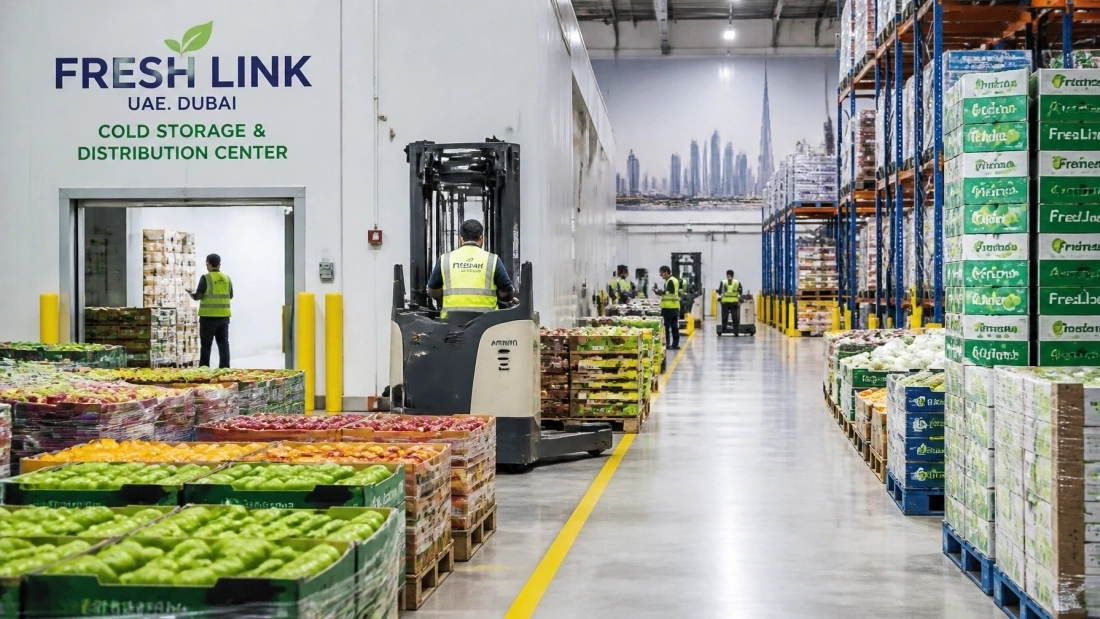
Late August is an active planning period for exporters supplying Dubai’s Al Aweer Central Fruit and Vegetable Market. Fresh produce continues to move through a high-volume wholesale environment supported by imports, regional supply corridors, local farms, supermarkets, restaurants, retailers, and GCC re-export demand.
For exporters assessing how to export food to Dubai, the current priorities are clear: confirm a verified UAE buyer, protect product quality during summer logistics, complete documentation before loading, and select the right commercial structure.
Mayil Global supports international exporters and UAE-based B2B buyers through dependable sourcing, quality control, hygienic handling, organized logistics, and wholesale distribution. Exporters can use Mayil Global’s transparent 3% commission model or request an immediate Cash & Carry container purchase, depending on their liquidity and market-risk requirements.
Late-August Al Aweer Market Dynamics
Managing high-volume fresh produce flows
Al Aweer is Dubai’s primary wholesale hub for fruits and vegetables. It serves as a distribution point for imported and locally sourced produce moving into supermarkets, restaurants, retailers, catering businesses, and regional markets.
Public reporting has previously described the market as receiving hundreds of trucks daily, with seasonal volumes reaching several thousand tonnes per day. The exact volume changes according to origin-country production, vessel arrivals, weather, domestic demand, and re-export activity.
The important late-August trend is not one fixed volume figure. It is the market’s continued capacity to absorb and redistribute container-scale shipments when the product specification, arrival timing, and documentation are properly managed.
Recent Al Aweer market reporting also shows substantial movement between product categories. For example, the 12 August 2026 Al Aweer market report recorded significant daily price changes in items such as celery, ginger, cherry tomatoes, cabbage, capsicum, and okra. This confirms that exporters must assess each commodity separately rather than apply one general market assumption to all fresh produce.
Building an arrival-based supply plan
Late-August exporters should monitor:
- Vessel arrival schedules and port congestion.
- Daily wholesale price movements at Al Aweer.
- Competing origins and available grades.
- Retail, restaurant, and supermarket demand.
- Product shelf life under UAE summer conditions.
- Clearance, inspection, storage, and delivery capacity.
A shipment can be commercially viable at loading but face pressure on arrival if several containers reach the market simultaneously. Mayil Global’s local distribution model helps exporters coordinate market placement and select between consignment distribution and direct container purchase.

Importing Onions to Dubai in Late August
Using current prices as planning references
Onions remain a practical commodity for container-scale export planning because they support regular demand across restaurants, foodservice businesses, retailers, and wholesale distributors.
Mayil Global’s 11 August 2026 Al Aweer sourcing briefing reported new-crop Indian onions in 18 kg packaging at approximately AED 1.90–1.95 per kilogram. This indicates a more stable working benchmark compared with earlier seasonal movements.
At that indicative level, an 18 kg bag represents a wholesale value of approximately AED 34.20–35.10 before adjustments for:
- Origin and crop quality.
- Onion size and grade.
- Packaging format.
- Quantity and sales terms.
- Freight, customs, storage, and handling.
- Daily market movements and buyer negotiation.
This price range is a planning reference, not a guaranteed selling price. Exporters should confirm the latest market level before loading and agree how price changes will be handled under the selected distribution model.
Protecting onion quality during summer logistics
Onions require correct curing, ventilation, and moisture control. Excess humidity, condensation, wet loading conditions, and extended heat exposure can cause rot, sprouting, skin deterioration, and reduced market value.
Exporters should complete the following checks before dispatch:
-
Inspect product condition
Load firm, dry, mature onions without visible rot, fungal growth, excessive bruising, or premature sprouting. -
Confirm the packaging specification
Mesh bags, ventilated sacks, or other suitable packaging should match the buyer’s requirements and support airflow. -
Control loading conditions
Avoid loading wet product or placing cargo into a container after exposure to rain or excessive humidity. -
Select suitable equipment
Ventilated containers may suit standard dry onion cargo. Reefer equipment can be considered for longer routes, premium grades, or shipments requiring tighter environmental control. -
Plan rapid post-clearance movement
After customs and food-control clearance, cargo should move promptly to Al Aweer or the confirmed B2B buyer.
Mayil Global maintains quality control from sourcing through storage, packaging, and distribution. Its sourcing and logistics system is designed to protect freshness, hygiene, and supply reliability at every stage.
How to Export Food to Dubai Through a Verified Buyer
1. Confirm a licensed UAE distribution partner
International exporters should secure a UAE-licensed importer, distributor, or verified buyer before loading the container. The local partner coordinates the commercial route and supports customs, food-control procedures, product handling, and final distribution.
For exporters searching for a verified buyer for exporters UAE, Mayil Global provides access to B2B wholesale channels serving supermarkets, restaurants, retailers, and wholesale distributors.
The exporter and buyer should confirm:
- Product and grade.
- Quantity and packaging.
- Origin and expected arrival window.
- Responsibility for freight and local charges.
- Inspection and rejection procedures.
- Payment timing.
- Sales reporting requirements.
- Commission or outright-purchase terms.
2. Complete the export documentation
A fresh produce shipment commonly requires:
- Commercial invoice.
- Detailed packing list.
- Certificate of origin.
- Phytosanitary certificate.
- Health or quality certificates where applicable.
- Fumigation documentation where required.
- Correct HS classification.
- Container and seal information.
- Net and gross weights.
- Product and packaging specifications.
- Arabic-English labeling information where applicable.
Requirements vary according to the commodity, origin, transport mode, and UAE authority instructions. Exporters should confirm the final documentation file with the UAE importer, customs broker, and freight forwarder before shipment.
3. Meet the advance manifest deadline
UAE-bound maritime cargo requires accurate advance cargo information. The recent Mayil Global compliance briefing explains that Shipping Instructions and manifest details should be submitted at least 72 hours before vessel departure from the applicable compliance load port.
The filing should accurately state:
- Shipper and consignee details.
- Notify party and forwarder information.
- Ports of receipt, loading, discharge, and delivery.
- Container and seal numbers.
- Cargo description and HS code.
- Package count.
- Net and gross weight.
- Container type and consolidation details.
A description such as “fresh onions, new crop, 18 kg mesh bags” is more useful than a generic description such as “food products.” Accurate information reduces avoidable port delays, documentation mismatches, demurrage, and summer quality loss.

Choosing Mayil Global’s 3% Commission Model
Distributing through a 3% commission structure
Under Mayil Global’s 3% commission model, the exporter’s cargo is distributed through UAE wholesale channels. The exporter retains participation in the sales outcome while Mayil Global coordinates local distribution and market access.
The model is designed to provide:
- A clearly defined 3% distribution commission.
- Access to UAE supermarkets, restaurants, retailers, and wholesalers.
- Local product handling and quality inspection.
- Organized market placement.
- Sales and inventory coordination.
- Reduced dependence on multiple intermediaries.
- A structured route for exporters entering Dubai.
The commission applies according to the agreed commercial terms, product category, sales structure, and documented responsibilities. Exporters should establish whether the 3% is calculated on gross sales or another agreed basis before dispatch.
For exporters seeking a 3 percent commission distributor UAE, the principal benefit is operational clarity. The exporter works with a local B2B partner that understands sourcing, logistics, quality control, and wholesale distribution.
Using immediate Cash & Carry container purchases
Some exporters prioritize immediate payment and working-capital recovery. Mayil Global’s Cash & Carry option enables the direct purchase of suitable containers, subject to product quality, volume, documentation, and commercial approval.
Cash & Carry can help exporters:
- Reduce credit exposure.
- Avoid extended collection cycles.
- Release capital for the next shipment.
- Simplify the transaction through a direct B2B buyer.
- Move cargo quickly into UAE wholesale channels.
The two models serve different objectives. The 3% commission model supports market-linked distribution and potential upside participation. Cash & Carry prioritizes immediate liquidity and a more direct sale.

A Late-August Export Checklist
Exporters preparing fresh produce or onion shipments for Dubai should complete the following sequence:
-
Define the commodity
Confirm origin, grade, size, crop, packaging, quantity, and target arrival date. -
Review the Al Aweer benchmark
Use current price data as a planning reference and confirm the latest level before loading. -
Select the commercial route
Choose Mayil Global’s 3% commission distribution model or request an immediate Cash & Carry container purchase. -
Confirm the buyer and documentation
Finalize the UAE importer, consignee, product description, HS code, weights, certificates, and labeling. -
Protect product quality
Use suitable packaging, ventilation, dry loading conditions, and temperature or humidity monitoring where appropriate. -
Meet the manifest deadline
Submit complete Shipping Instructions and cargo details at least 72 hours before the applicable vessel departure deadline. -
Coordinate clearance and final delivery
Arrange customs, inspection, transportation, warehouse handling, and buyer collection before cargo arrival.
Exporters can also review Mayil Global’s step-by-step food export guide and its onion export distribution model.
Building a Dependable UAE Supply Chain
Late-August Al Aweer activity provides a workable planning environment for onion and fresh produce exporters. However, commercial performance depends on more than the headline market price. Product condition, arrival timing, documentation, logistics, inspection, and buyer reliability directly affect the final result.
Mayil Global combines farm-direct sourcing, global supplier relationships, quality control, hygienic handling, storage, and organized distribution to support dependable B2B supply across the UAE. Its 3% commission model gives exporters a transparent route into the market, while the Cash & Carry option provides immediate liquidity for approved container purchases.
For international exporters and local UAE buyers, the operating objective remains direct: source consistently, comply accurately, protect product quality, and distribute efficiently. Contact Mayil Global to discuss onion imports, fresh produce containers, wholesale distribution, and verified buyer requirements in Dubai.