Frame-1-1-4-1100x619

Exporting Pusa Basmati 1718 Rice, Urad Dal, and Maize to Dubai Through Mayil Global’s 3% Commission Model

Rice, Pulses, and Grains Export Series : 1 September 2026

Dubai remains a strategic wholesale market for rice, pulses, and grains. Supermarkets, restaurants, retailers, catering operators, and wholesale distributors require dependable supply, consistent specifications, compliant documentation, and efficient distribution.

For exporters of Pusa Basmati 1718 Rice, Urad Dal, and Maize, the principal commercial challenge is not only securing a product. It is establishing a reliable route from origin to verified UAE buyers.

Mayil Global provides that route through two commercial models:

  1. A transparent 3% commission-based distribution model for international and local exporters.
  2. An Immediate Cash & Carry container purchase option for approved shipments requiring faster liquidity.

Mayil Global operates as a UAE wholesale supplier and distribution partner. Its supply chain combines global sourcing, quality control, hygienic handling, organized logistics, and B2B distribution across the UAE.

Dubai B2B Demand for Rice, Pulses, and Grains

Dubai’s food distribution network depends on regular international sourcing. Basmati rice supports retail, restaurant, catering, and hospitality demand. Urad Dal is used extensively by South Asian households, restaurants, foodservice operators, and packaged food businesses. Maize serves both food-grade and feed-grade channels, depending on processing and buyer requirements.

The market requires:

  • Container-scale supply.
  • Predictable quality and product specifications.
  • Retail and wholesale packaging options.
  • Accurate export and import documentation.
  • Timely delivery through organized logistics.
  • Reliable replenishment for recurring business demand.

The latest UAE export news and Al Aweer market updates also demonstrate the importance of origin diversification, verified trade relationships, and dependable distribution channels in the UAE.

For exporters searching for a verified buyer for exporters UAE, Mayil Global offers a structured local point of contact for product review, buyer coordination, and wholesale distribution.
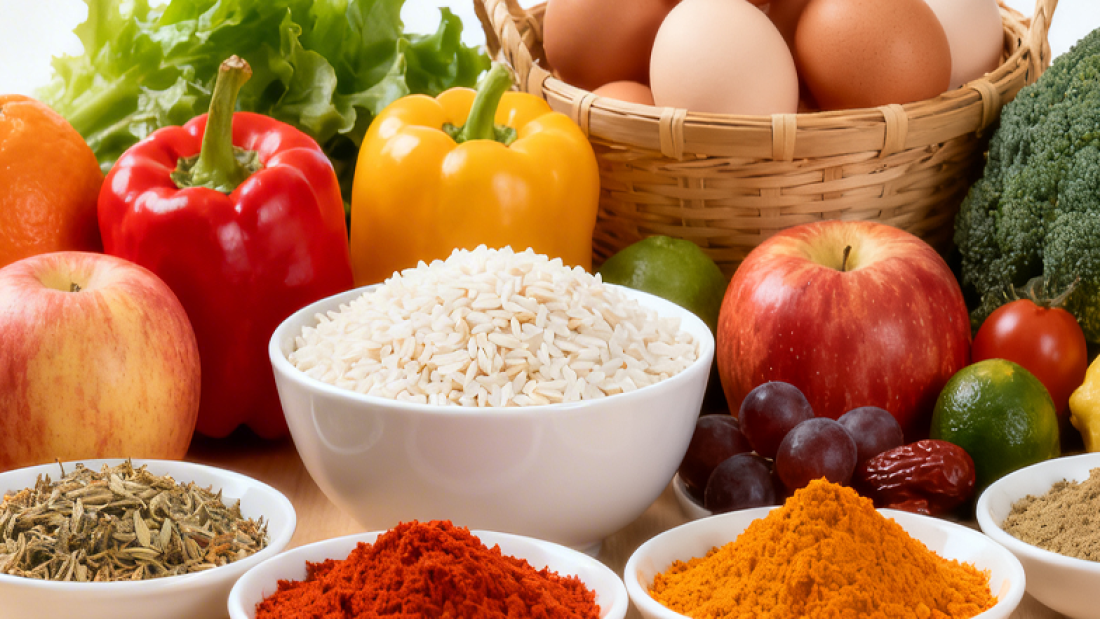
Rice grains representing bulk sourcing and wholesale distribution in Dubai

Product Specifications for Dubai Wholesale Buyers

Final specifications must be confirmed in the purchase contract. The following parameters provide a practical commercial baseline for evaluating export-ready lots.

Pusa Basmati 1718 Rice

Pusa Basmati 1718 is supplied in raw, steam, and Sella or parboiled formats. The exact processing format should be confirmed before quotation because it affects cooking performance, appearance, pricing, and buyer suitability.

A commercial specification may include:

  • Variety: Pusa Basmati 1718.
  • Processing: Raw, steam, or Sella.
  • Purity: Approximately 92–95%, depending on grade and contract.
  • Average raw grain length: Approximately 7.8–8.2 mm, subject to origin and lot.
  • Cooked elongation: Approximately 2.3–2.5 times the raw grain length.
  • Moisture: Generally a maximum of 12–12.5%.
  • Broken grains: Typically 0–2%, with premium lots often specified at 1% or lower.
  • Foreign matter: Nil or within a very low agreed tolerance.
  • Damaged or discoloured grains: Normally limited to approximately 1%.
  • Packaging: 5 kg, 10 kg, 25 kg, or 50 kg bags, according to retail, foodservice, or wholesale requirements.

Dubai buyers may request PP woven bags, laminated bags, jute bags, or private-label packaging. Labels should identify the variety, processing type, net weight, country of origin, batch information, dates, storage conditions, and importer details.

Mayil Global’s bulk rice guidance explains how a transparent commission structure can improve cost visibility for exporters and wholesale buyers.

Urad Dal : Black Gram

Urad Dal, also known as black gram, can be offered as whole black gram or as cleaned and split dal. Buyers should specify whether they require polished or unpolished product.

The product dossier should address:

  • Product type: Whole black gram, split urad dal, or dehusked urad dal.
  • Moisture: Generally 12–13% maximum.
  • Foreign matter: Preferably 0.5% maximum or as agreed.
  • Damaged or weevilled grains: Commonly controlled within a 3–5% maximum range, depending on grade.
  • Broken grains: Confirmed according to the intended application.
  • Colour and size: Consistent across the lot.
  • Infestation: No live insects, abnormal odour, or visible contamination.
  • Laboratory controls: Aflatoxin and pesticide residue testing according to applicable UAE requirements.

Restaurants and food manufacturers normally require consistent cleaning, splitting, cooking performance, and delivery schedules. Retailers may additionally require consumer-ready packaging and bilingual labelling.

Maize : Corn

Maize may be supplied for human consumption, food processing, or animal feed. The intended use must be identified before sourcing because food-grade and feed-grade specifications are different.

A typical commercial specification may include:

  • Product type: Food-grade maize, feed-grade maize, yellow maize, or another agreed variety.
  • Moisture: Generally 13–14% maximum.
  • Foreign matter: Commonly maintained within a 1–2% maximum range.
  • Broken kernels: Agreed according to food or feed application.
  • Aflatoxin: Tested against the buyer’s required UAE limit.
  • Odour: Free from musty, sour, or abnormal odour.
  • Condition: Free from live infestation, excessive dust, mould, and contamination.
  • Packaging: Bulk bags, PP woven bags, or buyer-specified formats.

Maize exporters should provide a Certificate of Analysis covering moisture, foreign matter, broken kernels, aflatoxin, and other parameters specified by the buyer.

Mayil Global’s Transparent 3% Commission Model

Mayil Global’s 3 percent commission distributor UAE model provides exporters with a clear route into the Dubai wholesale market without requiring them to build a separate UAE sales and distribution operation.

Under an agreed written arrangement, Mayil Global supports:

  • Buyer identification and commercial coordination.
  • Product and specification review.
  • UAE B2B distribution.
  • Shipment and delivery coordination.
  • Market feedback and replenishment planning.
  • Communication between exporters and wholesale buyers.

The commission is calculated transparently on the agreed sale value.

Illustrative USD Example

If the applicable sale value is USD 75,000:

  • Sale value: USD 75,000
  • Commission rate: 3%
  • Mayil Global commission: USD 2,250
  • Balance before other agreed costs or deductions: USD 72,750

This example is for illustration only. The final agreement should define the commission basis, payment timing, responsibilities, logistics costs, inspection charges, customs costs, and any other commercial deductions.

The model gives exporters predictable distribution costs while giving UAE buyers a more structured supply relationship. The objective remains dependable supply, consistent quality, and long-term B2B development.

Immediate Cash & Carry Container Purchase

Some exporters require immediate settlement rather than commission-based distribution. Mayil Global therefore offers an Immediate Cash & Carry container purchase option for suitable, export-ready shipments.

This option is designed for exporters with:

  1. A ready 20-foot or 40-foot container.
  2. Confirmed product specifications and quantity.
  3. Export-compliant documentation.
  4. Food-grade packaging and labelling.
  5. Clear product ownership and commercial terms.
  6. A shipment that passes agreed inspection and receiving conditions.

A 20-foot dry container may commonly carry approximately 24–27 metric tonnes of rice, pulses, or maize, depending on product density, bag size, and loading configuration. The final loading plan must be confirmed by the exporter, freight provider, and buyer.

Cash & Carry purchasing can help exporters:

  • Access working capital faster.
  • Reduce extended receivable exposure.
  • Fund the next production or shipment cycle.
  • Convert ready inventory into a direct UAE transaction.
  • Transfer local distribution responsibility to Mayil Global.

The commission model supports ongoing market access. The Cash & Carry option supports direct liquidity. Exporters can select the structure that matches their operational and financial requirements.

Quality Control from Origin to Dubai

Quality control remains a non-negotiable requirement for food distribution. Mayil Global works with trusted farms, mills, processors, and global suppliers and coordinates inspection throughout the supply chain.

1. Sourcing and supplier verification

Supplier capability, origin, processing standards, available volume, and export history are reviewed before commercial engagement.

2. Confirming product specifications

The exporter and buyer agree on variety, grade, moisture, purity, broken percentage, packaging, shelf life, and laboratory requirements.

3. Inspecting before shipment

Samples, bags, lot condition, container cleanliness, loading procedures, and documentation may be inspected before dispatch. Independent inspection can be arranged where required.

4. Maintaining hygienic handling

Rice, pulses, and maize are packed and handled using food-safe procedures designed to prevent contamination, moisture exposure, pest damage, and packaging failure.

5. Managing arrival and distribution

On arrival in Dubai, the shipment is checked against the agreed product and documentation file before storage and onward distribution.

Mayil Global’s sourcing and logistics system is built around reliable sourcing, inspection at every stage, hygienic handling, proper storage, and timely distribution.

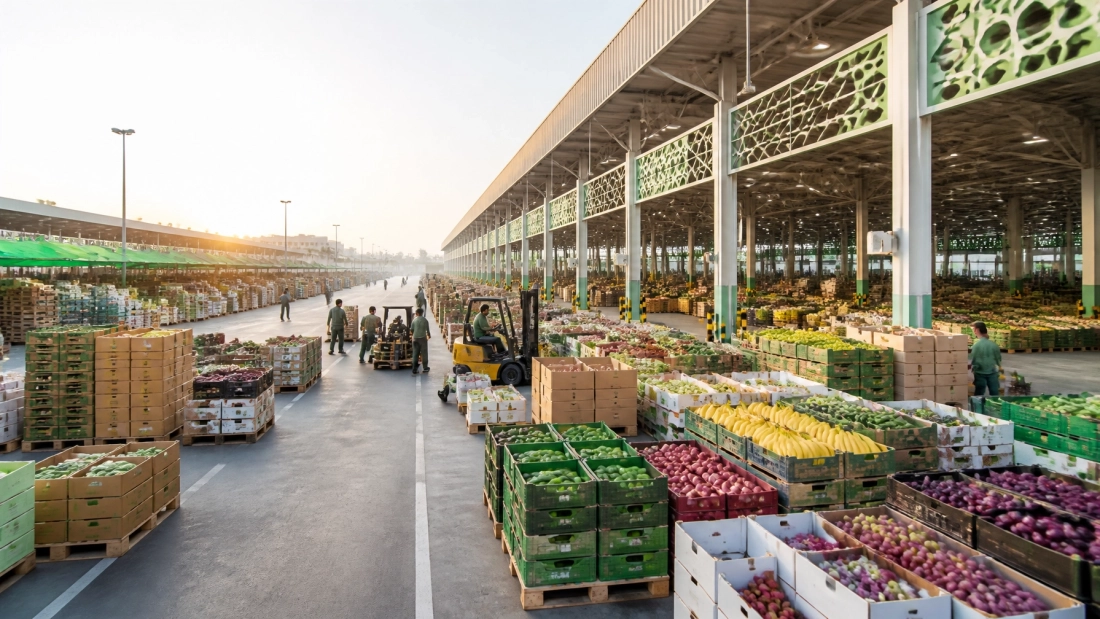
Quality control and hygienic food handling for UAE wholesale distribution

UAE Compliance and Export Documentation

Exporters and UAE buyers must confirm current requirements with the relevant customs, food safety, and municipality authorities. Documentation requirements may vary according to product, origin, packaging, intended use, and importer status.

A typical shipment file may include:

  • Commercial invoice.
  • Detailed packing list.
  • Certificate of Origin.
  • Bill of Lading.
  • Phytosanitary Certificate for applicable plant-origin products.
  • Health or food safety certificate where required.
  • Certificate of Analysis.
  • Fumigation certificate where applicable.
  • Pre-shipment inspection report where requested.
  • Product specifications and batch records.
  • Packaging artwork and label information.
  • Importer and product registration details.

Pre-packaged products should normally include accurate Arabic and English information. Labels should identify the product name, ingredients where applicable, net weight, country of origin, production or expiry dates, batch number, storage requirements, and manufacturer or importer information.

Businesses researching how to export food to Dubai can also review Mayil Global’s practical food export process guide.

Verified Buyer and Exporter Process

Mayil Global follows a defined process to reduce commercial and operational risk.

For exporters

  1. Submit company details and export experience.
  2. Provide product origin, grade, specifications, packaging, and available volume.
  3. Share product images, certificates, and laboratory reports.
  4. Confirm pricing, Incoterms, loading point, and delivery requirements.
  5. Select the 3% commission model or Cash & Carry option.
  6. Complete product verification and inspection.
  7. Finalize the commercial agreement and shipment schedule.

For UAE wholesale buyers

  1. Provide company profile and trade licence details.
  2. Confirm required product, grade, packaging, and monthly volume.
  3. Identify the delivery location and required schedule.
  4. Review specifications, samples, certificates, and quotations.
  5. Confirm payment, documentation, and receiving terms.
  6. Establish a recurring supply plan where appropriate.

This process supports transparent communication before shipment execution and helps both parties align on quality, payment, logistics, and compliance.

Benefits for Dubai Wholesale Buyers

Mayil Global serves supermarkets, restaurants, retailers, and wholesale distributors requiring reliable food supply.

Supermarkets

Supermarkets benefit from consistent packaging, accurate labelling, repeat replenishment, and product grades matched to retail demand.

Restaurants and catering operators

Restaurants require rice, dal, and maize with dependable cooking or processing performance. Consistent specifications support food-cost planning and menu standards.

Retailers

Retailers gain access to bulk and consumer-ready formats, private-label possibilities, and organized UAE delivery.

Wholesale distributors

Distributors require container-scale supply, documentation accuracy, competitive terms, and dependable inventory movement. Mayil Global’s international sourcing network supports multi-origin supply planning.

For businesses searching for bulk rice suppliers dubai, Mayil Global provides access to rice and a wider range of premium food products through its products portfolio.

Why Partner with Mayil Global?

Mayil Global connects international exporters with UAE B2B buyers through practical distribution and disciplined supply chain management.

The core advantages include:

  • Transparent 3% commission distribution.
  • Immediate Cash & Carry container purchases for approved shipments.
  • Global sourcing across multiple countries.
  • Supplier and product verification.
  • Inspection and quality control at every stage.
  • Hygienic packing, storage, and handling.
  • Organized logistics and timely delivery.
  • Wholesale supply for supermarkets, restaurants, retailers, and distributors.
  • Long-term relationship management based on dependable supply and consistent quality.

For exporters, Mayil Global offers a clear market-entry structure. For every wholesale food buyer Dubai businesses depend on, the priority is consistent: safe products, reliable availability, clear documentation, and efficient distribution.

Contact Mayil Global

Exporters with Pusa Basmati 1718 Rice, Urad Dal, or Maize available for Dubai can submit their product specifications, origin, packaging format, container volume, certificates, and preferred commercial model.

UAE supermarkets, restaurants, retailers, and wholesale distributors can share their required grade, monthly volume, delivery location, and packaging requirements.

Discuss:

  • 3% commission-based distribution.
  • Immediate Cash & Carry container purchase.
  • Bulk rice, pulses, and maize supply.
  • Private-label and wholesale packaging.
  • UAE buyer access and distribution.
  • Recurring food supply programmes.

Email: trade@mayilglobal.com
Phone: +971 585058626
Address: Office 54, M Floor, City Gate Building, Deira, Dubai, UAE

Mayil Global continues to build dependable food supply through trusted sourcing, strict quality control, hygienic handling, and efficient distribution. For exporters and UAE buyers, the 3% commission model and Immediate Cash & Carry option provide clear commercial pathways into Dubai’s wholesale food market.
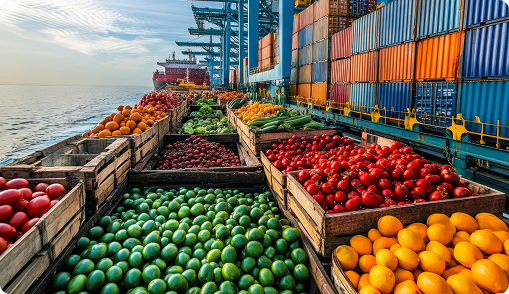

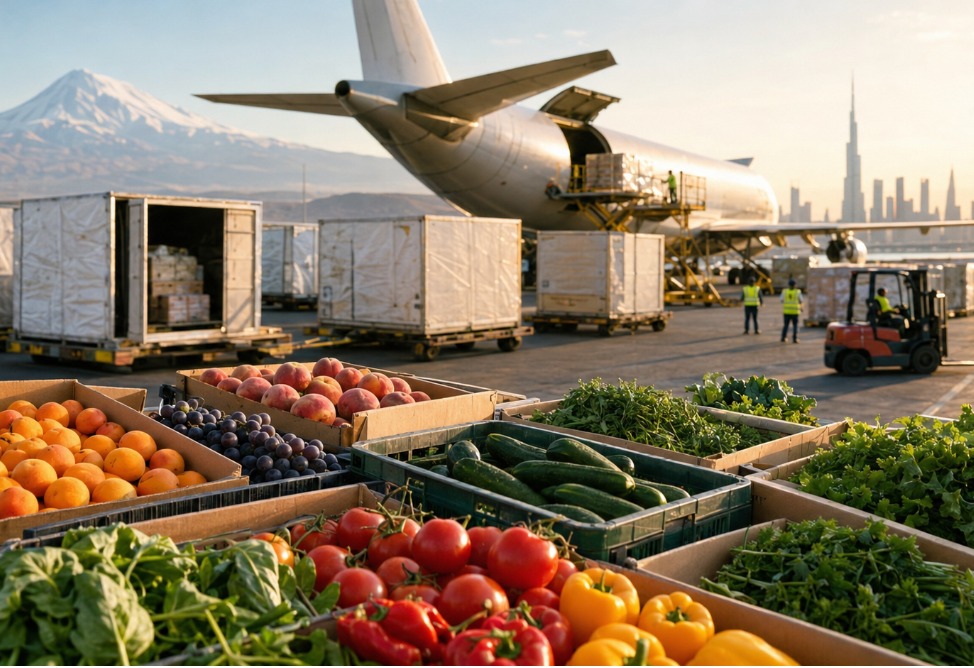
Global sourcing and organized logistics supporting reliable food distribution across the UAE

au7PWtyukll-1100x619

Verified Buyer & Exporter Authority Series: September 6 Al Aweer Market Briefing : Gourd-Led Gains, Onion Origin Benchmarks, Week 35 Closing Position, and How to Export Food to Dubai

Daily B2B briefing: Tuesday, 1 September 2026
Planning horizon: Sunday, 6 September 2026 : Week 35 closing and weekend trading position

Executive market position

Al Aweer Central Fruits and Vegetables Market is entering the Week 35 closing period with strong movement in selected gourds, onions, potatoes, and root vegetables. The latest accessible references dated 31 August–1 September 2026 indicate that origin, grade, pack format, and arrival timing remain decisive factors in Dubai wholesale pricing.

The figures in this briefing are indicative planning benchmarks, not quotations. Actual prices vary according to quality, quantity, negotiations, transport costs, inspection outcomes, and market arrivals.

The immediate signals are:

  1. Oman-origin gourds are leading the gainers.
  2. Indian new-crop onions are trading above several competing origin benchmarks.
  3. Selected products, including bitter gourd, ginger, sweet potato, green chilli, and grapes, are correcting.
  4. Exporters must calculate landed cost and compliance before committing a container.
  5. Mayil Global supports international exporters through a 3% commission-based UAE distribution model and Immediate Cash & Carry container purchases, subject to agreed commercial and compliance terms.

Top Al Aweer gainers

Product Origin Indicative benchmark Daily movement
Wax Gourd Oman AED 2.86/kg +33.6%
Bottle Gourd Oman AED 5.71/kg +24.9%
Potato Unwashed Lebanon AED 2.75/kg +22.2%
Radish Oman AED 4.29/kg +20.2%
Onion New Crop, 18 kg India AED 4.00/kg +14.3%

The gourd movement is the clearest short-term signal. Oman-origin wax gourd and bottle gourd are recording material daily gains, which may reflect arrival volumes, demand from restaurants and ethnic retail channels, or grade-specific scarcity. Exporters should not treat one-day appreciation as a guaranteed forward price. They should confirm buyer requirements, carton specifications, and delivery timing before loading.

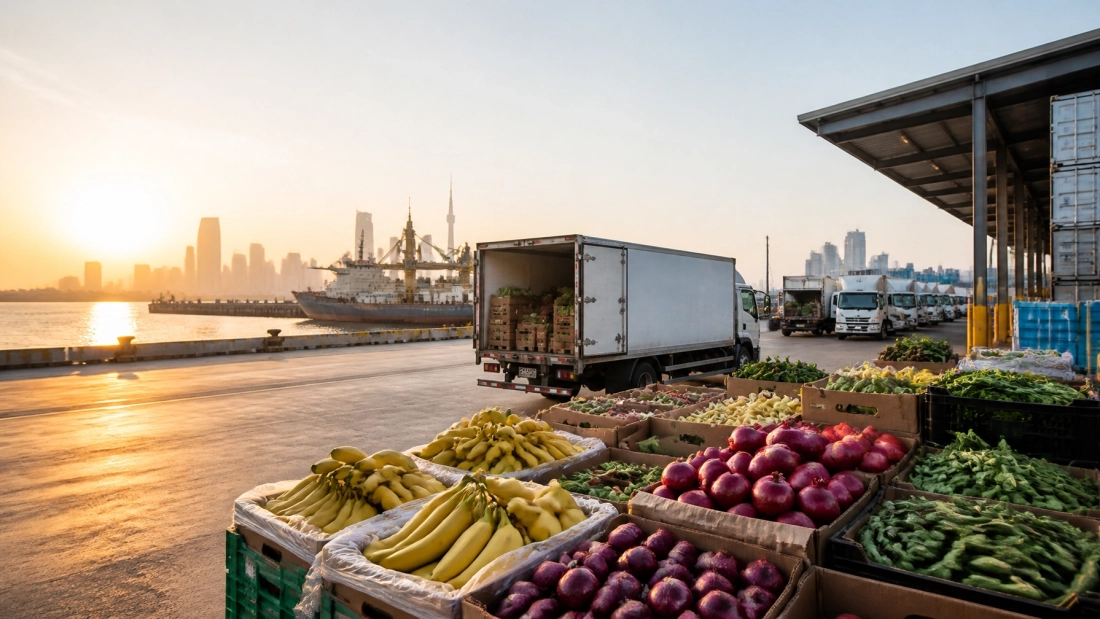
Refrigerated containers and port logistics supporting food exports to Dubai

Top Al Aweer drops

Product Origin Indicative benchmark Daily movement
Bitter Gourd UAE AED 6.00/kg −14.3%
Ginger India AED 3.43/kg −14.2%
Sweet Potato Egypt AED 3.25/kg −13.3%
Green Chilli G4 India AED 5.79/kg −12.0%
Grapes Globe Seed Egypt AED 6.57/kg −11.6%

These declines reinforce the importance of shipment discipline. A product can remain commercially attractive while its daily market level is declining, but only if the exporter manages transit time, quality preservation, and sales allocation. Mayil Global’s approach combines sourcing, inspection, hygienic handling, storage, and organized distribution to protect dependable supply and consistent quality.

Onion origin benchmarks for procurement planning

The onion family average was approximately AED 3.86/kg as of 31 August 2026, with an indicative range of AED 1.00–8.33/kg across 15 varieties. This wide range confirms that “onion price” is not a single market number. Origin, variety, size, crop cycle, pack format, and transport mode must be specified.

Key reference points include:

  • Egypt: 20 kg PPE bag : approximately AED 2.20/kg
  • India: new crop, 18 kg : approximately AED 4.00/kg
  • Sudan: pink onion, approximately 50 mm : approximately AED 3.50/kg
  • Turkey: red onion : approximately AED 2.50/kg
  • Yemen: onion : approximately AED 2.60/kg
  • White Onion: approximately AED 1.00/kg
  • Brown Onion: approximately AED 1.67/kg
  • Shallots: approximately AED 8.33/kg

The Indian new-crop benchmark is therefore above the Egypt, Turkey, Yemen, and Sudan references listed above. That premium may be justified by crop freshness, size, pack presentation, buyer preference, or current arrival conditions. Exporters should compare like-for-like specifications rather than comparing origin alone.

Review the Al Aweer onion new-crop reference and broader vegetable listings before finalizing procurement.

Trade context supporting Dubai food distribution

The UAE remains a major regional entry point for food products and re-export activity. UAE–India bilateral trade surpassed USD 100 billion for a second consecutive year, reaching approximately USD 101.25 billion in FY 2025–26. Both countries have established a longer-term target of USD 200 billion by 2032.

The MAITRI Virtual Trade Corridor is supporting digital cargo-clearance and trade facilitation objectives. The UAE has also signed 38 Comprehensive Economic Partnership Agreements, while H1 2026 non-oil foreign trade reached approximately AED 1.937 trillion.

For food exporters, this environment creates opportunity, but trade access does not remove product-level obligations. CEPA benefits must be assessed against the correct HS code, origin rules, tariff treatment, and required certificates. The UAE–India CEPA page provides the agreement and market-access resources.

Iran-origin compliance warning

Iran-origin food and fresh produce must not be treated as automatically executable. Any proposed shipment involving Iran origin, Iranian suppliers, transshipment, banking channels, vessels, counterparties, or documentation must be formally reviewed and cleared before commercial commitment.

Compliance control: Do not load, pay, market, or accept an Iran-origin shipment unless the importer, exporter, logistics provider, financial institution, and relevant authorities have confirmed that the transaction is permissible and properly documented.

This warning is operational, not political. A shipment that cannot clear customs, banking, sanctions screening, food-safety inspection, or origin verification is not a viable shipment.

Landed-cost framework

A Dubai wholesale benchmark is not the exporter’s net return. Use the following structure:

  1. Product cost at origin
  2. Export packing and inland transport
  3. Inspection, certification, and origin documentation
  4. Freight, insurance, and port charges
  5. Customs duty and applicable taxes
  6. Clearance, municipality, and handling charges
  7. Local transport to Al Aweer
  8. Quality loss, shrinkage, and rejected volume
  9. Distribution commission or agreed service charges

Mayil Global’s 3% commission distributor UAE model is designed to provide a transparent alternative to high and uncertain intermediary margins. Under the model, the agreed commission is 3% of gross sales value, with commercial reporting and buyer coordination structured around the exporter’s shipment.

Documentation and Al Aweer delivery workflow

For food shipments entering Dubai, exporters and importers should coordinate the following documentation:

  • Commercial invoice
  • Certificate of origin
  • Detailed packing list with weights and HS codes
  • Bill of lading or airway bill
  • Delivery order for container shipments
  • Customs import declaration or bill of entry
  • Original health certificate
  • Phytosanitary certificate for applicable plant-origin products
  • Halal certificate where applicable
  • Product registration, label, and food-safety approvals required by Dubai authorities

The normal workflow is:

  1. Confirm the licensed UAE importer and product eligibility.
  2. Verify product registration and label requirements.
  3. Match the shipment specification with a buyer.
  4. Prepare certificates and shipping documents.
  5. Submit pre-arrival information and customs documentation.
  6. Complete Dubai Customs and Dubai Municipality inspection.
  7. Release the cargo after clearance.
  8. Deliver to Al Aweer, a warehouse, supermarket, restaurant, or other approved B2B destination.

Dubai Municipality’s Food and Consumer services and the UAE import documentation guide should be reviewed for current requirements.

Quality inspection of food products before UAE distribution

How to export food to Dubai: eight practical steps

1. Define the product specification

State the variety, grade, size, origin, crop, pack weight, carton or bag type, shelf life, and expected arrival date.

2. Validate the UAE route to market

Determine whether the product will be sold to supermarkets, restaurants, wholesale distributors, or Al Aweer traders. Buyer requirements differ by channel.

3. Confirm the commercial model

Exporters can discuss Mayil Global’s 3% commission distribution model or Immediate Cash & Carry container purchases. Cash-and-carry transactions are subject to product approval, quality inspection, agreed terms, and shipment documentation.

4. Match the right buyer

Mayil Global coordinates B2B buyer access and product-specific demand. The objective is to identify a verified buyer of that particular product, not simply a general food contact.

5. Calculate landed cost

Build the full cost from farm or supplier through customs clearance and final delivery. Include shrinkage and quality risk.

6. Complete compliance documentation

Secure health, phytosanitary, origin, packing, invoice, and other product-specific certificates before dispatch.

7. Control logistics and handling

Use suitable freight, proper temperature or humidity management where required, hygienic packaging, and documented handovers.

8. Reconcile the shipment

After sale or cash-and-carry purchase, reconcile quantities, prices, commission, deductions, rejected units, and final settlement.

Mayil Global wholesale supply for UAE buyers

Mayil Global supplies supermarkets, restaurants, retailers, and wholesale distributors across the UAE. Our product categories include fresh fruits, vegetables, premium spices, premium rice, and farm-fresh eggs.

We are focused on:

  • Farm-direct and global sourcing
  • Inspection at every stage
  • Hygienic handling and packaging
  • Organized logistics and timely delivery
  • Reliable storage from farm to market
  • Consistent supply through a multi-country network

For local UAE buyers, the benefit is dependable wholesale access with clearer origin, pack, quality, and delivery coordination. Explore Mayil Global’s products and sourcing and logistics process.

Global food supply chain from farms to UAE wholesale buyers

Action checklist

For international exporters

  • Confirm origin and compliance status.
  • Share product specifications and photographs.
  • Provide expected container quantity and loading date.
  • Request a landed-cost assessment.
  • Ask about the 3% commission model or Immediate Cash & Carry container purchase.
  • Confirm a verified buyer of that particular product before loading.

For UAE buyers

  • State required product, origin, grade, pack, and weekly volume.
  • Confirm delivery location and receiving schedule.
  • Compare prices on a like-for-like basis.
  • Request current availability and inspection details.
  • Plan replenishment before weekend and Week 35 closing demand.

Conclusion

The September 6 Al Aweer planning position is defined by gourd-led gains, a firm Indian new-crop onion benchmark, and active correction in several vegetables and fruits. Exporters should treat market data as a planning tool, not a guaranteed quotation. Successful shipments depend on specification control, landed-cost discipline, complete documentation, and verified B2B buyer matching.

Mayil Global supports this process through reliable sourcing, strict quality control, efficient distribution, a transparent 3% commission-based UAE distributor model, and Immediate Cash & Carry container purchase options. The objective remains consistent: delivering dependable supply, consistent quality, and long-term commercial relationships across the UAE food supply chain.

Sources

Disclaimer

All Al Aweer prices, movements, averages, ranges, trade figures, and cost references are provided for indicative planning purposes only and are not quotations, offers, guarantees, or financial advice. Actual prices and availability depend on origin, grade, volume, packaging, timing, negotiation, logistics, inspection, customs, and market conditions. Exporters and importers must obtain current regulatory, customs, sanctions, food-safety, tax, and legal advice before committing to a shipment.

6INY4Fpyszk

UAE Export News & Al Aweer Market Updates: 1 September 2026 : Armenia Corridor Launch, Africa–Gulf Produce Trade & Verified Buyer Opportunities

Daily series: Tuesday, 1 September 2026 | Week 35 | First trading day of September

September begins with new sourcing options, active regional trade corridors and continued compliance requirements for exporters supplying the UAE. International suppliers are assessing the Armenia–UAE fresh produce corridor, while African origins are strengthening their position in Gulf food distribution. Pakistan is also preparing a new capital-market initiative to expand fruit exports to the region.

For exporters, the immediate priorities remain consistent: verified demand, accurate documentation, controlled temperature, reliable logistics and clear settlement terms. For UAE supermarkets, restaurants, retailers and wholesale distributors, dependable supply and consistent quality remain essential operating requirements.

Mayil Global supports both sides of the market through wholesale distribution, a 3 percent commission distributor UAE model for approved exporters and immediate cash-and-carry container purchases subject to product and compliance approval.

UAE Export News: Armenia–UAE Fresh Produce Corridor Begins This Month

Armenia is preparing to start exporting up to 40 tonnes of fresh fruit and vegetables per week to the UAE during September 2026. Volumes may increase as cooperation develops and buyer acceptance is established.

The corridor is linked to the Watermelon Ecosystem, a digital marketplace connecting restaurants, suppliers, agricultural companies, farmers and producers. The platform is intended to improve procurement coordination and connect Armenian producers with UAE buyers and distributors.

Armenia–UAE fresh produce corridor supporting new sourcing and distribution opportunities

The new route adds another multi-origin sourcing option for the UAE market. However, a corridor announcement does not replace shipment-level controls. Each consignment remains subject to:

  1. Product specification and grade approval.
  2. Phytosanitary and health documentation.
  3. UAE food-safety and import requirements.
  4. Suitable packaging and labelling.
  5. Temperature control from dispatch to delivery.
  6. Receiving inspection and buyer acceptance.

For exporters, the opportunity is operational rather than purely promotional. Armenian suppliers must demonstrate repeatable grading, packing, loading and documentation performance. UAE buyers require predictable arrival condition, usable shelf life and consistent replenishment.

Africa–Gulf Produce Trade Gains Momentum

The Gulf fresh produce market continues to expand. According to Mordor Intelligence, the GCC fruit and vegetable market is estimated at USD 22.43 billion in 2026 and is projected to reach USD 27.41 billion by 2031.

The UAE is the fastest-growing corner of the GCC market, expanding at approximately 5% annually according to market commentary. The UAE’s role as a logistics, distribution and re-export hub gives exporters access not only to local buyers but also to wider Gulf markets.

Fresh fruits and vegetables are exempt from customs duty in the UAE under the GCC Common Customs Tariff, subject to the correct classification and applicable regulatory controls. Exporters must still complete customs, food-safety, inspection and origin procedures accurately.

The UAE National Food Security Strategy 2051 also targets three to five supply sources for each major food category. This policy direction supports multi-origin procurement and reduces dependence on a single country or route.

East African Origins

Uganda and Kenya offer year-round harvest windows for selected produce and relatively short airfreight runs to Dubai. These origins can support restaurants, supermarkets and distributors requiring frequent replenishment.

Emirates SkyCargo reported moving more than 91,930 tonnes of perishables from Africa in 2024, demonstrating the scale of existing Africa–UAE perishables logistics. The UAE–Kenya CEPA, in place since 2025, provides an additional framework for trade and market access.

The commercial winners will treat Gulf supply as a programme rather than a spot trade. Successful supply requires:

  • Consistent grading and pack specifications.
  • Pre-dispatch quality control.
  • Cold-chain continuity.
  • Accurate phytosanitary and commercial documents.
  • Confirmed buyer requirements.
  • Scheduled replenishment.
  • Clear claims and settlement procedures.

East African produce undergoing quality control and temperature-controlled airfreight preparation for Gulf distribution

A low product price does not create a viable export programme if arrival losses, rejected cartons or documentation delays eliminate the margin. Sourcing, logistics and distribution must be planned together.

Pakistan Exporter Plans September IPO

Pakistan-based SE Fruits and Vegetables Company Limited is planning an initial public offering of approximately USD 6.9 million during September 2026.

The exporter intends to use the proceeds to expand Gulf fruit trade, increase working capital for crop procurement and strengthen processing and cold-chain capacity. Its target markets include the UAE, Oman, Saudi Arabia, Qatar, Bahrain and Kuwait.

The development reflects the strategic importance of Gulf markets for South Asian horticulture exporters. Pakistan’s mangoes, kinnow mandarins and potatoes already have established regional demand. Additional capital can support larger procurement programmes, better post-harvest handling and more reliable export scheduling.

For UAE buyers, this type of investment may expand origin availability. For exporters, it reinforces the need to present a complete commercial profile when approaching a verified buyer for exporters UAE: product, volume, grade, pack size, certificates, loading window, arrival schedule and settlement terms.

Iran Trade Suspension: Compliance Reminder

The UAE suspension of trade, commercial exchanges and financial transactions with Iran remains in effect from 19 August 2026 until further notice, according to reporting from Reuters and other international news sources.

Exporters, importers, distributors and financial institutions must complete compliance checks before accepting any Iranian-origin product, Iran-linked payment, Iranian counterparty or route connected to Iran.

Wholesale markets are continuing to assess alternative origins, including:

  • India.
  • Egypt.
  • Jordan.
  • Oman.
  • Syria.

These alternatives do not remove the need for sanctions screening, origin verification or legal review. Third-country routing must not be used to disguise a prohibited transaction. UAE buyers should maintain clear records of product origin, seller identity, payment path, shipping documents and final consignee.

Al Aweer Market Updates: 31 August 2026 Benchmarks

The following Al Aweer market updates use the approved My Veg Market reference dated 31 August 2026 for India-origin products.

These are planning benchmarks, not fixed quotations. Actual prices vary according to grade, availability, pack integrity, arrival condition, seasonality, freight, storage, wastage and negotiation. Same-day confirmation is required before commercial commitment.

Product Origin Pack size Benchmark
Onion India 1 kg AED 2.00
Ginger India 3 kg AED 7.00
Pomegranate India 2 kg AED 13.00
Small onion India 3 kg AED 14.00
Garlic India 3 kg AED 16.00
YB banana India 4 kg AED 16.00
Cluster beans India 3 kg AED 17.00
Ivy gourd India 3 kg AED 18.00
RK banana India 4 kg AED 20.00
Banana leaf India 4 kg AED 24.00
Suran India 9 kg AED 24.00
Amla India 3.5 kg AED 24.00
Green chilli India 4.5 kg AED 26.00
Drumstick India 3 kg AED 30.67
Okra India 3 kg AED 32.00
G9 banana green India 13 kg AED 37.00
Fresh turmeric India 3 kg AED 38.00
G9 banana yellow India 13 kg AED 45.00
Dry coconut India 13 kg AED 48.00

The drumstick reference increased to AED 30.67 per 3kg pack, compared with AED 28.00 in the 29 August reference. This movement illustrates why exporters and UAE wholesale buyers must use daily market checks rather than older price assumptions. Most other India-origin lines held steady in the approved reference.

How to Export Food to Dubai: September Checklist

Businesses researching how to export food to Dubai should follow a documented process.

1. Confirm the Product Specification

Define the variety, grade, size, origin, pack format, net weight, quantity, shelf life and temperature requirement.

2. Verify UAE Import Requirements

Check phytosanitary certificates, health certificates, labelling, food-safety rules, customs classification and any product-specific restrictions.

3. Validate the Buyer

Confirm the buyer’s legal identity, receiving location, storage capability, purchase quantity, quality expectations and settlement terms.

4. Calculate the Full Landed Cost

Include product value, packaging, inland transport, freight, insurance, clearance, inspection, storage, delivery, wastage and distribution commission.

5. Inspect Before Loading

Record product condition, carton count, loading temperature, container suitability, seal number, photographs and shipping documents.

6. Select the Commercial Model

Approved exporters can discuss Mayil Global’s 3 percent commission distributor UAE model or an immediate cash-and-carry container purchase.

7. Coordinate Arrival and Distribution

Arrange customs clearance, receiving inspection, storage and delivery. Fresh produce requires coordinated logistics because delays directly affect quality and usable shelf life.

Mayil Global: Verified Buyer and 3% Commission Distribution

Mayil Global provides exporters with a structured UAE route for approved fresh produce and food products. The company’s 3% commission distribution model is designed to support buyer coordination, market access, distribution planning and delivery scheduling.

The model is relevant for suppliers of:

  • Fresh fruits and vegetables.
  • Premium spices.
  • Premium rice.
  • Farm-fresh eggs.
  • Other approved food products.

The commission basis, inspection responsibilities, claims process, settlement schedule and delivery obligations should be defined in the commercial agreement. The 3 percent commission remains a central Mayil Global value proposition for exporters seeking a transparent distribution route.

Exporters requiring faster liquidity can also discuss immediate cash-and-carry container purchases. Purchases remain subject to exporter verification, product approval, documentation, quality inspection, origin confirmation and agreed logistics.

UAE buyers can review Mayil Global’s established export distribution model and contact the company regarding current supply requirements.

Wholesale Supply for UAE Buyers

Mayil Global supplies supermarkets, restaurants, retailers and wholesale distributors across the UAE through farm-direct sourcing and global supplier relationships.

The operating priorities are straightforward:

  • Dependable wholesale supply.
  • Consistent quality.
  • Strict quality control.
  • Hygienic handling and packaging.
  • Proper storage from farm to market.
  • Organized logistics.
  • Timely delivery.
  • Long-term B2B relationships.

Buyers seeking wholesale supply should provide the product, required volume, preferred origin, pack size, delivery location and delivery frequency. Exporters seeking a verified buyer for exporters UAE should submit product specifications, available quantity, origin documents, loading date, expected arrival and target commercial terms.

Quality inspection and hygienic handling of fresh produce before UAE distribution

Conclusion

The first trading day of September brings additional sourcing capacity through the Armenia–UAE corridor, continued momentum in Africa–Gulf produce trade and stronger investment interest in Pakistan’s fruit-export sector.

At the same time, Iran-related restrictions require immediate compliance controls. Al Aweer benchmarks demonstrate daily price movement, including the drumstick increase to AED 30.67 per 3kg pack. Exporters must plan around verified demand, not assumed quotations.

Mayil Global provides a reliable UAE wholesale channel, a transparent 3 percent commission distributor UAE model and immediate cash-and-carry container purchase opportunities for approved shipments. Sourcing, quality control, hygiene, storage and distribution remain the foundation of dependable supply.

Contact Mayil Global to discuss export distribution, wholesale food supply or verified buyer opportunities in the UAE.

Disclaimer

Al Aweer figures in this article are indicative India-origin planning benchmarks based on the approved My Veg Market reference dated 31 August 2026. They are not fixed offers, guaranteed prices or binding quotations. Actual prices vary according to grade, quality, origin, packaging, availability, timing, logistics and negotiation.

Exporters must independently confirm UAE import requirements, customs treatment, certificates, route availability and trade restrictions before dispatch. Iranian-origin products, related payments and connected routes require formal compliance confirmation while the UAE suspension remains in effect.

Sources

allfruits-1-1100x619

Verified Buyer & Exporter Authority Series: September 5 Al Aweer Market Briefing : Onion Procurement, Wholesale Fruits and Vegetables Dubai, and How to Export Food to Dubai

Daily B2B briefing | Tuesday, 1 September 2026 | Planning horizon: 5 September 2026

Al Aweer Market entered September with strong movement across selected vegetables and continued differentiation between onion origins, grades and pack formats. This briefing uses the latest accessible references dated 30–31 August 2026 to support September 1 procurement and export planning.

All figures in this article are indicative planning benchmarks, not quotations. Actual traded prices depend on origin, grade, size, packaging, arrival condition, availability, logistics and negotiation.

September 1 Al Aweer Market Position

The 31 August report recorded substantial day-on-day movement across fresh produce. The changes indicate that buyers should avoid using a single market average when preparing supermarket, restaurant or wholesale procurement plans.

Top Gainers

Product Reported movement Procurement implication
Wax Gourd +33.6% Confirm daily supply and delivery timing before committing.
Bottle Gourd +24.9% Volatility may affect restaurant and foodservice replenishment.
Potato Unwashed +22.2% Recalculate landed cost for bulk staple orders.
Radish +20.2% Inspect firmness, moisture and usable shelf life.
India New-Crop Onion +14.3% Compare India against Egypt, Yemen, Sudan and Turkey alternatives.

Top Drops

Product Reported movement Procurement implication
Bitter Gourd −14.3% Buyers may have a short-term replenishment opportunity.
Ginger −14.2% Confirm grade and origin before interpreting the decline.
Sweet Potato −13.3% Check whether the reduction reflects quality or increased supply.
Green Chilli G4 −12.0% Restaurant buyers should confirm firmness and colour.
Globe Seed Grapes −11.6% Avoid applying a general grape price to different varieties.

The complete 31 August Al Aweer market report confirms that these are market movements rather than fixed offers. For B2B buyers, the correct response is structured sourcing, product-specific inspection and same-day price confirmation.

Onion Procurement: Origin and Pack Comparison

Onions remain a central procurement category for supermarkets, restaurants, retailers and wholesale distributors. The following comparison provides a working September 1 reference using the latest accessible Al Aweer references dated 30–31 August.

Origin and specification Pack reference Indicative benchmark
Egypt 20 kg PPE bag AED 2.10/kg
Yemen Regional supply reference AED 2.55/kg
India new crop 18 kg AED 3.50/kg
Sudan pink Approximately 50 mm AED 3.55/kg
Turkey red Red onion AED 2.55/kg

These numbers are indicative planning benchmarks, not quotations. The accessible Al Aweer onion data shows that onion prices can vary widely by variety and pack size. Its 31 August family range extended from approximately AED 1.00/kg to AED 8.33/kg, with a family average of approximately AED 3.86/kg.

Specific product pages also demonstrate the importance of validating every line. The Egypt 20 kg PPE reference, India new-crop 18 kg reference, Sudan pink onion reference and Turkey red onion reference may display different daily listings according to the trading snapshot. Buyers must confirm the exact origin, pack, grade and arrival condition before issuing a purchase order.

Iran-Origin Compliance Warning

Iran-origin onion references are non-executable unless formally cleared. No displayed benchmark should be treated as available supply without confirmation of:

  1. Origin eligibility.
  2. Shipment authorization.
  3. Payment-channel availability.
  4. Customs acceptance.
  5. Food-safety and documentation requirements.
  6. Route and insurance feasibility.

Compliance review must precede any commercial commitment involving Iranian-origin goods, suppliers, payments or transit routes.

Bulk onions prepared for wholesale supply and Dubai market distribution

Importing Onions Dubai: A Landed-Cost Framework

Businesses importing onions to Dubai should compare total landed cost rather than origin price alone.

Landed-Cost Formula

Landed cost per kilogram =

Product value + export packing + inland transport + freight + insurance + port charges + customs and clearance + inspection and documentation + UAE storage + local delivery + expected wastage + agreed distribution commission

Use the following process before loading:

  1. Defining the specification
    Confirm onion colour, variety, bulb size, grade, dry matter, pack type, net weight and expected shelf life.

  2. Comparing origins
    Compare Egypt, Yemen, India, Sudan and Turkey using the same basis. A lower product price may be offset by freight, handling, wastage or slower clearance.

  3. Calculating usable cost
    Include expected shrinkage, rejected bags, damaged bulbs and quality claims. The relevant measure is the cost of saleable kilograms delivered to the buyer.

  4. Confirming the sales channel
    Assign the shipment to a supermarket, restaurant, retailer or wholesale distributor before loading. Exporters should seek a verified buyer of that particular product, not a general expression of interest.

  5. Adding distribution cost transparently
    Under Mayil Global’s 3% commission-based distribution model, the agreed 3% commission must be included in the commercial calculation from the beginning.

Quality Control, Ventilation and Cold-Chain Logistics

Onions require controlled handling from packing station to receiving location. The correct transport method depends on variety, moisture level, origin, season and agreed specification.

Pre-Dispatch Inspection

Inspect and record:

  • Bulb size and uniformity.
  • Dry outer skins and neck condition.
  • Visible mould, rot, sprouting or bruising.
  • Net weight per bag.
  • Bag strength, stitching and ventilation.
  • Lot number and country of origin.
  • Photographs before loading.
  • Container seal and loading records.

Ventilation and Temperature Control

Dry onions require airflow to manage heat, moisture and respiration. Bags should not block ventilation channels, and wet or poorly cured product should not be loaded into a sealed environment.

For longer or higher-risk routes, exporters and buyers should agree whether a reefer, ventilated dry container or another controlled transport solution is appropriate. Temperature and humidity settings must be confirmed against the commodity specification and carrier guidance rather than assumed.

Mayil Global’s sourcing and logistics service supports supplier coordination, inspection, hygienic handling, packaging, storage and organized UAE delivery.

Hygienic produce handling and packaging before UAE distribution

Documentation, Customs and Al Aweer Delivery Workflow

A compliant shipment should be prepared as one coordinated file. Typical documents for fresh onions and other produce include:

  • Commercial invoice.
  • Detailed packing list.
  • Certificate of origin.
  • Phytosanitary certificate from the competent authority in the exporting country.
  • Bill of lading or air waybill.
  • Health or fitness certificate where required.
  • Pesticide-residue analysis where applicable.
  • Product and packaging details.
  • Import permits or approvals required by the UAE buyer.

Dubai Municipality provides services for registering and assessing food items and for releasing imported food consignments for sale in the local market. Requirements can vary by product, origin, route and intended use. The UAE importer remains responsible for confirming current requirements with Dubai Municipality, UAE Customs and the relevant federal authorities.

Al Aweer Delivery Workflow

  1. Buyer confirmation: Confirm product specification, quantity, receiving time and commercial terms.
  2. Document review: Match invoice, packing list, origin, phytosanitary details and transport documents.
  3. Customs filing: The UAE importer or appointed clearance agent submits the customs declaration.
  4. Food-safety notification: Submit the required consignment information to Dubai Municipality or the relevant authority.
  5. Inspection and sampling: Authorities may inspect packaging, labels, condition and food-safety compliance.
  6. Release and transport: After clearance, move the cargo using an organized vehicle and agreed handling conditions.
  7. Receiving inspection: Record delivered quantity, quality, temperature or ventilation condition and any claims.
  8. Settlement and reporting: Reconcile sale value, approved deductions, commission and final supplier settlement.

How to Export Food to Dubai: Eight Practical Steps

Companies searching for how to export food to dubai should follow a controlled B2B process.

1. Confirm the Product

Define the product, origin, grade, pack size, quantity, loading date, shelf life and storage requirements.

2. Select a UAE Importer or Distributor

Work with a UAE entity holding the appropriate food-trading and import permissions. Confirm its customs registration, receiving capability and distribution network.

3. Verify Regulatory Requirements

Check phytosanitary, health, labelling, pesticide-residue, origin and food-safety requirements before production or loading.

4. Register Products Where Required

For packaged food, coordinate product and label assessment through the relevant Dubai Municipality or federal system before shipment.

5. Secure the Buyer

Match the shipment with a supermarket, restaurant, retailer or wholesale distributor. The objective is to become a verified buyer for exporters uae route with clear product allocation and settlement terms.

6. Inspect and Load

Complete quality inspection, weight verification, packaging checks, ventilation planning, container examination and photographic records.

7. Clear and Distribute

Coordinate customs, food-safety inspection, release, storage and final delivery to Al Aweer or another UAE receiving location.

8. Review the Shipment

Measure landed cost, arrival quality, wastage, rejection, realized price, payment timing and repeat-order potential.

Mayil Global supports sourcing and logistics, including supplier coordination, inspection, hygienic handling, packaging, storage and UAE distribution.

Mayil Global’s 3% Commission Distributor UAE Model

Mayil Global connects international exporters with UAE B2B distribution channels through a transparent 3% commission distributor UAE model.

The model is designed for approved suppliers of:

  • Fresh fruits and vegetables.
  • Premium onions and other staples.
  • Premium rice.
  • Spices.
  • Farm-fresh eggs.
  • Other compliant food products.

The 3% commission is a key Mayil Global USP. It provides exporters with a clearly defined distribution cost while Mayil Global coordinates product-specific buyer engagement, quality control, logistics and UAE delivery.

For UAE buyers, Mayil Global operates as a wholesale supplier supporting dependable supply, consistent quality and organized distribution. Buyers can review the Mayil Global products range or request a direct supply discussion.

Immediate Cash & Carry Container Purchases

Exporters seeking faster liquidity can also discuss Immediate Cash & Carry container purchases. This option may reduce receivables exposure and provide a faster settlement route for suitable containers.

Cash-and-carry purchases remain subject to:

  1. Exporter and product verification.
  2. Confirmed origin and specification.
  3. Quality inspection.
  4. Complete documentation.
  5. UAE regulatory eligibility.
  6. Agreed quantity, price and delivery terms.

Organized logistics supporting UAE wholesale food distribution

Wholesale Food Supply for UAE Buyers

Mayil Global supplies fresh fruits, vegetables, premium spices, rice and farm-fresh eggs to supermarkets, restaurants, retailers and wholesale distributors in the UAE.

Its operating model combines farm-direct sourcing, global supplier relationships, strict quality control, hygienic packaging, proper storage and organized distribution. This enables local B2B buyers to secure:

  • Dependable wholesale supply.
  • Consistent product quality.
  • Multi-origin sourcing options.
  • Timely delivery.
  • Controlled handling and packaging.
  • Long-term supply relationships.

Exporters seeking a verified buyer for exporters UAE should submit the exact product, origin, grade, pack size, available quantity, loading date, expected arrival, certificates, target price and preferred settlement terms.

September 1 Action Checklist

For Exporters

  • Confirm the exact product and origin.
  • Submit pack, grade, size and quantity details.
  • Provide inspection photographs and certificates.
  • Calculate complete landed cost.
  • Select the 3% commission model or Cash & Carry option.
  • Secure a verified buyer of that particular product.
  • Obtain written confirmation before loading.

For UAE Buyers

  • Confirm weekly and daily requirements.
  • Compare origins on a saleable-kilogram basis.
  • Check packaging and ventilation.
  • Verify arrival condition and documentation.
  • Allocate product to retail, HORECA or wholesale channels.
  • Request same-day confirmation before committing.

Conclusion

The September 1 position is defined by sharp vegetable movements, a 14.3% rise in India new-crop onions, continuing origin competition and the need for disciplined landed-cost management. Egypt, Yemen, India, Sudan and Turkey offer different price, pack and logistics profiles. No origin should be selected on headline price alone.

Mayil Global provides a structured UAE wholesale route through farm-direct sourcing, strict quality control, hygienic handling, organized logistics and reliable B2B distribution. For exporters, the transparent 3% commission-based distribution model and Immediate Cash & Carry container purchases provide two defined commercial pathways. For supermarkets, restaurants, retailers and distributors, the priority remains dependable supply and consistent quality.

Contact Mayil Global to discuss onion procurement, wholesale fruits and vegetables dubai requirements, export distribution or current UAE buyer demand.

Sources

Disclaimer

All market figures are indicative planning benchmarks, not quotations, offers or binding transaction prices. Actual Al Aweer prices vary by origin, grade, size, pack format, availability, arrival condition, logistics and negotiation. Exporters and buyers must independently confirm current prices, import approvals, customs requirements, phytosanitary documentation, food-safety rules, route availability and trade restrictions before making a commercial commitment. Iran-origin references are non-executable unless formally cleared by the relevant authorities and counterparties.

400d0019fc82-gettyimages-1273470708-1100x619

UAE Export News & Al Aweer Market Updates: 31 August 2026 : Week 35 Opening, 38 CEPA Agreements, Oman Corridor Growth & Verified Buyer Opportunities

The first trading day of Week 35 begins with strong UAE trade indicators, expanding international market access and continued changes in regional sourcing routes. This edition of the UAE export news and Al Aweer market updates series reviews the latest trade developments, corridor opportunities, compliance requirements and indicative India-origin wholesale prices.

For exporters, the operating priorities remain clear: secure a verified UAE buyer, calculate landed cost accurately, maintain product quality and select a reliable distribution structure. Mayil Global supports approved exporters through a 3 percent commission distributor UAE model and immediate cash-and-carry container purchases.

UAE Export News: Non-Oil Trade Reaches AED 1.937 Trillion

The UAE’s non-oil foreign trade reached approximately AED 1.937 trillion in H1 2026, representing annual growth of 13.1%. Non-oil exports increased by 23.9% to AED 452.8 billion, confirming the UAE’s position as a major global trading, sourcing and re-export hub.

This growth supports the food distribution sector in several ways:

  1. Expanding international trade connections.
  2. Stronger demand for logistics and distribution services.
  3. Greater access to alternative product origins.
  4. More opportunities for re-export and regional market supply.
  5. Continued investment in ports, storage and supply-chain infrastructure.

For fresh fruits, vegetables, premium spices, rice and eggs, the UAE remains a practical destination for exporters seeking access to supermarkets, restaurants, retailers and wholesale distributors.

UAE CEPA Network Reaches 38 Agreements

The UAE’s Comprehensive Economic Partnership Agreement network now includes 38 concluded agreements. Trade with CEPA partners where agreements are in force reached approximately AED 304.3 billion in H1 2026. UAE non-oil exports to these partners reached approximately AED 66.1 billion.

For food exporters, the expanding CEPA network can support:

  • Preferential access for eligible products.
  • Reduced trade barriers.
  • More competitive landed costs.
  • Wider multi-origin sourcing.
  • Additional UAE re-export opportunities.

Exporters must still verify the applicable rules of origin, tariff classification, certificates and product-specific requirements. A trade agreement does not remove the need for documentation, quality control or UAE import compliance.

EAEU-UAE Agreement Scheduled for 6 October

The EAEU-UAE Economic Partnership Agreement is scheduled to enter into force on 6 October 2026. Preferential access will cover approximately 86% of tariff lines, representing about 98% of EAEU export volume to the UAE.

Relevant food categories include:

  • Wheat, barley and corn.
  • Beef, mutton and poultry.
  • Eggs and dairy products.
  • Pulses and dried legumes.
  • Vegetable oils.
  • Selected processed food products.

Importers and exporters should review tariff schedules before booking October shipments. Product classification, origin documentation and eligibility will determine whether a shipment receives preferential treatment.

New Sourcing Corridors and Regional Trade Developments

Armenia Fresh-Produce Corridor

A planned Armenia-UAE fresh-produce corridor is expected to begin in September 2026, with potential shipments of up to 40 tons per week of fruits and vegetables.

This development adds another multi-origin sourcing option for UAE buyers. Armenian suppliers may offer additional availability in selected fruits and vegetables, subject to:

  • Product specification.
  • Seasonal availability.
  • Phytosanitary documentation.
  • Packaging and temperature control.
  • Transport timing.
  • UAE import eligibility.
  • Buyer acceptance standards.

A new corridor becomes commercially useful when quality, documentation and delivery performance are consistent across repeated shipments.

Oman-UAE Corridor Growth

Reports have described Oman’s non-oil exports to the UAE as nearly doubling as regional routes shift. However, official figures available through May 2026 indicate a more measured increase of approximately one-third, with exports reaching around OMR 645 million.

This distinction is important for commercial planning. Oman remains a significant regional trading partner and an important logistics route, but exporters should use verified official figures rather than headline estimates when preparing forecasts.

The Oman-UAE corridor may support:

  • Shorter regional replenishment cycles.
  • Alternative road and maritime routing.
  • Cross-border distribution.
  • Regional re-export activity.
  • Additional supply-chain resilience.

Fresh produce shipments require close coordination between loading, border clearance, storage and delivery. Transit delays can directly affect shelf life, rejection risk and margins.

Russia, Ukraine and Lebanon

The UAE-Russia Trade in Services and Investment Agreement is now in effect. It supports services and investment cooperation in areas including logistics, transportation, supply-chain services and other commercial sectors.

The UAE-Ukraine CEPA has been in force since 1 July 2026, creating broader tariff access for bilateral goods trade.

Lebanon-UAE economic cooperation has also deepened through trade, investment, agriculture, logistics and business-council agreements. Fujairah is emerging as a major UAE export and logistics hub, particularly because of its port infrastructure and location outside the Strait of Hormuz. Public agreements focus on broader logistics cooperation rather than formally designating Fujairah as a Lebanon-specific export gateway. Commercial routing will depend on carriers, cargo type and buyer requirements.

Iran Compliance Reminder

The UAE suspension of trade, commercial exchanges and financial transactions with Iran remains in effect from 19 August 2026.

Exporters, importers and distributors must complete compliance checks before dealing with:

  • Iranian-origin products.
  • Iranian suppliers or buyers.
  • Payments connected with Iran.
  • Routes involving Iranian ports or logistics providers.
  • Re-export transactions with Iranian commercial links.

Previous market references for Iranian produce should not be treated as executable offers. Businesses should obtain current guidance from UAE authorities, customs advisers, financial institutions and compliance professionals before proceeding.

Fresh vegetables representing Al Aweer wholesale supply and market distribution

Al Aweer Market Updates: India-Origin Planning Benchmarks

The following table uses the approved My Veg Market reference dated 29 August 2026. These figures are planning benchmarks for specified India-origin products and pack sizes. They are not fixed quotations.

Product Origin Pack size Indicative price
Onion India 1kg AED 2.00
Ginger India 3kg AED 7.00
Pomegranate India 2kg AED 13.00
Small onion India 3kg AED 14.00
Garlic India 3kg AED 16.00
YB banana India 4kg AED 16.00
Cluster beans India 3kg AED 17.00
Ivy gourd India 3kg AED 18.00
RK banana India 4kg AED 20.00
Banana leaf India 4kg AED 24.00
Suran India 9kg AED 24.00
Amla India 3.5kg AED 24.00
Green chilli India 4.5kg AED 26.00
Drumstick India 3kg AED 28.00
Okra India 3kg AED 32.00
G9 banana green India 13kg AED 37.00
Fresh turmeric India 3kg AED 38.00
G9 banana yellow India 13kg AED 45.00
Dry coconut India 13kg AED 48.00

Buyers should compare these market references against grade, size, packaging, loading date, freight, customs, storage, wastage and distribution costs. A product with a higher purchase price may still provide better value if it delivers stronger shelf life and lower rejection rates.

How to Export Food to Dubai: Practical Checklist

Businesses researching how to export food to Dubai should follow a controlled process.

1. Define the product

Confirm the product name, variety, origin, grade, size, packaging, quantity, shelf life and temperature requirements.

2. Verify market demand

Identify the intended buyer channel, such as supermarkets, restaurants, retailers or wholesale distributors. Requirements differ by channel.

3. Confirm UAE eligibility

Review import permits, phytosanitary or health certificates, labelling, food-safety requirements and country-of-origin restrictions.

4. Calculate landed cost

Include product value, packaging, inland transport, freight, insurance, customs, clearance, storage, delivery, commission and expected wastage.

5. Select a distribution model

Consider the 3 percent commission distributor UAE model or an immediate cash-and-carry container purchase, subject to approval and agreed terms.

6. Inspect before dispatch

Check quantity, grade, packaging, loading condition, photographs, seal numbers and documentation before the container leaves origin.

7. Coordinate arrival

Manage port clearance, inspection, transport to Al Aweer, storage and final buyer delivery.

8. Review performance

Measure actual landed cost, arrival condition, wastage, buyer acceptance, realized price and repeat-order potential.

Mayil Global supports sourcing, inspection, hygienic handling, packaging, storage and distribution through its sourcing and logistics services.

Mayil Global: Verified Buyer for UAE Exporters

Mayil Global operates as a verified buyer for exporters UAE, supporting approved suppliers of fresh fruits, vegetables, spices, rice, eggs and other food products.

3% Commission Distribution

The Mayil Global 3 percent commission distributor UAE model provides exporters with structured access to the UAE wholesale market. Support may include:

  • Buyer coordination.
  • Product and specification review.
  • Quality-control coordination.
  • Distribution planning.
  • Logistics communication.
  • Delivery scheduling.
  • Market placement.
  • Commercial settlement support.

The 3% commission should be documented clearly in the agreement, including the commission basis, product value, inspection duties, deductions, settlement schedule and claims process.

Immediate Cash-and-Carry Container Purchases

Approved exporters may also discuss immediate cash-and-carry container purchases. This option can improve liquidity and reduce extended receivables exposure.

Each purchase remains subject to product verification, regulatory eligibility, quality inspection, documentation, agreed specifications and delivery feasibility. Cash-and-carry purchasing does not replace food-safety obligations or quality control.

Organized logistics and storage infrastructure supporting UAE food distribution

Wholesale Supply for UAE Buyers

Mayil Global supplies fresh fruits, vegetables, premium spices, premium rice and farm-fresh eggs to UAE supermarkets, restaurants, retailers and wholesale distributors.

The supply model combines farm-direct sourcing, global supplier relationships, inspection at every stage, hygienic handling, compliant packaging, proper storage and organized logistics.

UAE buyers benefit from:

  • Dependable wholesale supply.
  • Consistent product quality.
  • Multi-origin sourcing options.
  • Timely delivery coordination.
  • Documented quality control.
  • Safe storage and handling.
  • Long-term supplier relationships.

For buyers, the priority is not only the lowest quoted price. Supply continuity, product condition and delivery reliability directly affect sales, wastage and customer satisfaction.

Conclusion

The first trading day of Week 35 begins against a strong UAE trade outlook. Non-oil trade reached AED 1.937 trillion in H1 2026, the CEPA network expanded to 38 agreements, and new sourcing and logistics corridors are developing across Armenia, Oman, Russia, Ukraine and Lebanon.

At the same time, exporters must manage regulatory restrictions, route changes, landed-cost pressure and product quality requirements. Iranian-origin products, payments and routes require particular compliance attention.

Mayil Global provides exporters with a structured UAE market route through its 3% commission distribution model, immediate cash-and-carry container purchases and verified buyer coordination. For local supermarkets, restaurants, retailers and distributors, the company provides wholesale sourcing and organized distribution of fresh and premium food products.

To discuss a shipment, wholesale requirement or buyer arrangement, contact Mayil Global.

Disclaimer

All Al Aweer prices in this article are indicative planning benchmarks based on the approved My Veg Market reference dated 29 August 2026. They are not fixed prices, quotations, guarantees or binding offers. Same-day confirmation is required because prices vary according to quality, origin, grade, packaging, quantity, availability, negotiation, logistics and market conditions.

Oman export growth figures should be verified against official data before use in commercial forecasts. The UAE suspension of trade, commercial exchanges and financial transactions with Iran remains subject to applicable official requirements. Exporters and buyers must complete current compliance checks before dealing with Iranian-origin products, payments or routes.

Sources

Frame-1-1-4-1100x619

Exporting Sugandha Basmati Rice, Green Moong Dal, and Buckwheat to Dubai Through Mayil Global’s 3% Commission Model

Rice, Pulses, and Grains Export Series : 31 August 2026

Dubai is a strategic food trade gateway serving supermarkets, restaurants, retailers, caterers, wholesale distributors, and re-export markets across the UAE and wider GCC. Its port infrastructure, established wholesale channels, and diverse consumer base create consistent demand for rice, pulses, and specialty grains.

For exporters of Sugandha Basmati Rice, Green Moong Dal, and Buckwheat, market access depends on more than shipping a container. Successful supply requires accurate specifications, UAE-compliant documentation, strict quality control, hygienic packaging, organized logistics, and reliable buyer coordination.

Mayil Global supports this process through two commercial models:

  1. Transparent 3% commission-based distribution for exporters seeking UAE market access.
  2. Immediate Cash & Carry container purchase for exporters seeking direct sales and faster liquidity.

As a UAE wholesale supplier and distribution partner, Mayil Global connects international and local exporters with supermarkets, restaurants, retailers, and wholesale food buyers. The operating model is built around farm-direct sourcing, a global supply network, inspection at every stage, hygienic handling, proper storage, and efficient distribution.

Dubai Demand for Rice, Pulses, and Specialty Grains

Dubai’s wholesale food market requires dependable supply across multiple product categories and price segments. Supermarkets require retail-ready packs and consistent replenishment. Restaurants and caterers require reliable foodservice volumes. Wholesale distributors require container-scale supply, accurate documentation, and predictable delivery schedules.

Sugandha Basmati Rice, Green Moong Dal, and Buckwheat serve different but complementary B2B segments:

  • South Asian supermarkets and ethnic retailers.
  • Restaurants and catering companies.
  • Health-focused retailers and specialty food stores.
  • Food manufacturers and bakeries.
  • Wholesale distributors supplying the UAE and GCC.
  • Re-export businesses operating through Dubai’s trade network.

Exporters can review relevant UAE export news and Al Aweer market updates when assessing market conditions, inventory movement, and distribution opportunities.

Rice grains and pulses representing bulk food sourcing for Dubai importers and wholesale buyers

Product Specifications for Dubai Wholesale Buyers

Specifications must be agreed before shipment. Final acceptance should be based on the approved sample, contract specification, laboratory Certificate of Analysis, and applicable UAE requirements.

Sugandha Basmati Rice

Sugandha Basmati is a long-grain aromatic rice suitable for retail, restaurants, catering, biryani kitchens, and specialty food distribution. Exporters should clearly identify the processing format because raw, steam, white sella, and golden sella products have different commercial characteristics.

A typical commercial specification should include:

  • Variety: Sugandha Basmati.
  • Processing type: raw, steam, white sella, or golden sella.
  • Approximate average grain length, commonly around 7.8–7.9 mm.
  • Moisture level, typically specified at approximately 12.5% maximum, subject to grade.
  • Broken grain tolerance, often approximately 1–2% for premium export grades.
  • Sortex or machine-cleaning status.
  • Purity, foreign matter, damaged grain, and chalky grain limits.
  • Crop year and ageing status, where applicable.
  • Country and region of origin.
  • Packaging format and available container volume.

Wholesale and foodservice buyers may require 25 kg or 50 kg food-grade bags. Supermarkets may require 5 kg, 10 kg, or private-label consumer packs. Packaging, labelling, and product registration must be aligned with the UAE importer before shipment.

Green Moong Dal

Green Moong Dal may be supplied as whole green moong or split moong dal. It is used by households, restaurants, caterers, food manufacturers, and South Asian retail channels.

The commercial specification should address:

  • Product format: whole or split.
  • Moisture, commonly targeted at approximately 12–13% maximum.
  • Purity, often specified at 98% or higher.
  • Foreign matter, commonly limited to approximately 1%.
  • Broken or shrivelled seeds, commonly limited to approximately 2%.
  • Colour, size, and uniformity.
  • Cleaning and sortexing method.
  • Absence of live infestation and abnormal odour.
  • Shelf life, packing date, and storage conditions.

These figures are indicative commercial reference points. The final standard must be confirmed through laboratory testing and the buyer’s approved specification.

Buckwheat

Buckwheat can be supplied as grain or flour. The exporter must state whether the product is hulled, unhulled, milled, or intended for a specific food manufacturing application.

A buyer-ready specification may include:

  • Product form: buckwheat grain or buckwheat flour.
  • Hulled or unhulled status.
  • Moisture, generally targeted at approximately 12–13% maximum.
  • Purity, commonly specified at 99% for grain.
  • Foreign matter and damaged kernel limits.
  • Insect, infestation, and contamination controls.
  • Microbiological and pesticide residue results.
  • Packaging and storage conditions.
  • Cross-contact controls if the product is marketed as gluten-free.

Any gluten-free claim must be supported by appropriate testing and documented production controls. Product claims should not be used on UAE packaging unless they are accurate, supportable, and accepted by the importer and relevant authorities.

Mayil Global’s Transparent 3% Commission Model

Mayil Global’s 3 percent commission distributor UAE model provides international and local exporters with a defined route into Dubai’s wholesale food market.

Under an agreed written arrangement, Mayil Global supports buyer identification, commercial coordination, local distribution, and market development. The exporter retains visibility over product specifications, pricing, shipment terms, and documentation requirements. The applicable distribution fee is a transparent 3% commission, subject to the signed commercial agreement.

How the 3% model works

  1. The exporter submits company information, product specifications, certificates, available volume, and pricing.
  2. Mayil Global reviews the offer and identifies suitable UAE B2B demand.
  3. Product samples, quality parameters, packaging, and documentation are aligned.
  4. The parties confirm the sale terms, shipment schedule, and commission basis.
  5. The exporter prepares and ships the goods according to the agreed specification.
  6. Mayil Global coordinates local buyer engagement, distribution, and reporting.
  7. Commission and settlement are handled according to the written agreement.

Illustrative USD example

Assume the applicable realized sale value is USD 50,000.

  • Sale value: USD 50,000
  • 3% commission: USD 1,500
  • Balance before separately agreed costs: USD 48,500

Freight, customs duties, inspection, storage, delivery, and other statutory or operational expenses should be itemized separately where applicable. The exact commission base, payment trigger, deductions, and settlement schedule must be confirmed in the formal agreement.

The 3% model gives exporters cost visibility without requiring an immediate investment in a UAE sales office, warehouse team, or independent distribution network.

Immediate Cash & Carry Container Purchase

Some exporters require immediate liquidity rather than commission-based market development. Mayil Global also supports Immediate Cash & Carry container purchases for qualifying shipments.

This option may suit exporters with:

  • Ready 20-foot or 40-foot containers.
  • Confirmed product specifications.
  • Export-ready documentation.
  • Suitable packaging for UAE wholesale distribution.
  • Clear ownership and payment terms.
  • A requirement for faster settlement after agreed inspection or receiving conditions.

The commercial process normally includes product review, supplier verification, document review, quality inspection, container assessment, and agreement on payment and delivery terms.

The two models serve different objectives:

  • 3% commission distribution supports market access, buyer development, and recurring sales.
  • Cash & Carry purchase supports direct container conversion and faster working-capital release.

Exporters should confirm the selected model before shipment execution.

Quality Control from Origin to Dubai

Food safety and quality control are non-negotiable. Mayil Global combines farm-direct sourcing, trusted mills and processors, and a global supply network across multiple countries to support dependable product availability.

The quality process includes:

  1. Supplier and origin review
    Supplier capability, processing standards, export history, and available certifications are assessed.

  2. Sample and specification approval
    Product identity, grade, moisture, purity, packaging, and intended use are confirmed before a container order.

  3. Pre-shipment inspection
    Product condition, batch details, weight, packaging, container cleanliness, and loading records are reviewed.

  4. Laboratory and compliance checks
    COAs may cover moisture, microbiological parameters, pesticide residues, contaminants, and other buyer-specific requirements.

  5. Hygienic handling and packaging
    Food-grade packaging and clean handling procedures help protect rice, pulses, and grains during transit and storage.

  6. Arrival and distribution inspection
    Shipment documents, packaging condition, batch information, and product conformity are reviewed during receiving and local distribution.

Proper storage protects products from moisture, pests, contamination, and excessive heat. Mayil Global’s sourcing and logistics system supports controlled movement from farm and supplier through Dubai distribution.

Food distribution and quality-control process supporting safe wholesale supply in the UAE

UAE Compliance and Export Documentation

Businesses learning how to export food to Dubai should coordinate with the UAE importer, customs broker, Dubai Municipality, and relevant origin-country authorities before loading.

Typical documentation for Sugandha Basmati Rice, Green Moong Dal, and Buckwheat may include:

  • Commercial invoice.
  • Detailed packing list.
  • Certificate of origin.
  • Bill of lading.
  • Original health or food safety certificate, where required.
  • Phytosanitary certificate for plant-origin products.
  • Fumigation certificate, where applicable.
  • Certificate of Analysis or laboratory report.
  • Pre-shipment inspection certificate, where requested.
  • Product registration and importer information.
  • Packaging artwork and label details.

Retail and pre-packed products generally require accurate product names, country of origin, net weight, production or packing dates, best-before information, batch number, storage instructions, and importer details. Arabic or Arabic-English labelling may be required for consumer-facing products.

Exporters and importers should confirm current requirements through the UAE import requirements and documentation guide and the Dubai Municipality Food Safety Department.

Verified Buyer and Exporter Process

For exporters searching for a verified buyer for exporters UAE, Mayil Global follows a structured review process.

Exporter onboarding

  1. Submit company profile and export history.
  2. Provide product specifications, origin, packaging, and available capacity.
  3. Share certificates, laboratory reports, product images, and price indications.
  4. Confirm FOB, CIF Jebel Ali, or other agreed terms.
  5. Select the 3% commission model or Cash & Carry purchase option.
  6. Finalize the agreement and shipment schedule.

UAE buyer onboarding

  1. Share company profile and trade license details.
  2. Confirm import capability and required product category.
  3. State monthly, pallet, or container-level demand.
  4. Review samples, specifications, and quotations.
  5. Confirm delivery location, payment terms, and documentation.
  6. Establish a recurring supply plan where appropriate.

This process protects both sides by clarifying product quality, payment, documentation, logistics, and responsibilities before shipment.

Benefits for Dubai Wholesale Buyers

A wholesale food buyer Dubai businesses rely on requires consistent specifications, timely delivery, transparent communication, and dependable replenishment.

Supermarkets and retailers

Retail buyers benefit from compliant labels, stable pack sizes, consistent product presentation, and access to both branded and private-label formats.

Restaurants and caterers

Foodservice operators require predictable cooking performance, reliable stock, and packaging suited to commercial kitchens. Consistent rice and pulse quality supports menu planning and food-cost control.

Wholesale distributors

Distributors require container-scale availability, accurate documents, proper storage, and organized receiving. A global supply network supports continuity when supply conditions change.

Businesses comparing bulk rice suppliers Dubai can review Mayil Global’s bulk rice distribution and Cash & Carry guidance.

Why Partner with Mayil Global?

Mayil Global provides a professional connection between international exporters and UAE B2B buyers. Its core advantages include:

  • Farm-direct sourcing from trusted farms and processors.
  • A global supply network across multiple countries.
  • Strict quality control with inspection at every stage.
  • Hygienic handling and food-grade packaging.
  • Proper storage from farm to market.
  • Efficient distribution and organized logistics.
  • A transparent 3% commission structure.
  • Immediate Cash & Carry container purchases for qualifying shipments.
  • Wholesale supply for supermarkets, restaurants, retailers, and distributors.
  • A long-term focus on dependable supply and consistent quality.

For exporters of Sugandha Basmati Rice, Green Moong Dal, and Buckwheat, Mayil Global provides two clear commercial pathways into Dubai. For UAE buyers, the company provides an organized wholesale supply channel supported by quality control, logistics, and reliable market coordination.

Contact Mayil Global

International and local exporters can submit product specifications, origin details, packing formats, available container volume, certificates, and preferred commercial model.

UAE supermarkets, restaurants, retailers, and wholesale distributors can share their product requirements, monthly volume, delivery location, and packaging needs.

Mayil Global

Contact Mayil Global to discuss 3% commission distribution, Immediate Cash & Carry container purchases, wholesale rice supply, Green Moong Dal, Buckwheat, private-label packaging, and recurring UAE distribution programs.

zAVhsMgixtn

Verified Buyer & Exporter Authority Series: August 31 Al Aweer Market Briefing : Week 35 Second Trading Day, Cucumber-Led Demand, Onion Multi-Origin Correction, Grape Seedless Rebound, and How to Export Food to Dubai

Monday, August 31, 2026 | GCC Week 35, second trading day

This daily B2B briefing uses the latest accessible Al Aweer Central Market reference dated August 30, 2026, published through Al Aweer Prices. All figures are indicative planning benchmarks in AED/kg and are not commercial quotations.

Executive Market Position

Al Aweer trading opened the week with a sharp cucumber-led movement, a broad correction across onion origins, and a clear rebound in Egyptian seedless grapes. High-moisture vegetables experienced the strongest volatility, while several imported fruit categories remained structured by origin, pack format, transit mode and product condition.

Key positions for UAE supermarkets, restaurants, retailers and wholesale distributors are:

  1. Cucumber demand is leading the daily movement. Iran sea carton cucumber reached AED 3.89/kg, up 52.0%, while UAE local carton cucumber reached AED 3.50/kg, up 16.7%.
  2. Onion prices corrected across India, Egypt, Yemen, Sudan and Turkey. Egypt 20 kg PPE bag onions were listed at AED 2.10/kg, down 10.6%.
  3. Egyptian grapes rebounded. Red seedless grapes rose 18.5% to AED 9.14/kg, while white seedless grapes reached AED 8.00/kg.
  4. Iranian onion references are non-executable. The displayed Iran red Shirazi and brown onion benchmarks remain reference-only under the continuing UAE–Iran trade suspension.
  5. Commercial planning requires verified sourcing and controlled logistics. Mayil Global supports exporters through a transparent 3 percent commission distributor UAE model or through Immediate Cash & Carry container purchasing.

Egyptian onions in export packaging undergoing quality control in a clean warehouse

Al Aweer Onion Benchmarks: Multi-Origin Correction

Origin and specification Mode and packaging Indicative AED/kg Daily movement
India new crop, 18 kg Sea, sold by weight 3.50 -12.5%
Egypt, 20 kg PPE bag Sea, by weight 2.10 -10.6%
Yemen onion Road, mesh bag 2.55 -12.1%
Sudan pink, approximately 50 mm Road, by weight 3.55 -13.4%
Turkey red onion Road, by weight 2.55 -12.1%
Iran red Shirazi, 65 mm+ Sea, by weight 1.70 Reference only; non-executable
Iran brown onion Sea, mesh bag 1.67 Reference only; non-executable

The correction is broad rather than isolated to one supplier or origin. Buyers should assess the commercial difference between an indicative market benchmark and an executable import offer. Grade, sizing, packaging, arrival condition, clearance status and delivery location can materially change the final cost.

For businesses importing onions Dubai, Egypt provides a practical alternative-origin conversation. Egypt’s export capacity is also supported by wider agricultural trade performance. According to Food Business MEA, Egypt gained access to 21 new agricultural export markets during the first half of 2026. Agricultural exports exceeded 5.8 million tonnes by July 11, including more than 123,000 tonnes of fresh onions, approximately 34,000 tonnes of garlic and around 20,000 tonnes of fresh tomatoes.

Importing Onions to Dubai: Practical Checklist

  1. Confirm origin, variety, size and crop cycle.
  2. Match the packaging specification to the UAE buyer’s handling system.
  3. Request commercial invoice, packing list, certificate of origin and phytosanitary documentation.
  4. Verify container condition, ventilation and temperature requirements.
  5. Confirm UAE import eligibility and customs requirements before dispatch.
  6. Inspect loading photographs, lot identification and product condition.
  7. Calculate freight, clearance, handling, local delivery and commission separately.
  8. Reconfirm the Al Aweer benchmark before making a final commitment.

Key Vegetable Movements

Product Origin and format Indicative AED/kg Movement
Cucumber Iran sea carton, 9 kg 3.89 +52.0%
Cucumber UAE local carton, 20 kg 3.50 +16.7%
Ivy gourd India air mesh bag 11.67 +25.1%
Green capsicum Iran sea crate 1.71 +19.6%
Cauliflower Iran sea crate 5.20 +15.6%
Eggplant Iran sea crate 1.80 +12.5%
Garlic, normal China sea carton 3.93 +10.1%
Carrot China sea carton 3.13 +4.3%
Tomato Jordan road wooden crate 2.71 +5.4%
Wax gourd Oman road carton 2.14 -25.2%
Cherry tomatoes Iran sea crate 8.00 -20.0%
Zucchini UAE local carton 1.75 -12.5%

Cucumber-Led Demand Interpretation

Cucumber is the most important daily signal because the movement affects both imported and local supply. A 52.0% increase on Iran sea carton cucumber and a 16.7% increase on UAE local carton cucumber indicate active demand, availability pressure, or a rapid adjustment in trading conditions.

For restaurants and foodservice buyers, cucumber purchasing should be managed through:

  • Shorter replenishment cycles.
  • Confirmed carton weight and grade.
  • Early-day inspection of firmness, colour and moisture condition.
  • Alternative sourcing between local and imported supply.
  • Clear delivery timing to reduce shelf-life loss.

The opposite movement in wax gourd, down 25.2%, confirms that the market is not moving uniformly. Buyers should avoid applying a single inflation or correction assumption across the entire vegetable basket.

Fruit and Grape Benchmarks

Wholesale export crates of cucumbers and seedless grapes being inspected in a cold-chain facility

Grape Seedless Rebound

Product Origin and format Indicative AED/kg Movement
Red seedless grapes Egypt road crate, 3.5 kg 9.14 +18.5%
Globe seed grapes Egypt road crate, 3.5 kg 7.43 +18.1%
White seedless grapes Egypt road crate, 3.5 kg 8.00 +16.6%
Black seedless grapes Egypt road crate, 3.5 kg 10.00 +16.7%
Red seedless grapes Lebanon road crate 10.00 No movement shown
Red seedless grapes Turkey road crate 10.00 -7.9%
White seedless grapes Turkey road crate 8.57 -9.1%

Egyptian grape prices strengthened while some Turkish grape lines corrected. This divergence demonstrates why exporters should specify variety, origin, pack size, road transit condition and arrival date rather than quoting “grapes” as a single category.

Additional Fruit References

  • Ecuador bananas: AED 6.31–6.92/kg for Del Monte, Extraban and Dole sea cartons; most lines were slightly softer.
  • India G9 bananas: AED 3.69/kg for green and AED 4.23/kg for yellow.
  • Kenya Hass avocados: AED 11.25/kg by sea and AED 12.00/kg by air.
  • Rwanda Hass avocados: AED 12.50/kg by air.
  • Egypt Valencia oranges: AED 3.20/kg for 88-piece cartons, up 2.2%.
  • South Africa lemons: AED 3.67/kg, down 5.2%.
  • South Africa pears: AED 4.00/kg for green and AED 4.80/kg for rosemary pears.

Illustrative Egyptian Onion Landed-Cost Calculation

The following example is a planning model only. It does not represent an offer or a confirmed freight rate.

Cost item Assumption Total for 20,000 kg
Product value AED 1.60/kg AED 32,000
Freight and insurance AED 0.22/kg AED 4,400
Clearance and documentation AED 0.10/kg AED 2,000
Port handling and local delivery AED 0.13/kg AED 2,600
Planning subtotal AED 2.05/kg AED 41,000
Mayil Global 3% commission 3% of subtotal AED 1,230
Total planning cost AED 2.1115/kg AED 42,230

Applicable taxes, customs duties, inspection costs, demurrage, storage and exceptional handling must be verified for the specific shipment. The Al Aweer Egyptian onion reference of AED 2.10/kg should not be treated as a guaranteed resale margin.

Logistics, Storage and Compliance Controls

Mayil Global’s operating model is built around farm-direct sourcing, supplier verification, inspection at every stage, hygienic handling and organized distribution. For fresh produce, operational controls include:

  • Reviewing supplier and origin documentation before loading.
  • Checking packaging integrity and lot identification.
  • Maintaining suitable cold-chain conditions for temperature-sensitive produce.
  • Separating damaged or non-conforming units during receiving inspection.
  • Coordinating customs clearance, market delivery and warehouse handling.
  • Maintaining traceability from source to UAE buyer.

Food safety, hygiene and international documentation standards remain non-negotiable. A competitive market price does not compensate for rejected, damaged or non-compliant cargo.

How to Export Food to Dubai: Eight Operating Steps

  1. Select the product and UAE buyer segment. Define whether the shipment is intended for supermarkets, restaurants, retailers or wholesale distributors.
  2. Verify the buyer and demand specification. Confirm the buyer’s required origin, grade, pack size, volume and delivery schedule.
  3. Confirm export eligibility. Review plant-health, food-safety, labelling, phytosanitary and customs requirements.
  4. Build the shipment economics. Calculate product cost, freight, insurance, handling, clearance, local delivery and distribution commission.
  5. Complete quality control before loading. Inspect grading, sizing, packaging, temperature and visible condition.
  6. Prepare trade documents. Organize the invoice, packing list, certificate of origin, phytosanitary certificate and applicable transport documents.
  7. Coordinate UAE arrival logistics. Plan clearance, inspection, storage and delivery to the agreed buyer or market channel.
  8. Close with transparent settlement terms. Use a documented commission distribution route or agree Immediate Cash & Carry container purchasing before dispatch.

Exporters seeking a verified buyer for exporters UAE should provide product details, available quantity, origin, packing format, harvest or packing date, shipping mode and target arrival date. The objective is to identify the verified buyer of that particular product, not to circulate a generic offer.

Mayil Global’s Two Commercial Routes

1. Transparent 3% Commission Distribution

Mayil Global can support exporters through a transparent 3 percent commission distributor UAE arrangement. The commission is agreed against the defined transaction base, with product specifications, logistics responsibilities, buyer requirements and settlement terms documented in advance.

This route suits exporters seeking:

  • UAE market access without building a local distribution structure.
  • Verified buyer development.
  • Coordinated import and market distribution.
  • Transparent commercial costs.
  • Long-term B2B relationships based on dependable supply and consistent quality.

2. Immediate Cash & Carry Container Purchasing

For exporters requiring faster liquidity, Mayil Global also considers Immediate Cash & Carry container purchases, subject to product approval, documentation, quality inspection, volume and arrival conditions.

This route is suited to shippers who prefer a direct purchase structure rather than commission-based distribution. It provides a defined commercial pathway for approved containers and supports exporters managing harvest cycles, inventory pressure or immediate cash-flow requirements.

For UAE buyers, Mayil Global operates as a wholesale supplier of fresh fruits, vegetables, premium spices, premium rice and farm fresh eggs. Buyers can review the company’s products, sourcing and logistics, about page or contact Mayil Global for supply discussions.

Conclusion

The August 30 Al Aweer reference shows a market defined by selective volatility. Cucumber is leading demand movement, onions are correcting across multiple compliant origins, and Egyptian seedless grapes are rebounding. Egypt’s expanding agricultural export base strengthens its position as a relevant origin for UAE onion and produce procurement.

Successful trading requires more than a benchmark price. It requires verified sourcing, quality control, compliant documentation, disciplined logistics and a clear route to market. Mayil Global provides those routes through a transparent 3% commission distribution model and Immediate Cash & Carry container purchasing.

Sources and Disclaimer

Disclaimer: All market figures in this briefing are indicative planning benchmarks compiled from the Al Aweer reference dated 30 August 2026 and normalised to AED/kg. They are not quotations, offers or guarantees of availability. Actual traded prices vary by quality, quantity, origin, packaging, timing and negotiation. Iran-origin onion references are shown for market context only and remain non-executable under the continuing UAE–Iran trade suspension. Verify current information directly at alaweerprices.com before making any commercial commitment.

Frame-1-1

Exporting 1509 Basmati Rice, Black-Eyed Peas, and Quinoa to Dubai Through Mayil Global’s 3% Commission Model

Rice, Pulses, and Grains Export Series : 30 August 2026

Dubai is a strategic food trade gateway connecting international exporters with supermarkets, restaurants, retailers, caterers, and wholesale distributors across the UAE and wider GCC. The market provides strong opportunities for 1509 Basmati Rice, Black-Eyed Peas, and Quinoa, provided exporters meet the commercial and operational requirements of UAE buyers.

Successful market entry requires dependable distribution, transparent settlement, strict quality control, and a route to verified UAE buyers. Exporters must also coordinate product specifications, packaging, documentation, logistics, storage, and delivery before a container is shipped.

Mayil Global supports this process through two structured commercial models:

  1. A transparent 3% commission-based distribution model for exporters seeking UAE market access.
  2. An Immediate Cash & Carry container purchase option for qualifying shipments and exporters requiring faster liquidity.

Dubai B2B Demand for Rice, Pulses, and Grains

Dubai’s wholesale food market serves multiple demand segments. Each segment requires consistent specifications and dependable replenishment.

  • Supermarkets require compliant labelling, stable packaging, consistent appearance, and repeat supply.
  • Restaurants and caterers require predictable cooking performance, reliable availability, and controlled food costs.
  • Retailers require products suited to defined customer preferences and pack sizes.
  • Wholesale distributors require container-scale volumes, accurate documentation, and efficient receiving.
  • Food manufacturers require reliable raw materials with documented moisture, purity, and safety parameters.

A wholesale food buyer Dubai businesses rely on evaluates more than the lowest price. Buyers assess origin, grade, purity, moisture, broken or damaged grain tolerance, packing, shelf life, documentation, and delivery reliability.

Businesses comparing bulk rice suppliers Dubai should therefore assess the entire supply chain, from origin sourcing to final distribution.

Product Specifications for Dubai Wholesale Supply

Specifications should be confirmed in writing before shipment. The following parameters represent typical export targets and must be adjusted according to the buyer’s product requirement, destination, and contract.

1509 Basmati Rice

1509 Basmati is a popular long-grain basmati variety used by restaurants, retailers, caterers, and wholesale distributors. It is commonly offered as Steam, White Sella, or Golden Sella.

Typical commercial specifications include:

  • Variety: Pusa 1509 Basmati.
  • Origin: India or another approved origin stated in the commercial offer.
  • Grade: Export-grade, machine-cleaned and sortex-cleaned.
  • Average raw grain length: Approximately 8.2–8.4 mm, subject to lot and processing.
  • Moisture: Typically 12.5–13% maximum.
  • Purity: Commonly 95% minimum, with admixture controlled according to contract.
  • Broken grains: Typically 1–2% maximum; premium lots may target less than 1%.
  • Foreign matter: Nil or tightly controlled, commonly up to 0.2% maximum.
  • Processing: Steam, White Sella, or Golden Sella according to buyer requirement.
  • Packing: 25 kg or 50 kg food-grade PP, BOPP, or jute bags; smaller retail formats are also available.
  • Quality evidence: Moisture report, purity analysis, broken-grain report, pre-shipment sample, and relevant laboratory certificates.

1509 Basmati is suitable for buyers seeking long, separate, and consistent cooked grains. The exact aroma, elongation, polish, and cooking performance should be approved through samples before loading.

Black-Eyed Peas, Lobia

Black-Eyed Peas, also known as Lobia or cowpeas, are widely used by households, restaurants, caterers, and foodservice operators. Buyers require clean, uniform peas with controlled moisture and minimal foreign material.

Typical wholesale specifications include:

  • Product: Black-Eyed Peas, Lobia.
  • Origin: India or another approved international origin, subject to availability and documentation.
  • Grade: Machine-cleaned export grade.
  • Purity: Commonly 98–99% minimum.
  • Moisture: Typically 12–14% maximum, subject to the agreed specification.
  • Foreign matter: Commonly 0.5–1% maximum.
  • Damaged or discoloured peas: Controlled according to grade, often within a 3–5% maximum tolerance.
  • Insect damage: Nil live infestation and no unacceptable pest damage.
  • Packing: 25 kg or 50 kg food-grade PP bags for wholesale distribution.
  • Additional controls: Size uniformity, colour, cleanliness, pesticide-residue compliance, and aflatoxin or contaminant testing where required.

Black-Eyed Peas should be protected from moisture, pests, and contamination during storage and transport. Proper packaging and stock rotation are essential for maintaining quality in the UAE climate.

Quinoa

Quinoa is supplied to supermarkets, health-food retailers, restaurants, hotels, caterers, and food manufacturers. White quinoa is commonly requested, although red, black, and blended formats may also be available.

Typical wholesale specifications include:

  • Product: Quinoa, with colour and variety stated in the offer.
  • Origin: Peru, Bolivia, or another approved origin supported by documentation.
  • Grade: Food-grade, cleaned, sorted, and suitable for human consumption.
  • Purity: Commonly 99% minimum for premium export lots.
  • Moisture: Typically 12–13% maximum.
  • Foreign matter: Commonly 0.5% maximum or as specified by the buyer.
  • Broken, immature, or discoloured grains: Controlled according to the agreed grade.
  • Processing: Washed or mechanically processed to control saponin, according to product type.
  • Packing: 25 kg or 50 kg food-grade bags for wholesale; retail packing can be arranged.
  • Quality evidence: Certificate of analysis, microbiological testing, contaminant testing, and pesticide-residue reports where applicable.

Quinoa specifications should identify the processing method, cooking characteristics, shelf life, and storage conditions. This prevents confusion between washed, unwashed, conventional, and specialty-grade products.

Quality rice, pulses, and grain products prepared for specification review

How Mayil Global’s 3% Commission Model Works

Mayil Global operates as a market-access and distribution partner for exporters supplying approved food products to the UAE. The agreed distribution fee is a transparent 3% commission on the applicable realized sale value, subject to the commercial terms confirmed for each shipment.

For exporters searching for a 3 percent commission distributor UAE, the model provides a defined route into the Dubai wholesale market without requiring immediate investment in a local sales office, distribution team, or independent buyer network.

Illustrative USD Example

Assume an exporter supplies a shipment that achieves a realized sale value of USD 100,000.

  1. Realized sale value: USD 100,000
  2. Mayil Global distribution commission at 3%: USD 3,000
  3. Balance before separately agreed costs and adjustments: USD 97,000

The commercial agreement should identify whether freight, customs, inspection, storage, handling, delivery, taxes, and other statutory charges are included or deducted separately. The 3% commission is the distribution component and does not eliminate legitimate logistics or regulatory costs.

The model provides:

  • Predictable distribution cost.
  • Access to UAE B2B buyers.
  • Local buyer communication and coordination.
  • Shipment and inventory visibility.
  • Support for repeat orders.
  • Lower market-entry infrastructure requirements.
  • A clear basis for landed-cost planning.

The 3% commission remains a central Mayil Global USP for international and local exporters seeking structured distribution in the UAE.

Immediate Cash & Carry Container Purchases

Exporters requiring immediate liquidity can discuss the Immediate Cash & Carry container purchase option with Mayil Global. Under this model, Mayil Global may purchase qualifying containerized shipments directly, subject to product verification, market demand, inspection, documentation, and agreed settlement terms.

The process generally includes:

  1. Submit the product, origin, grade, packing, and quantity details.
  2. Share samples, certificates, photographs, and loading information.
  3. Confirm regulatory eligibility for the UAE.
  4. Agree on price, delivery, inspection, and settlement responsibilities.
  5. Complete the purchase and receiving process under written terms.

Cash & Carry can provide exporters with faster working-capital recovery, lower downstream collection exposure, and improved ability to finance the next shipment. It is not a substitute for quality control or compliance. Every container must meet the agreed specification.

Quality Control from Origin to Dubai

Food safety, hygiene, and quality control are non-negotiable. Mayil Global maintains inspection procedures throughout the supply chain.

Origin and Supplier Review

Farm-direct sourcing and a global supply network across multiple countries allow Mayil Global to identify suitable farms, mills, processors, and international suppliers. Supplier capability, product availability, processing standards, and documentation are reviewed before a shipment is confirmed.

Pre-Shipment Inspection

Inspection may cover:

  • Product identity and grade.
  • Origin and crop information.
  • Moisture and purity.
  • Broken, damaged, or discoloured grain levels.
  • Foreign matter and infestation.
  • Bag condition and net weight.
  • Batch and lot numbers.
  • Container cleanliness.
  • Loading records and seal numbers.

Hygienic Handling and Storage

Rice, pulses, and quinoa require protection from moisture, pests, contamination, and excessive heat. Food-grade packaging, clean storage areas, palletized handling, stock rotation, and controlled loading help preserve quality from farm to market.

Mayil Global’s sourcing and logistics system integrates supplier coordination, inspection, hygienic handling, organized logistics, storage, and UAE distribution.

Quality inspection and controlled handling of food products before UAE distribution

UAE Compliance and Export Documentation

Exporters should coordinate with the UAE importer and customs broker to confirm current product-specific requirements. Standard documentation may include:

  • Commercial invoice.
  • Packing list.
  • Certificate of origin.
  • Bill of lading.
  • Certificate of analysis.
  • Phytosanitary certificate where applicable.
  • Health, fumigation, or conformity documentation where required.
  • Pesticide-residue and contaminant reports.
  • Product registration or importer documentation.
  • Arabic and English labelling for prepacked retail products.

Labels should accurately state the product name, country of origin, net weight, production or packing date, best-before date, storage instructions, and importer details. Current requirements should be verified with the Dubai Municipality Food Safety Department before shipment.

Verified Buyer and Exporter Process

Mayil Global follows a structured process for exporters and UAE buyers.

  1. Confirm the buyer requirement
    Define product, grade, origin, packaging, quantity, destination, and delivery window.

  2. Verify the exporter and supply
    Review supplier identity, available volume, processing capability, documents, and loading schedule.

  3. Approve specifications and samples
    Confirm moisture, purity, broken tolerance, packing, appearance, and relevant quality reports.

  4. Select the commercial model
    Choose the transparent 3% commission-based distribution model or Immediate Cash & Carry container purchase.

  5. Coordinate shipment and inspection
    Manage loading records, container checks, documentation, freight coordination, receiving, and storage.

  6. Distribute to the appropriate buyer
    Match the shipment with supermarkets, restaurants, retailers, caterers, or wholesale distributors.

  7. Review performance and establish repeat supply
    Evaluate arrival condition, buyer acceptance, realized value, delivery timing, and future demand.

This process gives exporters commercial clarity while providing UAE buyers with dependable supply and consistent quality.

Benefits for Dubai Wholesale Buyers

Mayil Global supplies rice and other premium food products to supermarkets, restaurants, retailers, and wholesale distributors across the UAE.

Dubai buyers benefit from:

  • Farm-direct and supplier-direct sourcing.
  • A global supply network across multiple countries.
  • Consistent product specifications.
  • Inspection at every stage.
  • Hygienic handling and secure packaging.
  • Proper storage from arrival through delivery.
  • Organized logistics and timely distribution.
  • Access to multiple food categories through one B2B supplier.
  • Long-term supply planning and repeat-order coordination.

A wholesale food buyer Dubai business can depend on requires stable quality, accurate communication, reliable delivery, and transparent commercial terms. Mayil Global’s model is structured around these requirements.

Why Partner with Mayil Global?

Mayil Global combines international sourcing with local UAE distribution capability. Its operating model supports exporters seeking market access and buyers requiring dependable wholesale supply.

The core advantages are:

  • Transparent 3% commission distribution for eligible exporters.
  • Immediate Cash & Carry container purchases for qualifying shipments.
  • Farm-direct sourcing from trusted farms.
  • Global supplier relationships across multiple countries.
  • Strict quality control with inspection at every stage.
  • Hygienic handling and food-grade packaging.
  • Efficient distribution with organized logistics.
  • Proper storage and handling from farm to market.
  • B2B supply to supermarkets, restaurants, retailers, and wholesale distributors.

For exporters and buyers evaluating bulk rice suppliers Dubai, Mayil Global provides a structured route focused on dependable supply, consistent quality, and long-term commercial relationships.

Contact Mayil Global

International exporters seeking a 3 percent commission distributor UAE, and UAE businesses requiring 1509 Basmati Rice, Black-Eyed Peas, or Quinoa, can contact Mayil Global to discuss product specifications, container volumes, documentation, and delivery requirements.

  • Email: trade@mayilglobal.com
  • Phone: +971 585058626
  • Business address: Office 54, M Floor, City Gate Building, Deira, Dubai, UAE

Visit the Mayil Global contact page to begin a product or distribution discussion.

Conclusion

Exporting 1509 Basmati Rice, Black-Eyed Peas, and Quinoa to Dubai requires specification control, verified sourcing, transparent settlement, strict quality control, hygienic handling, accurate documentation, and efficient logistics.

Mayil Global’s transparent 3% commission model provides international and local exporters with a structured route to UAE B2B buyers. The Immediate Cash & Carry option provides an alternative for qualifying exporters seeking direct container purchases and faster liquidity.

For supermarkets, restaurants, retailers, and wholesale distributors, Mayil Global functions as a reliable wholesale supply partner. By combining farm-direct sourcing, global supply capability, inspection at every stage, proper storage, and organized distribution, Mayil Global supports dependable food supply and consistent quality across the UAE.

400d0019fc82-gettyimages-1273470708-1100x619

UAE Export News & Al Aweer Market Updates: 30 August 2026 : Jordan-UAE Trade Surge, Al Aweer Price Benchmarks & Verified Buyer Opportunities

Briefing date: 30 August 2026
Market focus: UAE trade, food distribution, Al Aweer wholesale planning and exporter opportunities

The latest UAE export news confirms strong trade expansion, wider international market access and continued demand for reliable food distribution. At the same time, regulatory restrictions and shifting regional routes require exporters and UAE buyers to apply stricter sourcing, documentation and logistics controls.

For international exporters, Mayil Global provides a structured route into the UAE through its 3 percent commission distributor UAE model and immediate cash-and-carry container purchases for approved products. For supermarkets, restaurants, retailers and wholesale distributors, the company provides dependable access to fresh produce and premium food products.

UAE Export News: Trade Reaches AED 1.937 Trillion

UAE non-oil foreign trade reached approximately AED 1.937 trillion in H1 2026, representing annual growth of 13.1%. Non-oil exports increased 23.9% to AED 452.8 billion, confirming the UAE’s role as a global sourcing, re-export and distribution hub.

The UAE’s CEPA network now includes a reported 38 concluded agreements, while non-oil trade with countries where agreements are fully implemented reached approximately AED 304.3 billion. Non-oil exports to in-force CEPA partners reached AED 66.1 billion.

These developments support food businesses by improving access to international suppliers and strengthening the UAE’s logistics infrastructure. However, preferential market access does not remove the need for:

  1. Correct rules-of-origin documentation.
  2. Phytosanitary or health certificates.
  3. UAE food-safety compliance.
  4. Proper packaging and labelling.
  5. Quality inspection before dispatch.
  6. Verified buyer and settlement terms.

Jordan-UAE Trade Surge Supports Regional Food Supply

Jordanian industrial exports to the UAE increased by 29% during H1 2026, with the reported increase valued at approximately JD45 million. Total exports to the UAE are estimated at close to JD200 million, or approximately AED233 million.

Food, beverage and agricultural exports also recorded growth of approximately 9%. The UAE-Jordan CEPA has been in force since 15 May 2025 and provides preferential treatment across more than 98% of tariff lines, subject to rules of origin and applicable health, quarantine and regulatory restrictions.

For UAE buyers, the Jordan corridor provides an additional sourcing option for selected agricultural and processed food products. For Jordanian exporters, Dubai offers access to supermarkets, foodservice operators, retailers and wider regional distribution channels.

The opportunity depends on consistent specification, reliable loading schedules and a UAE-based distribution partner. Mayil Global supports exporters seeking a verified buyer for exporters UAE, subject to product, volume, origin, documentation and quality verification.

New Trade Corridors and Agreement Milestones

Several developments are changing the regional supply chain outlook.

EAEU-UAE Economic Partnership Agreement

The EAEU-UAE Economic Partnership Agreement is scheduled to enter into force on 6 October 2026. The agreement provides preferential access for approximately 86% of tariff lines, representing around 98% of current EAEU export volume to the UAE.

Relevant food categories include:

  • Wheat, barley and corn.
  • Beef, mutton and poultry.
  • Eggs and dairy products.
  • Pulses and dried vegetables.
  • Vegetable oils.
  • Confectionery, honey, jams and chocolate.

Armenia’s planned fresh-produce corridor is expected to begin in September 2026, with a proposed flow of up to 40 tons per week of fruits and vegetables to the UAE. The corridor can provide an additional origin for UAE buyers, but each shipment must still meet UAE import, inspection and food-safety requirements.

Other Regional Developments

  • The UAE-Egypt US$500 million, five-year wheat supply arrangement has moved into operational implementation, supporting structured wheat deliveries to Egypt.
  • Oman’s non-oil exports to the UAE are being described in market commentary as having nearly doubled as regional routes shift. Available official reporting indicates a more measured increase of approximately one-third through May 2026. Buyers should verify the relevant period and source before using the figure for commercial planning.
  • The UAE-Russia trade and investment agreement was announced on 23 August 2026 and is now supporting wider services and investment cooperation.
  • The UAE-Ukraine CEPA entered into force on 1 July 2026. The UAE-Serbia CEPA is also reported to be in force, although the exact entry date should be confirmed through official trade documentation.
  • The suspension of trade, commercial exchanges and financial transactions with Iran remains in effect from 19 August 2026. Exporters and buyers must complete compliance checks before dealing with Iranian-origin products, payments or routes.

Quality inspection and controlled handling of fresh produce before UAE distribution

Al Aweer Market Updates: India-Origin Planning Benchmarks

The following Al Aweer market updates use the approved My Veg Market reference dated 29 August 2026 for India-origin products.

These figures are indicative wholesale planning benchmarks. They are not fixed offers, guaranteed quotations or binding transaction prices. Actual prices change according to grade, quality, origin, pack size, availability, arrival condition, logistics and negotiation. Same-day confirmation is required before purchasing.

Product Pack size Indicative benchmark
Onion 1 kg AED 2.00
Ginger 3 kg AED 7.00
Pomegranate 2 kg AED 13.00
Small onion 3 kg AED 14.00
Garlic 3 kg AED 16.00
YB banana 4 kg AED 16.00
Cluster beans 3 kg AED 17.00
Ivy gourd 3 kg AED 18.00
RK banana 4 kg AED 20.00
Banana leaf 4 kg AED 24.00
Suran 9 kg AED 24.00
Amla 3.5 kg AED 24.00
Green chilli 4.5 kg AED 26.00
Drumstick 3 kg AED 28.00
Okra 3 kg AED 32.00
G9 banana green 13 kg AED 37.00
Fresh turmeric 3 kg AED 38.00
G9 banana yellow 13 kg AED 45.00
Dry coconut 13 kg AED 48.00

Green Chilli Demand Pressure

The India-origin green chilli reference stands at AED26 per 4.5kg, making it an important demand-pressure indicator for restaurants, retailers and wholesale buyers.

The benchmark should not be evaluated on price alone. Buyers must check freshness, colour, firmness, moisture, pack integrity, usable shelf life and arrival timing. Exporters should also calculate the complete landed cost, including freight, clearance, inspection, storage, distribution and commission.

How to Export Food to Dubai: Practical Checklist

Businesses researching how to export food to Dubai should use a controlled process.

1. Define the Product

Specify the product name, variety, origin, grade, size, pack format, net weight, quantity, shelf life and temperature requirements.

2. Confirm UAE Eligibility

Check import restrictions, food-safety requirements, labelling rules, phytosanitary documentation, health certificates and origin eligibility before loading.

3. Identify a Suitable Buyer

Verify the buyer’s company identity, product requirement, receiving location, storage capacity, payment terms and ability to accept the shipment.

4. Calculate Landed Cost

Include product value, packaging, inland transport, freight, reefer charges, insurance, customs, clearance, storage, delivery, wastage and distribution commission.

5. Inspect Before Dispatch

Record product condition, quantity, packaging, loading temperature, container suitability, seal number, inspection photographs and shipping documents.

6. Confirm the Commercial Model

Exporters may consider Mayil Global’s 3 percent commission distributor UAE model or an immediate cash-and-carry container purchase, subject to approval.

7. Coordinate Delivery

Organize clearance, transport, receiving inspection and delivery to the buyer. Fresh produce requires coordinated logistics because delays directly affect quality and wastage.

8. Review Performance

Measure actual landed cost, delivery time, arrival condition, rejection levels, realized price and repeat-order potential.

Mayil Global supports sourcing and logistics, including supplier coordination, inspection, hygienic handling, packaging, storage and UAE distribution.

Mayil Global: 3 Percent Commission Distributor UAE

Mayil Global provides exporters with a transparent 3 percent commission distributor UAE model for approved fresh produce and food products.

The model is designed for suppliers of:

  • Fresh fruits and vegetables.
  • Premium spices.
  • Premium rice.
  • Farm-fresh eggs.
  • Other approved food products.

Under agreed commercial terms, Mayil Global can support buyer coordination, distribution planning, quality-control coordination, delivery scheduling and UAE market access.

The 3% commission is a central Mayil Global USP. Commercial agreements should clearly define the commission basis, shipment value, inspection responsibilities, deductions, settlement schedule, claims process and delivery obligations.

Immediate Cash-and-Carry Container Purchases

Exporters requiring faster liquidity can discuss immediate cash-and-carry container purchases with Mayil Global. This option can reduce receivables exposure and provide a direct UAE purchasing route for suitable shipments.

Every purchase remains subject to:

  • Product and exporter verification.
  • Confirmed country of origin.
  • UAE regulatory eligibility.
  • Quality inspection.
  • Complete commercial documentation.
  • Agreed quantity and specification.
  • Confirmed logistics and delivery terms.

Cash-and-carry purchasing does not replace compliance or inspection. It is a commercial option for shipments that meet agreed quality and documentation standards.

Organized logistics and global supply infrastructure supporting food distribution

Wholesale Food Supply for UAE Buyers

Mayil Global supplies fresh fruits, vegetables, premium spices, rice and farm-fresh eggs to supermarkets, restaurants, retailers and wholesale distributors in the UAE.

Its operating model combines farm-direct sourcing, global supplier relationships, strict quality control, hygienic packaging, proper storage and organized distribution. This enables local B2B buyers to secure:

  • Dependable wholesale supply.
  • Consistent product quality.
  • Multi-origin sourcing options.
  • Timely delivery.
  • Controlled handling and packaging.
  • Long-term supply relationships.

Exporters seeking a verified buyer for exporters UAE should submit the exact product, origin, grade, pack size, available quantity, loading date, expected arrival, certificates, target price and preferred settlement terms.

Conclusion

The 30 August 2026 market position combines strong UAE trade growth, expanding CEPA access, new food corridors and active demand across Al Aweer Market. Jordanian exports are increasing, Armenia is preparing a structured fresh-produce route, and the EAEU-UAE agreement will create additional food-trade opportunities from October.

At the same time, Iran-related restrictions, freight uncertainty and documentation requirements make compliance and origin verification essential. Al Aweer prices are planning references only, and same-day confirmation is required before commercial commitment.

Mayil Global provides a reliable UAE wholesale channel, a transparent 3 percent commission distributor UAE model and immediate cash-and-carry container purchase opportunities for approved exporters. The operating priorities remain consistent: dependable supply, consistent quality, strict quality control and efficient distribution.

Contact Mayil Global to discuss export distribution, current Al Aweer demand, wholesale food supply or verified buyer opportunities.

Disclaimer

All Al Aweer figures are indicative India-origin planning benchmarks based on the approved My Veg Market reference dated 29 August 2026. They are not fixed offers or binding quotations. Actual prices vary according to quality, grade, origin, packaging, availability, timing, logistics and negotiation. Exporters must independently confirm UAE import requirements, tariffs, certificates, route availability and trade restrictions before dispatch. Iranian-origin products and related transactions require formal compliance confirmation while the suspension remains in effect.

Sources

Frame-1-1

Verified Buyer & Exporter Authority Series: August 30 Al Aweer Market Briefing : Onion Procurement, Wholesale Fruits and Vegetables Dubai, and How to Export Food to Dubai

Daily B2B briefing for international exporters, supermarkets, restaurants, retailers, and wholesale distributors : prepared 30 August 2026 using the latest accessible Al Aweer market reference dated 27 August 2026.

Executive Market Position

Al Aweer Central Fruit and Vegetable Market remains a key price-discovery and distribution hub for the UAE. The 27 August reference indicates firm movement across several onion origins, selected grapes, and UAE-grown vegetables, while some tomato, carrot, cucumber, and zucchini lines showed softer or more competitive positioning.

All figures in this briefing are indicative planning benchmarks, not live quotations or guaranteed transaction prices. Actual prices vary by origin, grade, packaging, quantity, timing, negotiation, regulatory eligibility, and logistics.

Mayil Global supports exporters and UAE B2B buyers through transparent sourcing, quality control, hygienic handling, organized logistics, and two commercial routes:

  1. A transparent 3% commission-based distribution model for exporters seeking UAE market access.
  2. Immediate Cash & Carry container purchasing for eligible products, origins, and agreed specifications, subject to inspection and written commercial terms.

These models are designed to create dependable supply, consistent quality, and faster settlement for international suppliers and UAE buyers.

Al Aweer Onion Procurement Benchmarks

The following benchmarks are taken from the accessible Al Aweer reference dated 27 August 2026.

Product and origin Pack or logistics reference Indicative benchmark Movement
Indian new-crop onion 18 kg, sea AED 4.25/kg +28.8%
Egypt onion 20 kg PPE, sea AED 2.60/kg +10.6%
Yemen onion Road, mesh bag AED 3.00/kg +11.1%
Turkey red onion Road, by weight AED 2.85/kg +9.6%
Iran red Shirazi onion 65 mm+, sea AED 2.05/kg +28.1%
Iran brown onion 9 kg mesh bag, sea AED 1.89/kg +13.2%

Interpreting the Onion Market

The spread between Indian, Egyptian, Yemeni, Turkish, and Iranian onions is commercially significant. It reflects more than country of origin. Buyers must compare:

  • Bulb size and uniformity.
  • Dryness, skin condition, and maturity.
  • Grade, colour, and defect tolerance.
  • Bag material and net weight.
  • Sea, road, or other transport mode.
  • Arrival date and remaining shelf life.
  • Import eligibility and documentation.
  • Order volume and payment terms.

The Indian new-crop benchmark of AED 4.25/kg is a planning reference for the listed 18 kg product line. It should not be treated as a universal Indian onion price. A different grade, pack, shipment timing, or negotiated container price may produce a materially different result.

For exporters importing onions Dubai, the commercial decision should be based on landed cost and buyer specification rather than the headline market price alone. Mayil Global can help match origin, pack, quality, and volume with supermarkets, restaurants, retailers, and wholesale distributors requiring dependable onion supply.

Bulk onions moving through a professional Dubai wholesale distribution operation

Wider Wholesale Fruits and Vegetables Dubai Indicators

The same 27 August reference shows differentiated conditions across the wider market.

Product Origin and format Indicative benchmark Movement
Cucumber Iran sea carton AED 1.78/kg Benchmark
Cucumber UAE local carton AED 2.00/kg Benchmark
Tomato Jordan road wooden crate AED 2.57/kg -10.1%
Carrot China sea carton AED 2.25/kg -10.0%
Valery yellow UAE local carton AED 2.00/kg +33.3%
Zucchini UAE local carton AED 1.75/kg -22.2%
Ecuador banana Sea carton, selected brands AED 6.54–7.08/kg Approximately +4.6% to +9.0%

Selected grape movements were stronger. Black grapes from Turkey were listed at approximately AED 12.86/kg, up 50.1%. Egypt red seedless grapes were approximately AED 9.43/kg, up 37.5%, while Turkey red seedless grapes were approximately AED 10.86/kg, up 35.7%. Turkey white seedless grapes were approximately AED 9.14/kg, up 28.0%. By contrast, Lebanon green seedless grapes were approximately AED 9.71/kg, down 19.1%.

These movements demonstrate why B2B buyers should use origin-specific and pack-specific comparisons. A lower benchmark does not automatically represent better value if the product has higher shrinkage, weaker shelf life, inconsistent sizing, or more complex logistics.

Indicative Landed-Cost Calculation: Indian Onions

The following example shows how an exporter can evaluate a shipment before committing inventory. It is an illustrative planning model only.

Assumed shipment: 1,000 bags × 18 kg = 18,000 kg
Indicative Al Aweer sales benchmark: AED 4.25/kg

Cost component Assumption Total
Product purchase or FOB cost AED 2.00/kg × 18,000 kg AED 36,000
Ocean freight and insurance AED 0.35/kg AED 6,300
Indicative import duty allowance 5% of AED 42,300 CIF AED 2,115
Port, documentation, and clearance AED 0.20/kg AED 3,600
Inland transport and distribution AED 0.25/kg AED 4,500
Inspection and hygienic handling AED 0.10/kg AED 1,800
Shrinkage and contingency allowance AED 0.15/kg AED 2,700
Indicative total cost AED 3.1675/kg AED 57,015

At an indicative sales benchmark of AED 4.25/kg, gross sales equal AED 76,500. A 3% commission on gross sales equals AED 2,295. After the listed costs and commission, the illustrative contribution is approximately AED 17,190, before VAT, financing, corporate overhead, and any unlisted commercial costs.

This calculation is not a quotation. Duty, tax, freight, inspection, clearance, loss, and distribution costs must be confirmed for the specific shipment. The 3% commission applies only under agreed Mayil Global distribution terms and does not automatically include freight, customs, storage, or other third-party charges.

Reefer, Storage, and Logistics Controls

Onions require controlled handling, but the correct equipment depends on variety, moisture level, origin, shipping duration, and buyer specification. Some onion programs may require ventilated dry transport, while other mixed or sensitive produce programs may require reefer equipment.

Mayil Global’s logistics controls should be aligned with the product plan:

  1. Confirm the required temperature, humidity, and ventilation range before loading.
  2. Inspect container cleanliness, odour, floor condition, and air circulation.
  3. Avoid loading wet or damaged onions with sound product.
  4. Maintain pallet stability and prevent compression damage.
  5. Record container number, seal number, loading time, and dispatch condition.
  6. Monitor port dwell time, customs clearance, and final-mile delivery.
  7. Conduct arrival inspection for rot, sprouting, bruising, size variation, and packaging damage.

For mixed wholesale fruits and vegetables Dubai programs, different products should not be consolidated without checking compatible temperature, humidity, ethylene, and ventilation requirements.

Quality inspection and controlled handling of food products for UAE distribution

Documentation and Compliance Checklist

Exporters should prepare a product-specific compliance file before confirming a shipment. Depending on the commodity and origin, this may include:

  • Commercial invoice.
  • Packing list with net and gross weights.
  • Certificate of origin.
  • Phytosanitary certificate where applicable.
  • Bill of lading or transport document.
  • Product specifications and grade declaration.
  • Importer and exporter registration details.
  • Correct HS classification.
  • Packaging and labelling information.
  • Pesticide-residue or laboratory documents where required.
  • Inspection and quality records.

Requirements may change by product, origin, shipment route, and UAE authority. Exporters must verify current requirements with the relevant UAE authorities, customs representatives, and licensed clearing agents. Any restricted, sanctioned, or legally ineligible origin must not be treated as executable, regardless of market demand or indicative pricing.

How to Export Food to Dubai

1. Define the exact product specification

State the commodity, origin, variety, grade, size, pack format, net weight, acceptable defects, shelf-life requirement, and monthly volume. A verified buyer does not purchase a general product description. The buyer requires an executable specification.

2. Confirm regulatory eligibility

Check whether the origin, product, packaging, and transport route are eligible for entry into the UAE. Confirm documentation and labelling requirements before production or loading.

3. Build the landed-cost model

Calculate product cost, freight, insurance, duty if applicable, port charges, clearance, inspection, storage, inland delivery, shrinkage, and distribution commission. Do not compare FOB cost directly with an Al Aweer wholesale benchmark.

4. Submit a commercial offer

Provide photographs, product data, packing details, crop or production information, loading window, container capacity, Incoterms, payment terms, and inspection conditions. Clear documentation improves buyer confidence and reduces negotiation delays.

5. Reach a verified buyer

Mayil Global works with supermarkets, restaurants, retailers, and wholesale distributors in the UAE. Exporters seeking a verified buyer for exporters UAE should submit the exact commodity and specification rather than a broad catalogue.

For suppliers looking for a verified buyer of that particular product, Mayil Global reviews product suitability, buyer demand, volume, timing, and compliance before progressing commercial discussions. This process helps exporters avoid sending unsuitable cargo to an unconfirmed market.

6. Select the commercial model

Under the 3 percent commission distributor UAE model, Mayil Global supports market access and distribution for an agreed 3% commission on the applicable sales value, with reporting and settlement terms documented in advance.

Under the Immediate Cash & Carry option, Mayil Global may purchase eligible containers directly for immediate or accelerated settlement, subject to product approval, inspection, documents, origin eligibility, and mutually agreed terms. This option is designed to improve exporter liquidity and reduce extended credit exposure.

7. Inspect, clear, and distribute

Product is checked at the relevant stages of loading, arrival, storage, and delivery. Hygienic handling, secure packaging, and organized logistics protect quality and support long-term B2B relationships.

Mayil Global’s UAE Distribution Role

Mayil Global combines global sourcing with local wholesale distribution. The company supplies fresh fruits, vegetables, premium spices, rice, and farm-fresh eggs to UAE businesses through structured procurement and logistics processes.

Learn more about Mayil Global products, sourcing and logistics, and the company’s onion distribution and Cash & Carry model.

Exporters can contact Mayil Global with the product name, origin, grade, packaging, available quantity, loading date, and preferred commercial model. UAE buyers can submit their purchase requirement for onions or other wholesale fruits and vegetables Dubai programs.

Disclaimer and Sources

All Al Aweer figures in this article are indicative planning benchmarks referenced from 27 August 2026. They are not live quotations, offers, guarantees, legal advice, or confirmation that a product is currently executable. Actual prices and availability vary by origin, grade, packaging, quantity, timing, negotiation, regulatory eligibility, logistics, and market conditions.

Importers and exporters must independently verify current UAE customs, food safety, phytosanitary, labelling, tax, and product-specific requirements with the relevant authorities and professional advisers.

Market source: Al Aweer Central Market price reference
Latest accessible report: Al Aweer report dated 27 August 2026