

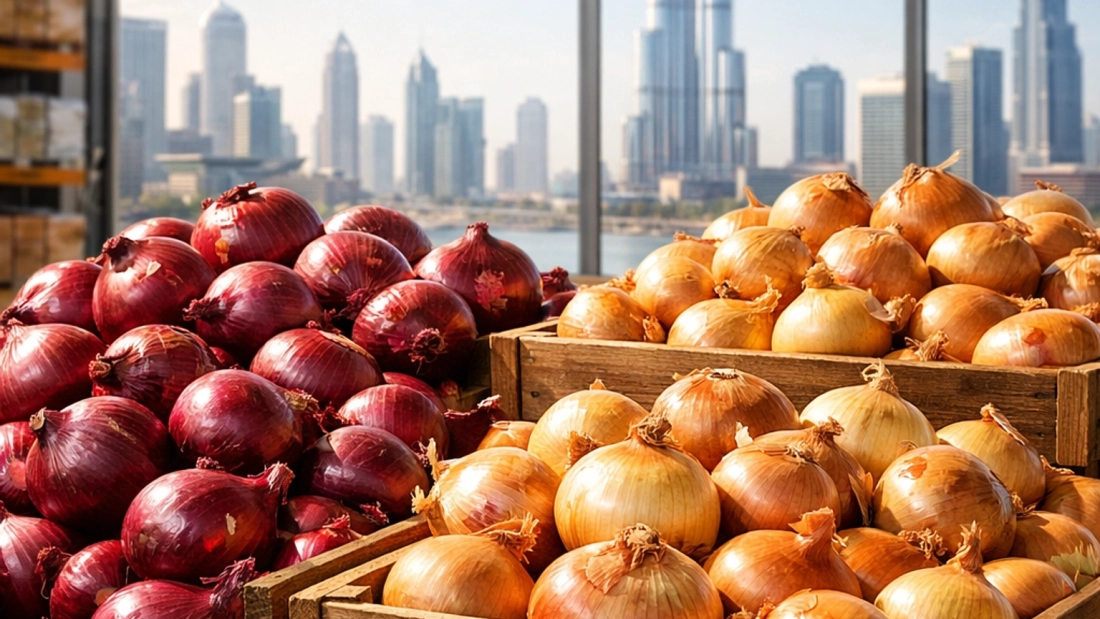
Dubai’s Al Aweer market gives onion exporters access to UAE wholesalers, retailers and food-service buyers. Success depends on more than finding a buyer: exporters need a sound landed-cost calculation, compliant documents, a clearly agreed product specification and a distribution model that fits their cash-flow requirements.
Mayil Global supports exporters through two routes: a 3% commission-based distribution model and a Cash & Carry model for container purchases, subject to agreed terms and inspection. This guide explains how to prepare a shipment, assess Al Aweer wholesale prices and select a route to market.
Why Al Aweer matters to onion exporters
Al Aweer is a key wholesale hub for fresh produce in Dubai. Buyers compare onions by origin, variety, grade, packaging, condition and availability. A market quote is therefore a reference, not a guaranteed price for every shipment.
For exporters targeting wholesale fruits and vegetables in Dubai, consistency matters. Buyers need product that matches the agreed specification, documentation that supports clearance and logistics that protect condition from origin to delivery.
Mayil Global connects international suppliers with UAE businesses, including supermarkets, restaurants and wholesale buyers. Learn more about our fresh produce range and sourcing and logistics.
Al Aweer onion pricing: use comparable quotes
Indicative Al Aweer rates recorded on 20 October 2026 demonstrate how much prices can differ across origins and product types:
| Onion listing | Origin shown | Indicative price |
|---|---|---|
| New-crop onion, 18 kg listing | India | AED 4.30/kg |
| White onion | Iran | AED 1.33/kg |
| Onion, 20 kg PPE bag listing | Egypt | AED 2.20/kg |
The Indian new-crop listing reported a 62-trading-day average of AED 3.30/kg, with a range of AED 1.85–4.80/kg. The white-onion listing reported an average of AED 1.37/kg over 61 trading days. These figures show why an exporter should avoid basing a shipment decision on one quote.
The prices are indicative wholesale observations, not official price controls or guaranteed sale values. Check the underlying new-crop onion, white onion and Egyptian onion listings before quoting. Confirm same-day prices directly with buyers and compare like with like: origin, size, colour, packaging, quality, quantity and delivery terms.
Calculate the landed cost, not just the farm-gate price
Build a shipment estimate that accounts for the full route to sale:
- Product and packing costs at origin.
- Freight and insurance to the UAE.
- Customs duty and clearance charges.
- Inspection, testing or other applicable fees.
- Port handling, inland transport and unloading.
- Storage, distribution and an allowance for quality loss or rejection.
Dubai Customs states a general customs duty of 5% of CIF value in its FAQ. The applicable classification, customs value and charges must be confirmed for the specific shipment with a licensed customs broker or Dubai Customs. Do not treat a market price as your net return: it is only one input to the calculation.
How to export food to Dubai: an onion shipment checklist
1. Confirm the route to market and importer
Work with a UAE-licensed importer or distribution partner familiar with fresh-produce clearance. Dubai Customs says businesses using its services must register and obtain a Customs Business Code; the importer or authorised representative submits the appropriate declaration.
Before loading, agree who will act as importer of record, who will manage clearance and inspection, where the cargo will be delivered, and when title and risk transfer. Put payment terms and responsibility for freight, duties, fees and rejected or damaged goods in writing.
2. Confirm import conditions for the origin and product
Check the latest requirements with the UAE importer and relevant authorities before shipment. Rules can depend on origin, product and current circulars. Do not assume that a requirement applying to one country or produce type applies to every onion consignment.
The UAE Ministry of Climate Change and Environment (MOCCAE) lists a release service for imported agricultural products. Its published requirements include a phytosanitary certificate issued by the exporting country’s competent authority, a customs manifest or bill of lading/delivery authorisation, a certificate of origin when the origin is not stated on the phytosanitary certificate, and a contents list or invoice. The service also notes that fruit and vegetable consignments may require a pesticide-residue analysis certificate according to applicable circulars.
3. Match the shipment documents
Make sure the commercial invoice, packing list, certificate of origin, bill of lading and phytosanitary certificate agree on product description, origin, package count, weights, lot identification and shipping marks. Discrepancies can delay clearance and inspection.
4. Agree the onion specification before packing
Provide the buyer with a written specification covering variety, origin, size range, colour, curing and dryness, packaging, net weight and acceptable defect tolerances. Set expectations for sprouting, mould, rot, soil, pest damage and mechanical damage.
Use clean, suitable packaging that protects the onions and allows appropriate ventilation. Keep lot identification and traceability records aligned with the shipment documents. Agree any labelling requirements with the importer before the goods are packed.
5. Coordinate transport, inspection and delivery
Choose a transport plan suited to the product and expected transit time. Avoid loading wet onions, protect cargo from avoidable moisture and condensation, and plan inspection, clearance, unloading and onward delivery before the vessel arrives.
MOCCAE states that imported agricultural consignments are inspected at the point of entry and released after import requirements are met. Visual inspection or laboratory testing may be required. Keep the UAE importer and customs broker supplied with documents early so they can prepare for arrival and respond promptly to any checks.

Choose the right Mayil Global model
3% commission distribution
Under the commission-based option, Mayil Global distributes the shipment to UAE buyers for an agreed 3% commission on gross sales value, as outlined in our onion export model. The exporter should confirm in writing the sales process, reporting, settlement schedule and any costs outside the commission before appointing a distributor.
This approach can suit exporters who want local market access and distribution support while retaining a connection to the sales outcome. The fixed commission provides a clear basis for planning, while local market knowledge can help align the offer with buyer specifications and prevailing prices.
Cash & Carry container purchase
Cash & Carry is a direct wholesale purchase route. Mayil Global assesses the container and product condition, then agrees valuation and payment terms with the exporter. The model is designed to support faster liquidity than waiting for downstream resale, but timing and payment remain subject to the agreed transaction terms, inspection and acceptance.
Exporters should document the valuation basis, inspection criteria, responsibility for clearance and any costs or deductions before dispatch. Read more about the Cash & Carry approach in Dubai wholesale.

Pricing decisions that protect the shipment
Before committing a container, compare the expected sale value with the landed cost under several price scenarios. Use recent Al Aweer references, but allow for changes between loading and sale. Ask prospective buyers for a firm indication tied to a defined origin, grade, pack and quantity.
Also consider what happens if the shipment arrives late, needs additional inspection, or falls outside the agreed size or quality tolerance. Clear specifications, accurate documents and a realistic contingency allowance help reduce disputes and protect buyer relationships.
For exporters new to importing onions in Dubai, the practical sequence is clear: confirm the buyer and importer, verify origin-specific rules, agree the product specification, calculate landed cost, prepare matching documents and secure transport and inspection arrangements before dispatch.
Build a dependable route into the UAE market
Exporting onions is a coordinated supply-chain operation, not simply a price negotiation. Reliable sourcing, compliance, careful handling and well-planned logistics support consistent quality and dependable supply for UAE buyers.
Mayil Global works with international exporters and local B2B customers through its 3% commission distribution model and Cash & Carry wholesale system. To discuss a shipment or market-entry plan, contact Mayil Global.