


Briefing date: Friday, September 4, 2026
Market reference: Al Aweer Central Fruit & Vegetable Market, Dubai
Latest accessible report: August 28, 2026
This Week 35 weekend briefing focuses on carrot-led vegetable gains, continuing cucumber momentum, bulk watermelon purchasing, declining banana leaf and lime references, and multi-origin onion procurement.
All figures are indicative wholesale references. Actual traded prices vary according to origin, grade, packaging, quantity, arrival condition, timing, negotiation, logistics, and regulatory eligibility.
August 28 Al Aweer Market Movers
Top gainers
| Product | Reported movement |
|---|---|
| Cucumber | +50.0% |
| Cucumber | +43.8% |
| Carrot | +33.3% |
| Watermelon, pickup truck approximately 4 MT | +33.3% |
| White Cucumber | +30.0% |
The two cucumber entries represent separate market listings or trading references. Buyers should not combine them into one uniform market increase. Origin, carton size, grade, and arrival condition must be compared before procurement approval.
Top declines
| Product | Reported movement |
|---|---|
| Banana Leaf, 50 pieces | -28.9% |
| Lime | -27.8% |
| Apricot | -22.2% |
| Valery | -19.9% |
| Wax Gourd | -19.9% |
A declining price does not automatically create a buying opportunity. Lower prices may reflect increased arrivals, weaker grade, shorter shelf life, or reduced demand in a specific sales channel.
Category Procurement Controls and Checklists
Carrot-Led Vegetable Gains
Carrot recorded a +33.3% movement in the August 28 report. This makes carrots a live-priced category for weekend planning. Buyers should control landed cost and quality rather than responding to the percentage movement alone.
The August 27 market data included a China carrot listing in a 4 kg carton at approximately AED 2.25/kg. This is an origin-specific reference and must be evaluated against freight, packing, grade, usable shelf life, and delivery requirements.
Carrot buying checklist
-
Confirm the specification.
Define carrot variety, size, colour, straightness, firmness, and acceptable defects. -
Verify net weight.
Check carton weight against the commercial invoice and packing list. -
Inspect freshness.
Reject lots showing excessive dehydration, cracking, softness, mould, decay, or heavy surface damage. -
Compare origin-level landed cost.
Product price alone is insufficient. Add freight, clearance, handling, storage, delivery, commission, and expected wastage. -
Match the sales channel.
Supermarkets may require uniform retail presentation. Restaurants and wholesalers may accept different sizes if the price and usable yield are suitable. -
Confirm turnover capacity.
Do not purchase volumes that exceed the buyer’s weekend movement or available cold-storage capacity.
Carrot procurement requires disciplined sourcing, quality control, hygienic handling, and organized distribution. These controls protect buyers from nominally low prices that create higher wastage.
Cucumber Momentum into the Weekend
The August 28 cucumber benchmark was AED 2.78/kg. The 55-day average was AED 2.26/kg, with a reported range of AED 1.47–3.90/kg. The July 29 reference was AED 2.72/kg.
The reported listings were:
- Iran sea carton, 9 kg: AED 23 per package, approximately AED 2.56/kg.
- UAE local carton, 20 kg: AED 60 per package, approximately AED 3.00/kg.
Iranian-origin listings remain non-executable while the UAE–Iran trade suspension continues. They may be used for market analysis only. Any transaction involving Iranian origin requires formal confirmation of legal eligibility, payment compliance, shipment authorization, and applicable UAE requirements.
Cucumber momentum indicates demand for immediate replenishment by supermarkets, restaurants, groceries, juice shops, and foodservice operators. Weekend buyers should prioritize reliable arrival timing and usable quality.
Cucumber receiving checklist
- Confirm country of origin and regulatory eligibility.
- Match carton sizes on a true AED-per-kilogram basis.
- Check firmness, colour, uniformity, bruising, cuts, softness, and decay.
- Record product temperature where applicable.
- Confirm remaining shelf life at arrival.
- Verify carton ventilation and packaging integrity.
- Photograph loading condition, seals, and received goods.
- Define rejection thresholds and the claims process in writing.
Watermelon Pickup-Truck Volume Buying
Watermelon in the approximately 4 MT pickup-truck category recorded a +33.3% movement. This reference points to bulk buying activity and requires stronger quantity controls than a small-carton purchase.
Watermelon bulk-buying checklist
- Confirm total truck quantity and expected net saleable weight.
- Establish size range and acceptable weight variation.
- Inspect external damage, soft spots, cracks, bruising, and decay.
- Verify representative samples rather than approving only the top layer.
- Confirm internal quality through agreed sampling, including maturity and sweetness where required.
- Match the volume to confirmed supermarket, restaurant, or wholesale demand.
- Calculate wastage exposure if the product cannot be moved within the planned weekend cycle.
Bulk buying can reduce unit handling costs, but it increases exposure when quality, weight, or turnover is not verified.
Banana Leaf and Lime Declines
Banana Leaf, 50 Pieces, declined 28.9%, while lime declined 27.8%. Buyers should not treat these movements as automatic discounts.
For banana leaf, inspect colour, flexibility, tearing, browning, moisture damage, and usable piece count. For lime, confirm size, firmness, juice yield, skin condition, dehydration, and remaining shelf life.
Lower-priced banana leaf or lime may be suitable for fast-moving restaurants but unsuitable for a supermarket programme requiring consistent presentation. Channel fit remains a core procurement control.
Onion Multi-Origin Competition
The August 27 origin-level references remain relevant for weekend procurement planning:
| Origin and product | Pack or reference | Indicative price |
|---|---|---|
| India new-crop onion | 18 kg | AED 4.25/kg |
| Egypt onion | 20 kg PPE | AED 2.60/kg |
| Yemen onion | Market reference | AED 3.00/kg |
| Turkey red onion | Market reference | AED 2.85/kg |
| Sudan pink onion, approximately 50 mm | Market reference | AED 4.30/kg |
| Iran Red Onion Tabrezi | Market reference | AED 2.10/kg |
| Iran Red Shirazi, 65 mm+ | Market reference | AED 2.05/kg |
The August 27 report also recorded strong movements in selected onion and grape listings, including Indian new-crop onion at +28.8%, Red Onion Tabrezi at +35.5%, black grapes at +50.1%, Egyptian red seedless grapes at +37.5%, and Turkish red seedless grapes at +35.7%.
Iranian-origin onion references are non-executable without formal regulatory confirmation. Egypt, Yemen, Turkey, Sudan, and India should be compared through documented specifications, route feasibility, supply continuity, and buyer acceptance.
Onion procurement controls
- Confirm variety, colour, crop status, and size range.
- Check firmness, dryness, sprouting, bruising, cuts, rot, and soil contamination.
- Verify net weight and packaging material.
- Review certificate of origin and phytosanitary documentation.
- Obtain pre-dispatch inspection photographs.
- Define arrival inspection and rejection terms.
- Calculate complete landed cost before confirming the purchase.

Freight and Landed-Cost Controls
Weekend procurement decisions must be based on complete landed cost. The calculation should include:
- Product and packaging cost.
- Inland transport.
- Ocean freight and reefer charges.
- Peak Season Surcharges and emergency surcharges.
- Insurance and port handling.
- Customs clearance and storage.
- UAE delivery costs.
- Mayil Global’s agreed commission or distribution cost.
- Expected wastage, rejection, and financing exposure.
A CMA CGM reefer Peak Season Surcharge reference for the North Europe to Middle East Gulf lane was reduced to approximately USD 1,000 per reefer container. A Maersk emergency exposure reference was approximately USD 3,800 per reefer container. Strait of Hormuz risk may affect routing, insurance, surcharges, transit times, and service availability.
These are planning references only. Exporters and buyers must obtain written confirmation from the relevant carrier or freight forwarder before issuing a firm commercial offer.
Landed-cost control sequence
- Set the target Al Aweer wholesale value.
- Deduct the agreed 3% commission or distribution cost.
- Add confirmed freight and reefer charges.
- Add clearance, handling, storage, and delivery.
- Include documented wastage and rejection allowances.
- Calculate the maximum viable origin-side purchase price.
- Confirm the result against payment terms and working-capital requirements.

How to Export Food to Dubai: Eight-Step Checklist
1. Define the product
Confirm product name, variety, origin, grade, size, packaging, quantity, shelf life, and temperature requirements.
2. Identify the correct buyer
Verify the buyer’s business identity, registration, receiving location, storage capacity, product requirements, and payment capability.
3. Confirm regulatory eligibility
Review UAE import requirements, food-safety obligations, labelling, certificates, phytosanitary documentation, and origin restrictions before loading.
4. Calculate landed cost
Include product value, packaging, freight, surcharges, clearance, storage, delivery, commission, insurance, and expected wastage.
5. Select the commercial model
Choose a documented 3% commission-based distribution model or an Immediate Cash & Carry container purchase, subject to product and buyer verification.
6. Inspect before dispatch
Check quantity, condition, packaging, loading records, photographs, seal numbers, container suitability, and documents.
7. Coordinate clearance and delivery
Manage shipping documents, customs clearance, inspection, transport to Al Aweer, storage, and final delivery.
8. Review shipment performance
Measure landed cost, arrival quality, wastage, delivery timing, buyer acceptance, realized price, and repeat-order potential.
Mayil Global’s 3% Commission Distributor UAE Model
Mayil Global supports international and local exporters through a transparent 3% commission distributor UAE model.
The model is designed for approved fresh fruits, vegetables, premium spices, rice, eggs, and other food products. It supports:
- Product-specific buyer coordination.
- Supermarket, restaurant, retailer, and wholesale distributor access.
- Distribution planning across the UAE.
- Quality-control coordination.
- Shipment and documentation support.
- Delivery scheduling.
- Clear commission calculation.
- Long-term commercial relationships.
The 3% commission is a central Mayil Global value proposition. Each agreement should define the product, shipment value, commission basis, inspection responsibilities, deductions, settlement schedule, claims process, and delivery obligations.
Immediate Cash & Carry Container Purchases
Exporters requiring faster liquidity can discuss Immediate Cash & Carry container purchases with Mayil Global. This model can reduce extended receivables exposure and support faster working-capital recovery.
Every container remains subject to:
- Exporter and product verification.
- Confirmed origin and regulatory eligibility.
- Quality inspection.
- Complete shipment documentation.
- Agreed quantity and specification.
- Confirmed arrival and delivery feasibility.
- Written purchase and settlement terms.
Cash & Carry is a commercial purchasing option, not a substitute for compliance, inspection, or food-safety controls.
Wholesale Fruits and Vegetables Dubai Supply
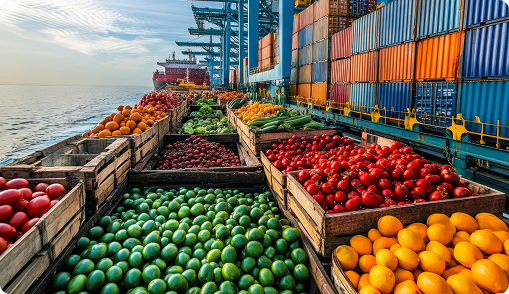
Mayil Global supplies fresh fruits, vegetables, premium spices, rice, and farm-fresh eggs to UAE supermarkets, restaurants, retailers, and wholesale distributors.
Its operating model combines farm-direct sourcing, international supplier relationships, inspection at every stage, hygienic packaging, proper storage, and organized logistics. This provides buyers with dependable wholesale supply, consistent quality, alternative-origin sourcing, timely delivery, and documented quality control.
Verified Buyer Guidance for Exporters
Exporters seeking a verified buyer for exporters UAE should submit a complete product offer containing:
- Exact product and variety.
- Country of origin.
- Grade, size, and tolerance.
- Pack format and net weight.
- Available quantity.
- Loading and estimated arrival dates.
- Temperature and handling requirements.
- Required certificates.
- Target price.
- Preferred settlement structure.
The objective is to identify a verified buyer of that particular product. A buyer for Indian onions may not be suitable for cucumbers, carrots, watermelons, premium fruits, spices, rice, or eggs.
Mayil Global evaluates product, origin, grade, quantity, timing, buyer channel, and delivery requirements before coordinating a suitable UAE opportunity. The company’s 3% commission model provides a defined commercial structure for qualified distribution arrangements.
Conclusion
The September 4 Week 35 position is defined by carrot-led gains, sustained cucumber momentum, bulk watermelon activity, declining banana leaf and lime references, and active multi-origin onion competition.
The correct procurement decision is not based on the lowest price. It depends on specification control, quality inspection, regulatory eligibility, complete landed cost, reliable logistics, and a verified buyer.
Mayil Global’s 3% commission distribution model, Immediate Cash & Carry option, and wholesale supply network support exporters and UAE B2B buyers requiring dependable supply and consistent quality.
For sourcing, distribution, or buyer coordination, contact Mayil Global.
Disclaimer
All market figures are indicative references compiled from Al Aweer market data dated August 28, 2026, and related August 27 origin-level listings. They are not fixed quotations, guarantees, or binding offers. Actual prices vary by quality, origin, packaging, quantity, timing, negotiation, logistics, and market conditions.
Iranian-origin references are non-executable unless formal regulatory, trade, payment, and commercial eligibility is confirmed. Freight and surcharge figures are planning references only and must be verified in writing with the relevant carrier or freight forwarder.