

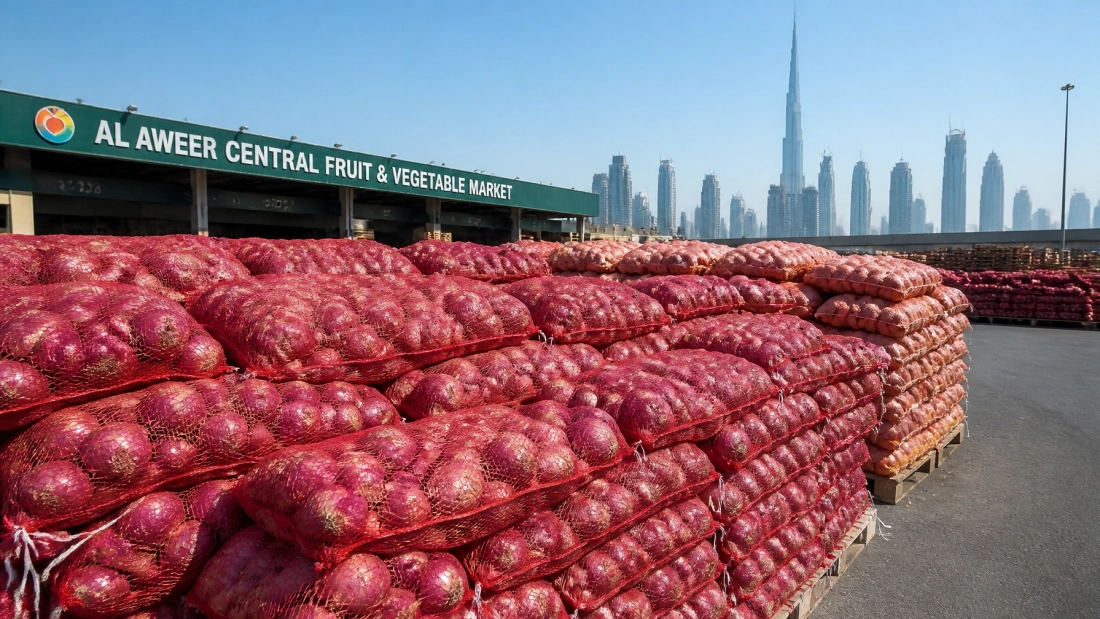
For international food exporters, the Dubai wholesale market remains one of the most lucrative yet operationally complex hubs in the GCC. As of July 2026, the onion trade, in particular, is navigating a unique set of geopolitical and harvest-driven variables. Successfully importing onions to Dubai requires more than just high-quality produce; it demands an intricate understanding of shifting logistics, real-time pricing at Al Aweer, and a distribution partner capable of providing immediate liquidity.
This installment of the Verified Buyer & Exporter Authority Series provides actionable intelligence for exporters targeting the UAE market during this volatile mid-year period.
The Dubai Wholesale Onion Landscape (July 2026)
The Al Aweer Central Fruit and Vegetable Market serves as the primary pulse for onion distribution in the region. In the current month, we are observing a stabilized but highly specific pricing structure.
- Pink Onions: Currently trading steadily between 0.75 and 0.85 AED/kg.
- Premium Red Onions: Maintaining a robust position, with wholesale rates ranging from 1.15 to 7 AED/kg depending on size, origin, and curing quality.
While origin prices in some regions have softened, the landed cost in Dubai is heavily influenced by the current maritime logistics climate. Tensions in the Strait of Hormuz have significantly impacted freight reliability. Container rates for a standard refrigerated unit from major Asian ports to Jebel Ali have surged from a baseline of ~$2,150 to a current range of $8,600–$9,700 per container.
Exporters must factor these "logistics surcharges" into their C&F (Cost and Freight) calculations to remain competitive. Efficiency in clearing and distributing these containers is no longer just a preference: it is a financial necessity.
Sourcing Origins: The Shift in Supply Chains
India continues to be the dominant force in the UAE's onion supply chain, accounting for approximately 59.6% of the total market share. The 2026 Rabi harvest in India has been robust, particularly in the Lasalgaon region, where prices at the origin remain soft at roughly ₹1,100 per quintal.
However, the logistics squeeze in the Gulf has created a bottleneck. While the supply at the source is high, the volume reaching Jebel Ali is constrained by the aforementioned container costs and transit delays. This has opened significant opportunities for secondary sources:
- Kazakhstan (23.3%): Providing a steady overland and sea-link alternative.
- Pakistan (16.3%): Leveraging geographical proximity to maintain a consistent flow despite regional maritime challenges.
Exporters from these regions are finding that wholesale fruits and vegetables in Dubai demand a faster turnover to offset the increased cost of transit.

UAE Regulatory Requirements: Compliance is Non-Negotiable
Navigating the regulatory framework of the Ministry of Climate Change and Environment (MOCCAE) and the Dubai Municipality is the first barrier to entry for any exporter. Failure to meet these standards results in costly re-exports or destruction of cargo.
- ZAD/FIRS Registration: All food products must be registered within the ZAD (National Food Registration System) or the FIRS (Food Import & Re-export System).
- MOCCAE Import Approval: For first-time imports or new varieties, approval must be secured prior to the shipment's arrival.
- Labeling Standards: Arabic labeling is mandatory for all retail-bound shipments. This includes product name, country of origin, net weight, and importer details.
- Shelf Life & Health Certificates: Onions must arrive with a minimum of 50–75% of their total shelf life remaining. A valid Phytosanitary Certificate and Certificate of Origin (COO) are mandatory for every consignment.
At Mayil Global, we facilitate this process for our partners. Our team provides comprehensive FIRS registration assistance, ensuring that your documentation aligns perfectly with UAE standards before the container even leaves your port.

The Mayil Global Advantage: 3% Commission & Cash-and-Carry
The traditional distribution model often leaves exporters waiting weeks for payment, trapping capital in a cycle of "consignment and wait." In a high-freight environment like July 2026, this delay is unsustainable.
Mayil Global operates as a 3 percent commission distributor in the UAE, a model specifically designed to maximize transparency and liquidity for the exporter.
How the 3% Commission Model Works:
- Transparent Reporting: We provide daily sales reports directly from the Al Aweer market. You see exactly what your produce sold for, with no hidden margins.
- Fixed Fee Structure: We charge a flat 3% commission on the gross sales value. This aligns our interests with yours; we are incentivized to achieve the highest possible market price for your onions.
- Daily Liquidity: Our cash-and-carry approach ensures that as produce is sold to our network of supermarkets and retailers, the funds are cleared and reported immediately.
Immediate Cash-and-Carry Container Purchases
For exporters who prefer immediate settlement, Mayil Global offers a cash-and-carry container purchase option. We buy full containers of onions, potatoes, and garlic at agreed-upon market rates, providing you with instant liquidity and removing the market risk from your shoulders. This is particularly beneficial for exporters managing high-interest export credit lines.

Strategy for Success: How to Export Food to Dubai in 2026
If you are looking at how to export food to Dubai this season, your focus must be on speed and partnership.
- Prioritize Curing: With transit times potentially extended due to maritime shifts, ensuring your onions are properly cured and dried is vital to maintaining grade-A quality upon arrival at Al Aweer.
- Leverage Local Expertise: Do not attempt to navigate FIRS or MOCCAE alone. Partnering with a distributor that has an established "Importer of Record" status saves time and reduces risk.
- Monitor Al Aweer Trends: Prices fluctuate daily. Our daily Al Aweer market price updates allow our partners to time their shipments for maximum profit.
Conclusion
The July 2026 onion market presents a landscape of both high risk and high reward. While freight costs have escalated, the consistent demand for premium produce in the UAE remains a constant. By utilizing Mayil Global’s 3% commission model, exporters can bypass the traditional "black box" of distribution, gaining a transparent, reliable, and liquid pathway to the heart of the Dubai food trade.
Secure your margins today. Partner with Mayil Global for professional, farm-to-market distribution in the UAE.