

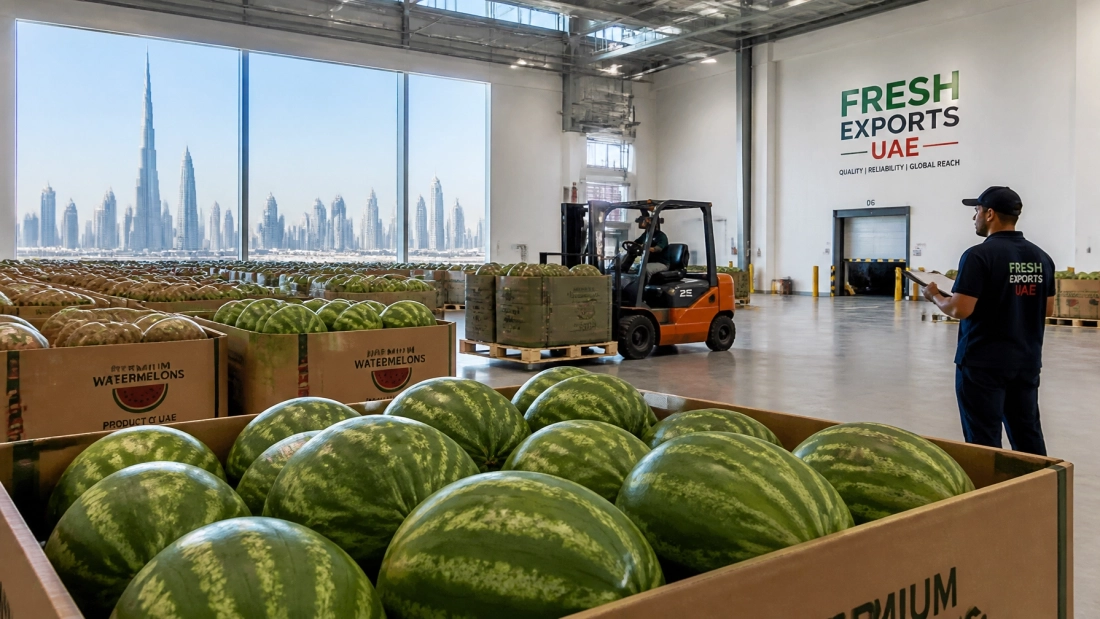
The United Arab Emirates represents one of the most lucrative markets for fresh produce globally, with Dubai serving as the primary commercial gateway. As a central hub for redistribution across the GCC, the demand for high-quality watermelons remains consistently high throughout the year. For international exporters, the challenge lies not just in the cultivation of the product, but in navigating the complex logistics, regulatory frameworks, and market dynamics of the Aweer Central Fruit & Vegetable Market.
At Mayil Global, we specialize in bridging the gap between global farms and UAE B2B buyers. By leveraging our 3% commission distributor UAE model, exporters can bypass traditional, high-margin middlemen to secure better returns and maintain operational transparency. This guide outlines the strategic steps required to successfully export watermelons to Dubai while maximizing your profit margins.
Understanding the Dubai Watermelon Market Dynamics
Dubai’s market is characterized by a sophisticated consumer base and a high concentration of institutional buyers, including supermarket chains, hotel groups, and catering companies. To succeed, exporters must recognize that the market is segmented by quality. High-grade, uniform watermelons with high sugar content (Brix) command a premium price, while lower-grade produce is often diverted to secondary wholesale channels.
Successfully entering this market requires a partner with deep roots in local distribution. Mayil Global operates as a bridge, providing wholesale fruits and vegetables in Dubai through a streamlined supply chain that prioritizes freshness and speed to market.
Step 1: Regulatory Compliance and Mandatory Documentation
The UAE Ministry of Climate Change and Environment (MOCCAE) enforces strict standards to ensure food safety and plant health. Compliance is non-negotiable and begins long before the shipment leaves the port of origin.
Phytosanitary and Plant Health Standards
Every shipment of watermelons must be accompanied by a Phytosanitary Certificate issued by the National Plant Protection Organization (NPPO) of the exporting country. This document certifies that the produce has been inspected and is free from quarantine pests. Furthermore, the produce must strictly adhere to UAE’s Maximum Residue Limits (MRLs) for pesticides. Failure to meet these chemical safety standards can lead to the total rejection of the container at the port.
Essential Shipping Documents
To facilitate smooth customs clearance at Dubai’s ports, exporters must ensure the following documentation is accurate and complete:
- Commercial Invoice: Detailing the value, quantity, and description of the goods.
- Packing List: Specifying the number of cartons, weights, and piece counts per pallet.
- Certificate of Origin: Validated by the relevant Chamber of Commerce.
- Bill of Lading: The primary document for ocean freight logistics.
Step 2: Implementing Rigorous Quality Control
In the competitive environment of the Aweer market, quality is the primary determinant of price. Inconsistent quality leads to price renegotiations and potential losses for the exporter.

Grade Specifications and Brix Levels
For the Dubai market, watermelons are typically graded based on size, weight, and internal quality. Premium buyers look for:
- Brix Level: A minimum of 8° to 10° is expected, with 12°+ being highly desirable for premium retail.
- Physical Integrity: No cracks, bruises, or signs of field heat.
- Uniformity: Consistent sizing (e.g., 5-7kg or 8-10kg per fruit) to meet supermarket shelf requirements.
Mayil Global employs strict quality control measures at every stage. We recommend that exporters conduct pre-shipment inspections to ensure that only the highest-standard produce is loaded into the containers.
Step 3: Optimization of Packaging and Logistics
The hot climate of the UAE necessitates a robust cold chain strategy. Watermelons are sensitive to temperature fluctuations, which can lead to premature ripening or internal degradation during transit.

Utilizing Refrigerated Supply Chains
Exporters must utilize 40ft High Cube Refrigerated (Reefer) containers to maintain a constant temperature: typically between 10°C and 12°C: depending on the transit time. Proper ventilation is also critical to manage ethylene gas and moisture levels.
Packaging Standards
Watermelons should be packed in heavy-duty, corrugated cardboard cartons or bins designed for export. Standardized packaging facilitates easier handling at our sourcing and logistics hubs. Ensuring that the boxes are palletized and shrink-wrapped prevents movement during transit, reducing the risk of physical damage that occurs during long-haul sea freight.
Step 4: Navigating the Aweer Central Fruit & Vegetable Market
The Aweer market produce buyers are the engine of Dubai's food trade. This massive wholesale hub is where the majority of the region’s produce is traded daily. Navigating this market requires local expertise and a physical presence.

The 3% Commission Model Advantage
Traditional distributors in Dubai often charge high margins or provide opaque pricing structures. Mayil Global disrupts this by offering a transparent 3% commission model. Under this arrangement, we act as your local distribution arm, selling your container directly to our network of supermarkets and retailers.
Exporters retain the majority of the market value, paying only a flat 3% service fee for our logistics, storage, and sales expertise. This model is specifically designed to maximize the exporter's margins and provide a competitive edge in a crowded market.
Step 5: Securing Liquidity with Cash-and-Carry
Cash flow is the lifeblood of any export business. One of the most significant risks for international suppliers is the delay in payment or the uncertainty of market-based pricing.

Mitigating Financial Risk for Exporters
Mayil Global addresses liquidity concerns through our immediate cash-and-carry container purchase option. For exporters who prefer immediate liquidity over a commission-based sale, we offer direct purchase of full containers upon arrival and inspection. This ensures that you receive your funds quickly, allowing you to reinvest in your next harvest or shipment without waiting for secondary sales to conclude.
This dual approach: offering both a high-yield 3% commission strategy and immediate cash purchases: positions Mayil Global as the most flexible partner for global watermelon exporters.
Conclusion: Partnering with Mayil Global
Exporting watermelons to Dubai offers significant opportunities for those who can maintain high quality and manage costs effectively. By following these five steps: ensuring compliance, maintaining quality, optimizing logistics, leveraging the Aweer market, and securing liquidity: you can build a sustainable and profitable export business.
Mayil Global is committed to fostering long-term relationships with international exporters. Whether you are looking for a reliable lemon buyer in Dubai or seeking to dominate the watermelon trade, our infrastructure and transparent business models are designed for your success.
To discuss your next shipment and learn more about our 3% commission advantage, contact our team today.