

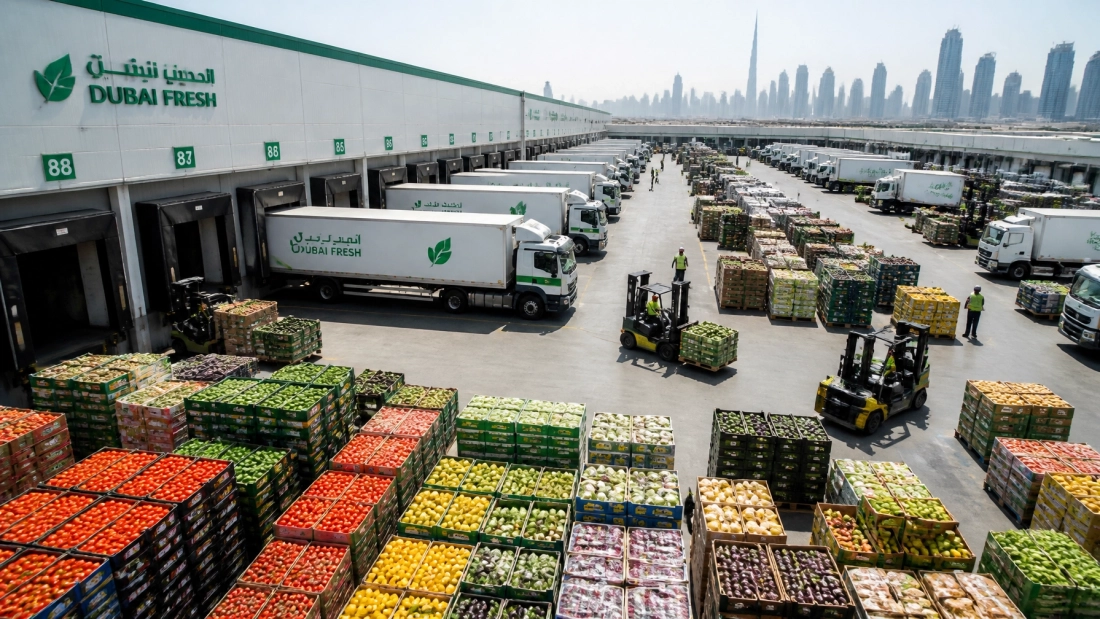
Navigating the complex landscape of international trade requires more than just high-quality products; it demands a reliable gateway into the target market. For global exporters eyeing the Middle East, the United Arab Emirates: specifically Dubai: serves as the primary commercial hub. However, the traditional barriers of entry, including long payment cycles and opaque distribution layers, often deter small to medium-sized exporters.
Mayil Global is redefining this entry point by serving as a verified buyer and distributor. By focusing on a 3% commission-based distribution model and immediate Cash & Carry wholesale container purchases, we provide the liquidity and transparency that global exporters need to thrive in the competitive UAE market.
If you are currently evaluating the potential of wholesale fruits and vegetables in Dubai, understanding the mechanics of the local market is essential. Here are five critical insights into the Cash & Carry wholesale model and how it benefits your export business.
1. Liquidity and the Cash & Carry Advantage
The most significant challenge for any exporter is the "liquidity gap": the period between shipping the goods and receiving payment. In many traditional retail and food-service models, payment terms can range from 30 to 90 days. For an exporter dealing with perishable goods like fresh produce, this delay can be catastrophic for cash flow.
The Cash & Carry wholesale model in Dubai, particularly when handled by a verified buyer like Mayil Global, prioritizes immediate turnover. This model is designed for speed:
- Rapid Inventory Movement: Goods are sold to a wide network of local B2B buyers: including supermarkets, restaurants, and secondary wholesalers: who pay upfront or on very short terms.
- Immediate Payouts: For exporters, this means faster settlement of accounts. At Mayil Global, we facilitate daily liquidity for exporters, ensuring that your capital isn't tied up in the supply chain.
- Risk Mitigation: Cash transactions significantly reduce the risk of bad debt or non-payment, which is a common concern when dealing with unknown retail entities across borders.
By leveraging our cash-and-carry infrastructure, exporters can reinvest their capital into the next shipment faster, increasing their total annual volume and profitability.

2. Transparency Through the 3% Commission Model
Trust is the currency of international trade. Many exporters are wary of "black box" distribution where the final selling price is hidden, and the distributor takes an arbitrary margin. Mayil Global addresses this by offering a transparent 3% commission model.
Under this arrangement, we act as your local partner and distributor. We handle the sales, logistics, and collections for a flat, pre-agreed 3% fee on the gross sales value. This model offers several advantages:
- Full Price Discovery: Exporters receive detailed reports on the daily selling prices at the market. You know exactly what your products sold for and what your net return will be.
- Alignment of Interests: Because our fee is a percentage of sales, we are incentivized to achieve the highest possible market price for your goods.
- Simplified Accounting: There are no hidden "marketing fees" or "listing charges." The 3% commission covers the core distribution service, making your financial forecasting straightforward.
This level of transparency is rare in the high-volume world of wholesale vegetables in Dubai, but it is the cornerstone of our long-term partnerships with global suppliers.
3. Navigating the Dynamics of Al Aweer Central Market
The Al Aweer Central Fruit and Vegetable Market is the heartbeat of the UAE’s food trade. Most shipments entering the country eventually pass through or are priced based on the activity in Al Aweer. Understanding its dynamics is crucial for any exporter.
Pricing in Al Aweer is highly volatile and set daily based on supply and demand. Factors such as a delayed vessel from India or an early harvest in Egypt can cause prices to fluctuate by 20-30% in a single day.
Strategic Pricing Insights:
- Timing is Key: Arriving during "gap" periods when competitors are out of stock can lead to premium pricing.
- Grade and Size Consistency: The market has a high demand for specific grades. For example, when importing onions to Dubai, sizes between 45mm and 60mm are often preferred for the retail sector.
- Origin Reputation: Certain origins carry a "premium" status. Ensuring your packaging clearly identifies the origin and adheres to international standards is vital for maintaining high market value.
Mayil Global provides real-time market intelligence from Al Aweer, allowing our partners to time their shipments for maximum profit.

4. Technical Compliance: How to Export Food to Dubai
One of the most frequent questions we receive from new partners is: how to export food to Dubai without getting stuck in customs? The UAE has rigorous standards managed by the Ministry of Climate Change and Environment (MOCCAE) and the Dubai Municipality.
To ensure a seamless entry, exporters must adhere to the following mandatory requirements:
- Product Registration: Every food item must be registered in the "Zad" portal. This involves providing detailed product specifications and laboratory test reports.
- Health & Phytosanitary Certificates: Fresh produce requires an original phytosanitary certificate from the exporting country’s agricultural authority. Processed foods require health certificates confirming the item is fit for human consumption.
- Arabic Labeling: All retail and wholesale packaging must have Arabic labels. This must include the product name, ingredients (for processed goods), country of origin, and clearly printed manufacture and expiry dates.
- Customs Documentation: A complete set of documents, including a Commercial Invoice, Packing List, Certificate of Origin, and Bill of Lading, must be submitted via the Dubai Customs "Mirsal 2" system.
Navigating these regulations can be daunting. Mayil Global assists our exporters by verifying documentation before the cargo leaves the port of origin. By ensuring 100% compliance at the source, we prevent costly delays and demurrage charges at the port of Jebel Ali.
5. High-Volume Opportunities: Importing Onions and Staple Produce
While the UAE market demands a variety of exotic fruits, the real volume lies in staples. For many exporters, importing onions to Dubai represents one of the most stable and high-volume opportunities. Onions, potatoes, and garlic are daily essentials for the UAE's massive restaurant and catering sector (HoReCa).
Key Considerations for Onion Exporters:
- Packaging: 18kg or 20kg mesh bags are the industry standard for onions. Using high-quality mesh that allows for proper ventilation is critical to preventing sprout and rot during transit.
- Variety: Red onions from India and Pakistan, and yellow onions from Europe or Egypt, each have distinct peak seasons. Understanding these seasonal windows is the key to securing a verified buyer for onions in Dubai.
- Logistics: Freshness is directly tied to the speed of the supply chain. Utilizing refrigerated containers (Reefers) is non-negotiable for long-distance sea freight to ensure the produce arrives in "market-ready" condition.
At Mayil Global, we specialize in high-volume commodity distribution. Our infrastructure is designed to move dozens of containers per week, providing exporters with a reliable "sink" for their production capacity.

Conclusion: Securing Your Supply Chain with Mayil Global
The UAE food market is a land of opportunity, but it rewards those who prioritize operational excellence and local expertise. By choosing a partner that offers a 3% commission distribution and a robust Cash & Carry wholesale infrastructure, you remove the guesswork from your export strategy.
Mayil Global is more than just a distributor; we are your "boots on the ground" in the Middle East. Whether you are exporting bulk rice, fresh apples, or premium spices, our commitment remains the same: ensuring that your products are handled with care, sold at fair market prices, and that you receive your returns without delay.
By aligning with a verified buyer who understands the nuances of the Al Aweer market, global exporters can turn the UAE from a challenging prospect into a consistent, high-yield revenue stream.
