

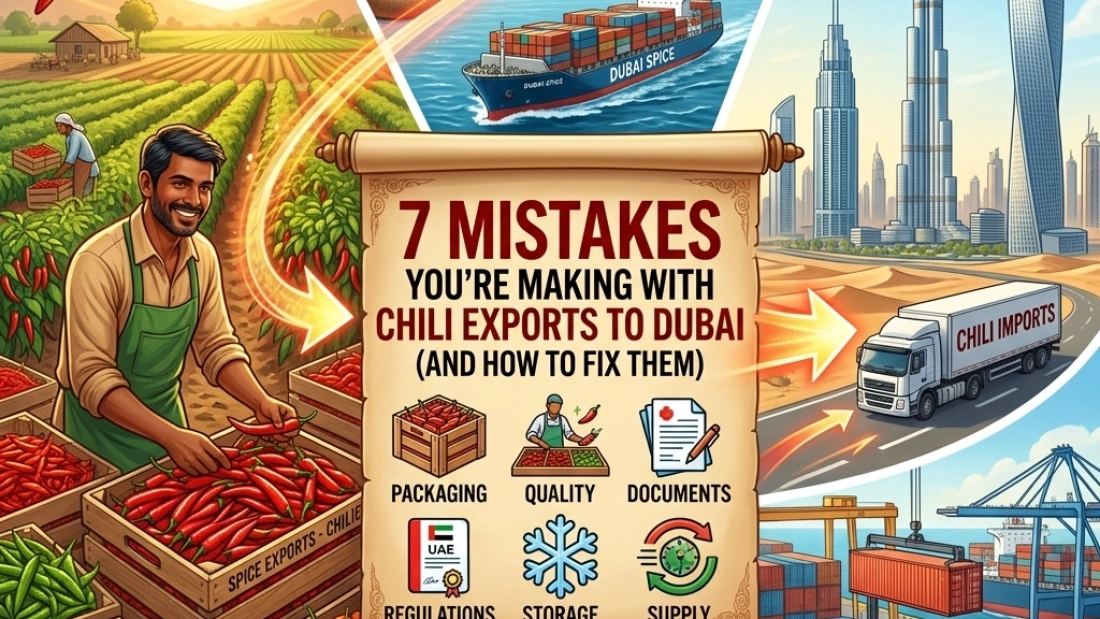
Exporting fresh produce to the Middle East, particularly the high-demand hub of Dubai, offers lucrative opportunities for international growers and traders. However, the chili market in the UAE is unforgiving. One minor oversight in variety selection or a slight deviation in cold chain management can lead to a total loss of cargo.
Many exporters find themselves frustrated by low returns, high spoilage rates, and opaque commission structures that eat into their margins. At Mayil Global, we see these patterns daily at the Aweer Fruit and Vegetable Market. To help you secure your profits and establish a sustainable export business, we have identified the seven most common mistakes exporters make when shipping chilies to Dubai: and, more importantly, how you can fix them using our transparent 3% commission and Cash & Carry models.
1. Exporting the Wrong Variety for the Local Market
The most fundamental mistake is assuming that any green chili will sell at a premium. The Dubai market is highly specific about consumer preferences. While the European market might prioritize finger chilies like the Jwala variety, the UAE market: driven by a massive South Asian and Middle Eastern demographic: demands the G4 (Green 4) variety.
The Mistake: Sending varieties that are too thin-skinned or lack the specific pungency and color profile required by local retailers.
The Fix: Focus your production or sourcing specifically on the G4 variety. These chilies are dark green, typically 4 to 6 inches in length, and possess a thick skin. The thick skin is not just a preference; it is a biological necessity for surviving the 5–8 day sea voyage and maintaining a long shelf life once they hit the retail shelves in Dubai. Understanding these sourcing and logistics requirements is the first step toward a successful shipment.
2. Sourcing from Non-Specialized Production Belts
Freshness is the primary currency in the food distribution business. If your chilies have already spent three days in a local mandi (market) before being packed for export, they are essentially "dead on arrival" in terms of shelf life.
The Mistake: Buying open-market stock from general traders rather than sourcing directly from specialized chili-growing regions.
The Fix: Establish direct links with farmers or specialized aggregators in established chili belts, such as those in Andhra Pradesh, Telangana, or Maharashtra in India. By sourcing at the origin, you ensure that the product is harvested, sorted, and packed within 24 hours. This minimizes the "field heat" and ensures the product enters the cold chain in peak condition.

3. Neglecting the Pre-Cooling Process
Chilies are living organisms that continue to respire after harvest. Respiration generates heat, and heat leads to rapid decay. Many exporters pack chilies into containers immediately after harvest without removing the field heat.
The Mistake: Skipping the pre-cooling stage to save time or costs.
The Fix: Pre-cooling is non-negotiable for Dubai exports. Chilies must be brought down to an ambient temperature of approximately 7°C to 8°C before they are loaded into a refrigerated container. This "shocks" the product into a dormant state, significantly slowing down the ripening and spoilage process. If you are looking for a tomato buyer in Dubai or a chili buyer, you will find that those who manage pre-cooling always receive higher prices.
4. Substandard Sorting and Packaging Protocols
In the competitive environment of the Aweer Market, presentation is everything. A container that arrives with inconsistent grading or damaged boxes will be sold at a "clearance" price, regardless of the quality of the chilies themselves.
The Mistake: Using weak corrugated boxes or failing to sort chilies by size, color, and stem freshness.
The Fix:
- Rigorous Sorting: Remove any chilies with broken stems, soft spots, or yellowing. Even one decaying chili can release ethylene gas that spoils the rest of the box.
- Ventilated Packaging: Use high-strength, moisture-resistant 3kg or 4kg boxes with adequate ventilation holes.
- Branding: Proper labeling and clean packaging signal to buyers that the exporter follows international standards.
Investment in quality packaging usually costs an extra few cents per kilogram but can result in a price increase of several Dirhams per box.
5. Incorrect Reefer Container Temperature Settings
Even if you do everything right at the farm, a mistake by the shipping line or a wrong setting on the reefer container can ruin the entire batch.
The Mistake: Setting the temperature too low (causing chilling injury) or too high (causing ripening and redness).
The Fix: The optimal temperature for transporting green chilies to Dubai is 7°C to 8°C (45°F to 46°F) with a relative humidity of 90-95%. If the temperature drops below 7°C, the chilies may suffer from pitting and black spots (chilling injury). If it rises above 10°C, the green chilies will quickly turn red, losing their market value in the "green chili" category. Always use independent data loggers inside the container to verify the temperature throughout the journey.
6. Falling Victim to Opaque Commission Structures
This is where most exporters lose their actual profit. Traditional commission agents in Dubai often operate on a "black box" model. They might charge a 10% or 15% commission, but they also hide margins in the "actual" selling price they report back to the exporter.
The Mistake: Working with agents who do not provide transparent sales receipts or who charge exorbitant, fluctuating commission rates.
The Fix: Switch to the Mayil Global 3% Commission Model. We have revolutionized the export-import dynamic by offering a fixed, flat 3% commission strategy. We provide full transparency on the selling price. If we sell your container for AED 50,000, we take exactly 3%, and the rest belongs to you. This model ensures that our interests are aligned: we want to sell at the highest possible price because it proves our value to you.

7. Liquidity Gaps and Payment Delays
The fresh produce trade moves fast, but payments often move slow. Many exporters fail because their capital is tied up in containers that are "in transit" or "sold on credit" by local agents.
The Mistake: Exporting without a plan for immediate liquidity, leading to a breakdown in the sourcing cycle.
The Fix: Leverage Mayil Global’s Cash & Carry Model. For exporters who prefer immediate certainty over the variable returns of the commission model, we offer a Cash & Carry solution. We buy the container from you at a fair market price upon arrival and inspection. This provides you with daily liquidity, allowing you to reinvest in your next shipment immediately.
Looking for a Chili Buyer in Dubai?
If you are currently searching for a reliable partner to handle your chili exports, you need more than just a buyer; you need a distribution partner that understands the technicalities of the UAE market. Whether you are exporting onions to Dubai or focusing on high-value chilies, the principles of success remain the same: quality, cold chain, and transparency.
Why Partner with Mayil Global?
At Mayil Global, we function as your extended team on the ground in Dubai. Our facility at the Aweer Market is designed to handle bulk volumes while maintaining the integrity of the product.
- 3% Commission Advantage: We offer the lowest transparent commission in the market. You keep 97% of the sales value.
- Wholesale Reach: We don't just wait for buyers; we have an active network of wholesale vegetable buyers in Dubai ranging from supermarket chains to catering companies.
- Operational Excellence: From customs clearance to final sale, we handle the logistics so you can focus on sourcing.
How to Get Started
Exporting chilies to the UAE doesn't have to be a gamble. By fixing these seven mistakes, you position yourself as a premium supplier in one of the world's most vibrant food hubs.
- Validate your variety: Ensure you are growing or sourcing G4 Green Chilies.
- Audit your cold chain: Implement pre-cooling and 7°C reefer settings.
- Contact Mayil Global: Reach out to our team to discuss your container volumes.
Whether you are an established exporter or a new player looking to enter the market, our doors are open. We invite you to experience a new standard of food distribution where transparency isn't just a buzzword: it's our business model.
Ready to maximize your chili export profits?
Contact us today to learn more about how our 3% commission and Cash & Carry models can transform your business. You can also explore our full range of products and learn more about our mission to bring transparency to the Dubai wholesale market.