

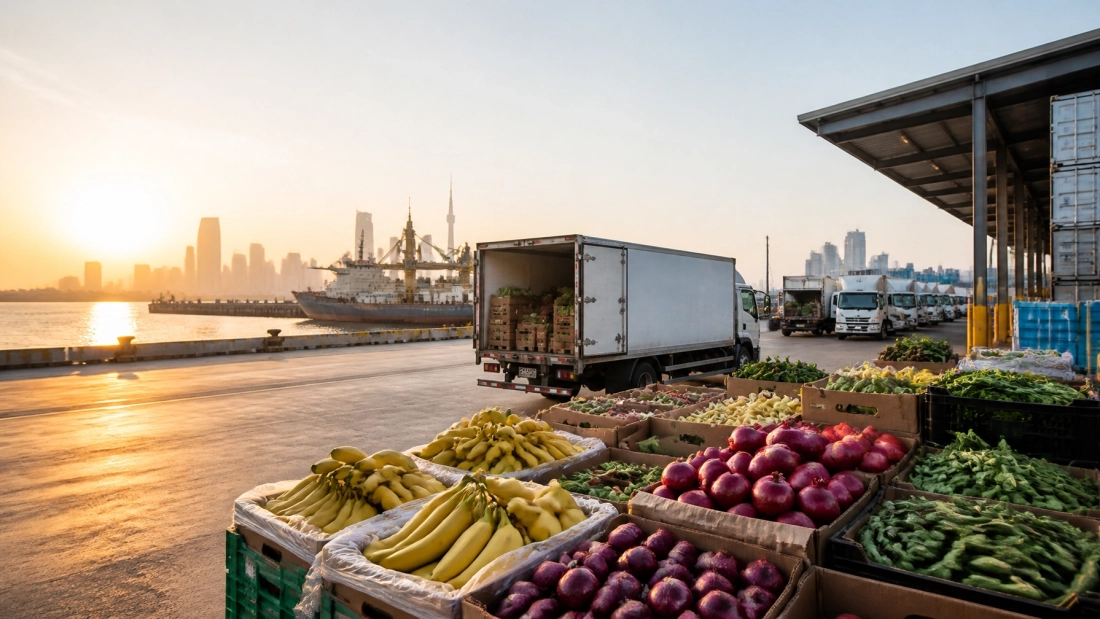
Daily series: Tuesday, 1 September 2026 | Week 35 | First trading day of September
September begins with new sourcing options, active regional trade corridors and continued compliance requirements for exporters supplying the UAE. International suppliers are assessing the Armenia–UAE fresh produce corridor, while African origins are strengthening their position in Gulf food distribution. Pakistan is also preparing a new capital-market initiative to expand fruit exports to the region.
For exporters, the immediate priorities remain consistent: verified demand, accurate documentation, controlled temperature, reliable logistics and clear settlement terms. For UAE supermarkets, restaurants, retailers and wholesale distributors, dependable supply and consistent quality remain essential operating requirements.
Mayil Global supports both sides of the market through wholesale distribution, a 3 percent commission distributor UAE model for approved exporters and immediate cash-and-carry container purchases subject to product and compliance approval.
UAE Export News: Armenia–UAE Fresh Produce Corridor Begins This Month
Armenia is preparing to start exporting up to 40 tonnes of fresh fruit and vegetables per week to the UAE during September 2026. Volumes may increase as cooperation develops and buyer acceptance is established.
The corridor is linked to the Watermelon Ecosystem, a digital marketplace connecting restaurants, suppliers, agricultural companies, farmers and producers. The platform is intended to improve procurement coordination and connect Armenian producers with UAE buyers and distributors.
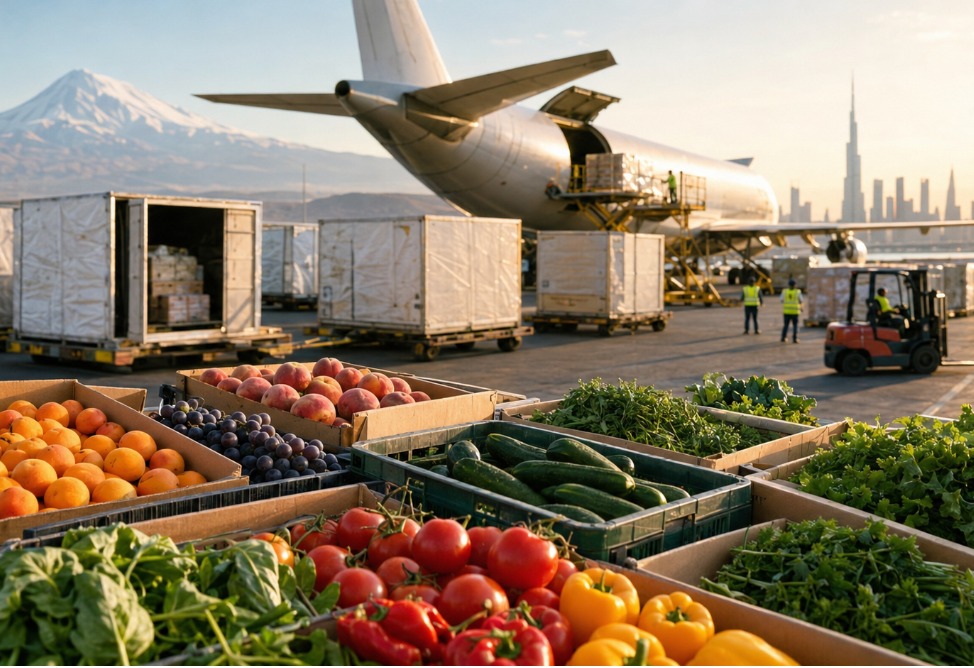
The new route adds another multi-origin sourcing option for the UAE market. However, a corridor announcement does not replace shipment-level controls. Each consignment remains subject to:
- Product specification and grade approval.
- Phytosanitary and health documentation.
- UAE food-safety and import requirements.
- Suitable packaging and labelling.
- Temperature control from dispatch to delivery.
- Receiving inspection and buyer acceptance.
For exporters, the opportunity is operational rather than purely promotional. Armenian suppliers must demonstrate repeatable grading, packing, loading and documentation performance. UAE buyers require predictable arrival condition, usable shelf life and consistent replenishment.
Africa–Gulf Produce Trade Gains Momentum
The Gulf fresh produce market continues to expand. According to Mordor Intelligence, the GCC fruit and vegetable market is estimated at USD 22.43 billion in 2026 and is projected to reach USD 27.41 billion by 2031.
The UAE is the fastest-growing corner of the GCC market, expanding at approximately 5% annually according to market commentary. The UAE’s role as a logistics, distribution and re-export hub gives exporters access not only to local buyers but also to wider Gulf markets.
Fresh fruits and vegetables are exempt from customs duty in the UAE under the GCC Common Customs Tariff, subject to the correct classification and applicable regulatory controls. Exporters must still complete customs, food-safety, inspection and origin procedures accurately.
The UAE National Food Security Strategy 2051 also targets three to five supply sources for each major food category. This policy direction supports multi-origin procurement and reduces dependence on a single country or route.
East African Origins
Uganda and Kenya offer year-round harvest windows for selected produce and relatively short airfreight runs to Dubai. These origins can support restaurants, supermarkets and distributors requiring frequent replenishment.
Emirates SkyCargo reported moving more than 91,930 tonnes of perishables from Africa in 2024, demonstrating the scale of existing Africa–UAE perishables logistics. The UAE–Kenya CEPA, in place since 2025, provides an additional framework for trade and market access.
The commercial winners will treat Gulf supply as a programme rather than a spot trade. Successful supply requires:
- Consistent grading and pack specifications.
- Pre-dispatch quality control.
- Cold-chain continuity.
- Accurate phytosanitary and commercial documents.
- Confirmed buyer requirements.
- Scheduled replenishment.
- Clear claims and settlement procedures.

A low product price does not create a viable export programme if arrival losses, rejected cartons or documentation delays eliminate the margin. Sourcing, logistics and distribution must be planned together.
Pakistan Exporter Plans September IPO
Pakistan-based SE Fruits and Vegetables Company Limited is planning an initial public offering of approximately USD 6.9 million during September 2026.
The exporter intends to use the proceeds to expand Gulf fruit trade, increase working capital for crop procurement and strengthen processing and cold-chain capacity. Its target markets include the UAE, Oman, Saudi Arabia, Qatar, Bahrain and Kuwait.
The development reflects the strategic importance of Gulf markets for South Asian horticulture exporters. Pakistan’s mangoes, kinnow mandarins and potatoes already have established regional demand. Additional capital can support larger procurement programmes, better post-harvest handling and more reliable export scheduling.
For UAE buyers, this type of investment may expand origin availability. For exporters, it reinforces the need to present a complete commercial profile when approaching a verified buyer for exporters UAE: product, volume, grade, pack size, certificates, loading window, arrival schedule and settlement terms.
Iran Trade Suspension: Compliance Reminder
The UAE suspension of trade, commercial exchanges and financial transactions with Iran remains in effect from 19 August 2026 until further notice, according to reporting from Reuters and other international news sources.
Exporters, importers, distributors and financial institutions must complete compliance checks before accepting any Iranian-origin product, Iran-linked payment, Iranian counterparty or route connected to Iran.
Wholesale markets are continuing to assess alternative origins, including:
- India.
- Egypt.
- Jordan.
- Oman.
- Syria.
These alternatives do not remove the need for sanctions screening, origin verification or legal review. Third-country routing must not be used to disguise a prohibited transaction. UAE buyers should maintain clear records of product origin, seller identity, payment path, shipping documents and final consignee.
Al Aweer Market Updates: 31 August 2026 Benchmarks
The following Al Aweer market updates use the approved My Veg Market reference dated 31 August 2026 for India-origin products.
These are planning benchmarks, not fixed quotations. Actual prices vary according to grade, availability, pack integrity, arrival condition, seasonality, freight, storage, wastage and negotiation. Same-day confirmation is required before commercial commitment.
| Product | Origin | Pack size | Benchmark |
|---|---|---|---|
| Onion | India | 1 kg | AED 2.00 |
| Ginger | India | 3 kg | AED 7.00 |
| Pomegranate | India | 2 kg | AED 13.00 |
| Small onion | India | 3 kg | AED 14.00 |
| Garlic | India | 3 kg | AED 16.00 |
| YB banana | India | 4 kg | AED 16.00 |
| Cluster beans | India | 3 kg | AED 17.00 |
| Ivy gourd | India | 3 kg | AED 18.00 |
| RK banana | India | 4 kg | AED 20.00 |
| Banana leaf | India | 4 kg | AED 24.00 |
| Suran | India | 9 kg | AED 24.00 |
| Amla | India | 3.5 kg | AED 24.00 |
| Green chilli | India | 4.5 kg | AED 26.00 |
| Drumstick | India | 3 kg | AED 30.67 |
| Okra | India | 3 kg | AED 32.00 |
| G9 banana green | India | 13 kg | AED 37.00 |
| Fresh turmeric | India | 3 kg | AED 38.00 |
| G9 banana yellow | India | 13 kg | AED 45.00 |
| Dry coconut | India | 13 kg | AED 48.00 |
The drumstick reference increased to AED 30.67 per 3kg pack, compared with AED 28.00 in the 29 August reference. This movement illustrates why exporters and UAE wholesale buyers must use daily market checks rather than older price assumptions. Most other India-origin lines held steady in the approved reference.
How to Export Food to Dubai: September Checklist
Businesses researching how to export food to Dubai should follow a documented process.
1. Confirm the Product Specification
Define the variety, grade, size, origin, pack format, net weight, quantity, shelf life and temperature requirement.
2. Verify UAE Import Requirements
Check phytosanitary certificates, health certificates, labelling, food-safety rules, customs classification and any product-specific restrictions.
3. Validate the Buyer
Confirm the buyer’s legal identity, receiving location, storage capability, purchase quantity, quality expectations and settlement terms.
4. Calculate the Full Landed Cost
Include product value, packaging, inland transport, freight, insurance, clearance, inspection, storage, delivery, wastage and distribution commission.
5. Inspect Before Loading
Record product condition, carton count, loading temperature, container suitability, seal number, photographs and shipping documents.
6. Select the Commercial Model
Approved exporters can discuss Mayil Global’s 3 percent commission distributor UAE model or an immediate cash-and-carry container purchase.
7. Coordinate Arrival and Distribution
Arrange customs clearance, receiving inspection, storage and delivery. Fresh produce requires coordinated logistics because delays directly affect quality and usable shelf life.
Mayil Global: Verified Buyer and 3% Commission Distribution
Mayil Global provides exporters with a structured UAE route for approved fresh produce and food products. The company’s 3% commission distribution model is designed to support buyer coordination, market access, distribution planning and delivery scheduling.
The model is relevant for suppliers of:
- Fresh fruits and vegetables.
- Premium spices.
- Premium rice.
- Farm-fresh eggs.
- Other approved food products.
The commission basis, inspection responsibilities, claims process, settlement schedule and delivery obligations should be defined in the commercial agreement. The 3 percent commission remains a central Mayil Global value proposition for exporters seeking a transparent distribution route.
Exporters requiring faster liquidity can also discuss immediate cash-and-carry container purchases. Purchases remain subject to exporter verification, product approval, documentation, quality inspection, origin confirmation and agreed logistics.
UAE buyers can review Mayil Global’s established export distribution model and contact the company regarding current supply requirements.
Wholesale Supply for UAE Buyers
Mayil Global supplies supermarkets, restaurants, retailers and wholesale distributors across the UAE through farm-direct sourcing and global supplier relationships.
The operating priorities are straightforward:
- Dependable wholesale supply.
- Consistent quality.
- Strict quality control.
- Hygienic handling and packaging.
- Proper storage from farm to market.
- Organized logistics.
- Timely delivery.
- Long-term B2B relationships.
Buyers seeking wholesale supply should provide the product, required volume, preferred origin, pack size, delivery location and delivery frequency. Exporters seeking a verified buyer for exporters UAE should submit product specifications, available quantity, origin documents, loading date, expected arrival and target commercial terms.

Conclusion
The first trading day of September brings additional sourcing capacity through the Armenia–UAE corridor, continued momentum in Africa–Gulf produce trade and stronger investment interest in Pakistan’s fruit-export sector.
At the same time, Iran-related restrictions require immediate compliance controls. Al Aweer benchmarks demonstrate daily price movement, including the drumstick increase to AED 30.67 per 3kg pack. Exporters must plan around verified demand, not assumed quotations.
Mayil Global provides a reliable UAE wholesale channel, a transparent 3 percent commission distributor UAE model and immediate cash-and-carry container purchase opportunities for approved shipments. Sourcing, quality control, hygiene, storage and distribution remain the foundation of dependable supply.
Contact Mayil Global to discuss export distribution, wholesale food supply or verified buyer opportunities in the UAE.
Disclaimer
Al Aweer figures in this article are indicative India-origin planning benchmarks based on the approved My Veg Market reference dated 31 August 2026. They are not fixed offers, guaranteed prices or binding quotations. Actual prices vary according to grade, quality, origin, packaging, availability, timing, logistics and negotiation.
Exporters must independently confirm UAE import requirements, customs treatment, certificates, route availability and trade restrictions before dispatch. Iranian-origin products, related payments and connected routes require formal compliance confirmation while the UAE suspension remains in effect.
Sources
- Armenia plans fresh-produce exports to the UAE
- FreshPlaza: Armenia to start exporting fruit and vegetables to the UAE
- Mordor Intelligence: GCC fruits and vegetables market
- Emirates SkyCargo perishables activity from Africa
- Pakistan exporter plans USD 6.9 million IPO
- Reuters: UAE suspension of Iran trade and financial transactions
- My Veg Market Al Aweer price reference
- Mayil Global export distribution and cash-and-carry model
- Mayil Global contact page