

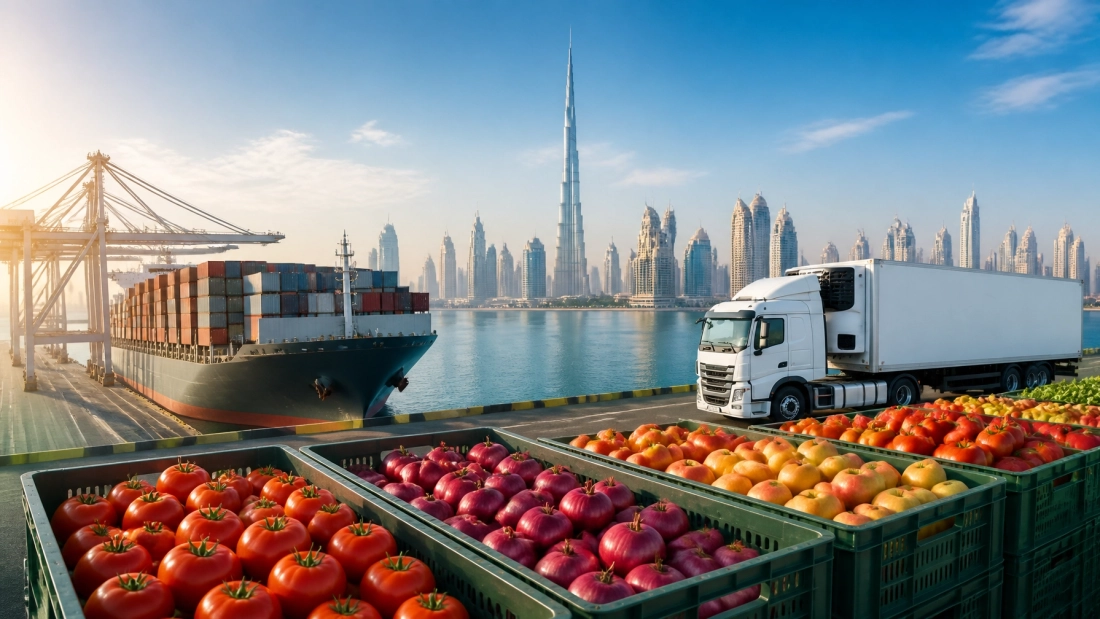
The United Arab Emirates represents one of the most sophisticated and lucrative food markets globally. As a central hub for the Middle East and North Africa (MENA) region, Dubai serves as the primary gateway for international food exporters. However, navigating the regulatory landscape, managing cold-chain logistics, and securing a reliable buyer require a strategic approach.
For global exporters looking at how to export food to dubai, success depends on more than just high-quality produce. It requires a partner who understands the local market dynamics, particularly the pricing structures within the Al Aweer Central Fruit & Vegetable Market. At Mayil Global, we facilitate this transition by offering a competitive 3% commission-based distribution model and immediate cash-and-carry purchasing options for containers.
Step 1: Establish Regulatory Compliance and Product Registration
The first and most critical stage of exporting food to the UAE is ensuring full compliance with federal and local regulations. The UAE Ministry of Industry and Advanced Technology (MoIAT) and the Dubai Municipality oversee all food imports to ensure public safety and quality standards.
Mandatory Registration via FIRS
Every food item entering Dubai must be registered through the Food Import and Re-export System (FIRS), managed by Dubai Municipality. This digital portal tracks every SKU, requiring detailed information including:
- Product brand and name.
- Detailed list of ingredients.
- Country of origin.
- Shelf life and storage requirements.
- Label artwork (must be in Arabic and English).
Exporters must ensure that their local partner or importer is a registered food establishment with a valid trade license. Mayil Global maintains rigorous adherence to these standards, ensuring that all wholesale fruits and vegetables dubai arrivals meet the necessary health and safety benchmarks before reaching the market floor.
Labeling and Certification
Food labels must be clear, non-erasable, and contain specific data including production and expiry dates. For certain products, Halal certification from a MOIAT-approved body is mandatory. Failure to provide accurate documentation: including the Phytosanitary Certificate and Certificate of Origin: can lead to shipment delays or rejection at the port of entry.
Step 2: Optimize Quality Control and Packaging for Perishables
In the competitive landscape of the UAE, quality is the primary differentiator. This is particularly true when importing onions dubai or other high-volume commodities where visual appeal and shelf stability dictate the final sale price.

Adhering to International Standards
Maintaining a consistent supply chain requires strict quality control at the source. At Mayil Global, we emphasize farm-direct sourcing and inspection at every stage. Exporters must prioritize:
- Pre-cooling: Removing field heat immediately after harvest to extend shelf life.
- Grading: Ensuring uniform size and color according to UAE market preferences.
- Packaging: Utilizing export-grade crates or mesh bags that allow for proper ventilation during transit.
When exporting onions, for example, the moisture content and skin integrity must be monitored to withstand the shipping duration to Jebel Ali Port. Poor packaging leads to high wastage, which directly impacts the net return in the Al Aweer market.
Step 3: Managing Logistics and the Cold Chain
Dubai’s strategic location is supported by world-class infrastructure, specifically Jebel Ali Port and Dubai World Central. However, the "last mile" from the port to the wholesale hub at Al Aweer is where many exporters encounter challenges.

Efficient Supply Chain Distribution
Ensuring timely delivery is non-negotiable. Logistics in the UAE food sector must be organized and efficient. Exporters should utilize refrigerated containers (reefers) equipped with GPS and temperature tracking.
Upon arrival, the consignment must be cleared through customs and the Food Control Department. Working with a distributor like Mayil Global ensures that your goods are moved swiftly from the port to temperature-controlled storage. Our sourcing and logistics division focuses on maintaining the cold chain from farm to market, minimizing the risk of quality claims and ensuring that the produce reaches the buyer in optimal condition.
Step 4: Understanding Financial Models: The 3% Commission Advantage
A common hurdle for international exporters is the cost of distribution within the UAE. Traditionally, commission agents at the Al Aweer market charge a standard 5% to 7% fee to handle and sell goods.
Maximizing Margins with Mayil Global
Mayil Global has disrupted this traditional model by offering a 3% commission-based distribution. This lower overhead allows exporters to retain a larger share of the profits. We handle the sales process, provide transparent reporting based on daily market "guide prices," and ensure that the exporter is compensated fairly.
By choosing the 3% commission strategy, exporters gain access to our extensive network of supermarkets, restaurants, and secondary wholesalers without the heavy financial burden of traditional agents. This model is designed to build long-term relationships based on mutual profitability and trust.

Step 5: Securing a Verified Buyer through Cash & Carry
For many exporters, the primary concern is liquidity. Waiting for produce to sell in a commission-based environment can create cash flow gaps. To address this, Mayil Global offers a Cash & Carry wholesale model.
Immediate Liquidity and Verified Buying
Under this model, we act as the verified buyer, purchasing full containers of fresh produce: such as onions, tomatoes, or fruits: directly from the exporter upon arrival and inspection. This provides the exporter with:
- Immediate payment and cash flow.
- Elimination of market price volatility risks.
- Reduced administrative burden.
This model is particularly attractive for exporters of high-volume items like onions and potatoes. For more details on how this works for specific commodities, see our guide on exporting onions to Dubai.

Conclusion: Partnering for Success in the UAE Market
Exporting food to Dubai is a highly structured process that rewards consistency, quality, and strategic partnership. By following these five steps: ensuring regulatory compliance, maintaining high quality, optimizing logistics, choosing a cost-effective commission model, and securing immediate liquidity: global exporters can establish a permanent and profitable presence in the UAE.
Mayil Global is committed to being the bridge between global farms and UAE markets. Whether you are looking for wholesale vegetables in Dubai or a reliable partner to manage your onion exports, our professional team provides the expertise and infrastructure needed to succeed.
For exporters ready to scale their operations in the Middle East, we invite you to explore our distribution models and join our network of trusted global suppliers. Together, we can ensure a steady, reliable, and high-quality food supply for the UAE's growing demand.