

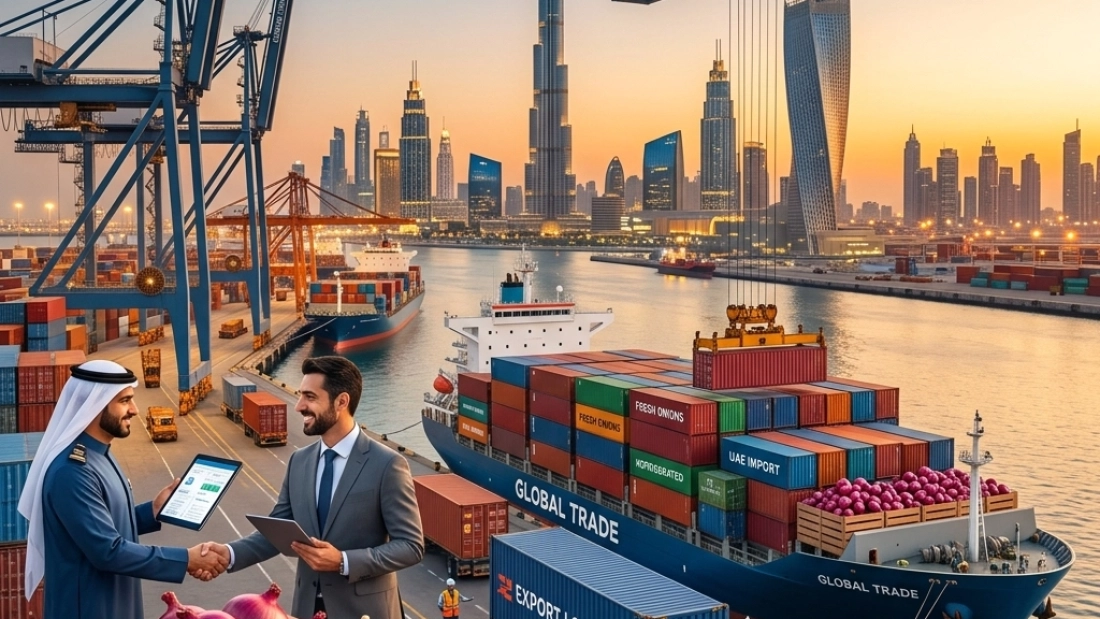
The United Arab Emirates, and Dubai in particular, represents one of the world's most consistent and high-volume markets for fresh produce. For global exporters, the onion trade is a cornerstone of this demand. As a critical ingredient in nearly every regional cuisine, onions are moved in massive quantities through the Al Aweer Fruit & Vegetable Market and Jebel Ali Port daily.
However, entering the Dubai market is not merely about having a quality product; it requires a deep understanding of regulatory compliance, logistics, and financial models that protect your margins. At Mayil Global, we specialize in bridging the gap between international farms and the Dubai wholesale sector. This guide outlines the five essential steps to successfully importing onions to Dubai, highlighting how our 3% commission model and Cash & Carry infrastructure provide a competitive edge for global shippers.
Step 1: Secure a Licensed UAE Importer of Record
The first and most critical hurdle for any exporter is the legal requirement for a UAE-based entity to clear the goods. Foreign companies cannot directly file import declarations with Dubai Customs without a valid local trade license.
To successfully importing onions dubai, you must partner with an established "Importer of Record." This partner must possess:
- A Valid UAE Trade License: Specifically registered for food trading or fruit and vegetable distribution.
- Dubai Customs Importer Code: This code is mandatory for all customs clearance activities.
- Dubai Municipality FIRS Registration: The Food Import & Re-export System (FIRS) is the portal through which all food safety inspections are managed.
Mayil Global operates as a professional distribution partner, offering exporters a transparent gateway into the UAE. By leveraging our established corporate structure, exporters avoid the complexities of setting up local offices while gaining immediate access to the wholesale fruits and vegetables dubai ecosystem.

Step 2: Navigate Regulatory Compliance and MOCCAE Permits
The UAE Ministry of Climate Change and Environment (MOCCAE) maintains strict standards to ensure food security and plant health. Before a single bag of onions is loaded at the origin, the UAE importer must obtain a MOCCAE Import Permit.
Shipping onions without a pre-approved permit is a high-risk strategy that often leads to shipments being held at the port, resulting in demurrage charges and potential spoilage. The regulatory process involves:
- Pesticide Residue Limits (MRLs): Onions must comply with UAE-standard Maximum Residue Limits.
- Country-Specific Protocols: Certain origins may have specific phytosanitary requirements or temporary bans based on seasonal pest outbreaks.
- FIRS Pre-Registration: The shipment details must be uploaded to the Dubai Municipality system before arrival to facilitate a smooth inspection process.
Our team at Mayil Global manages these regulatory hurdles on behalf of our partners. We ensure that all "Verified Buyer" protocols are met, providing exporters with the peace of mind that their cargo will not face unnecessary administrative delays.
Step 3: Standardize Documentation and Packaging for the UAE Market
In the high-stakes world of perishables, documentation errors are the leading cause of financial loss. For those learning how to export food to dubai, the following "Golden Set" of documents is non-negotiable:
- Commercial Invoice: Must clearly state the unit price, total value, and currency.
- Packing List: Detailing the number of bags, net weight, and gross weight.
- Phytosanitary Certificate: Issued by the plant protection authority at the origin, confirming the onions are free from pests like the onion fly or stem nematode.
- Certificate of Origin: Authenticated by the relevant Chamber of Commerce.
- Bill of Lading: Essential for title transfer and customs clearance.
Packaging Specifications:
The Dubai market, particularly the Al Aweer wholesale hub, has specific preferences. Onions should typically be graded (45mm-55mm or larger for catering) and packed in strong mesh or jute bags. Proper curing is essential to prevent sprouting during the sea transit to Jebel Ali. Labels must clearly indicate the product name, country of origin, and the exporter’s details.

Step 4: Execute Logistics and Al Aweer Market Integration
Once the vessel arrives at Jebel Ali, the logistics phase transitions into the "Last Mile" of wholesale distribution. The process involves:
- Customs Clearance: Filing the declaration and paying the 5% import duty (unless exempt under specific trade agreements).
- Municipality Inspection: Food safety officers inspect the cargo for quality, infestation, and labeling compliance.
- Transport to Al Aweer: After clearance, the onions are trucked to the Al Aweer Fruit & Vegetable Market.
This is where Mayil Global’s infrastructure becomes an asset. We don't just clear the goods; we manage the physical movement and storage. Our Cash & Carry wholesale facilities allow for immediate offloading and sales, ensuring that the product reaches the end-buyer while it is still at peak freshness. For exporters, this speed is vital for maintaining the "Daily Liquidity" required to fund the next container.

Step 5: Maximize Margins with the 3% Commission Model
The traditional export-import model often involves multiple middlemen, each taking a significant cut of the profit. In many cases, exporters are charged 10% to 12% in commissions, or are forced to sell at a fixed price that doesn't reflect the daily market highs of Dubai.
Mayil Global has revolutionized this through our 3% Commission Model. This transparent strategy is designed to attract the world's best exporters by ensuring the majority of the profit stays with the producer.
Why the 3% Model Works:
- Transparency: We provide real-time data on market pricing at Al Aweer. You see what the market pays, and we deduct only a 3% service fee for handling, distribution, and sales.
- Market Upside: If onion prices spike in Dubai due to a supply shortage, the exporter gains the full benefit of that price increase.
- Liquidity: Combined with our Cash & Carry model, we ensure fast turnover. We understand that for an exporter, "Cash is King." Our system is built to provide rapid settlements, allowing you to reinvest in your next shipment immediately.

Strategic Advantages of Partnering with Mayil Global
As part of our "Verified Buyer" series, we focus on creating a sustainable supply chain that benefits both the global exporter and the local UAE consumer. By positioning ourselves as a professional distribution hub rather than just a traditional buyer, we offer:
- Supply Chain Stability: We help you navigate the fluctuations of the wholesale fruits and vegetables dubai market.
- Risk Mitigation: Our expertise in Dubai Municipality and Customs regulations reduces the risk of shipment rejections.
- Dedicated Support: From the moment your container leaves the port of origin until the last bag of onions is sold in Dubai, our team provides matter-of-fact, professional updates.
Exporters interested in securing their margins should review our 3% commission strategy explained to understand how we maintain such competitive rates while providing premium service.
Conclusion: Your Gateway to Dubai’s Onion Trade
Importing onions to Dubai is a lucrative venture for those who prioritize professional standards and reliable partnerships. By following these five steps, securing a licensed partner, ensuring regulatory compliance, standardizing documentation, managing logistics, and adopting a high-margin commission model, exporters can build a long-term, profitable presence in the Middle East.
At Mayil Global, our mission is to simplify the complex. We provide the infrastructure, the legal framework, and the market access you need to succeed. Whether you are shipping from India, Pakistan, Egypt, or Europe, our 3% commission model is designed to make you the most competitive player in the Al Aweer market.
For more information on how to start your export journey or to inquire about our current "Verified Buyer" requirements, please visit our contact page or explore our post sitemap for more industry insights. Secure your profits, minimize your risks, and join the Mayil Global distribution network today.