

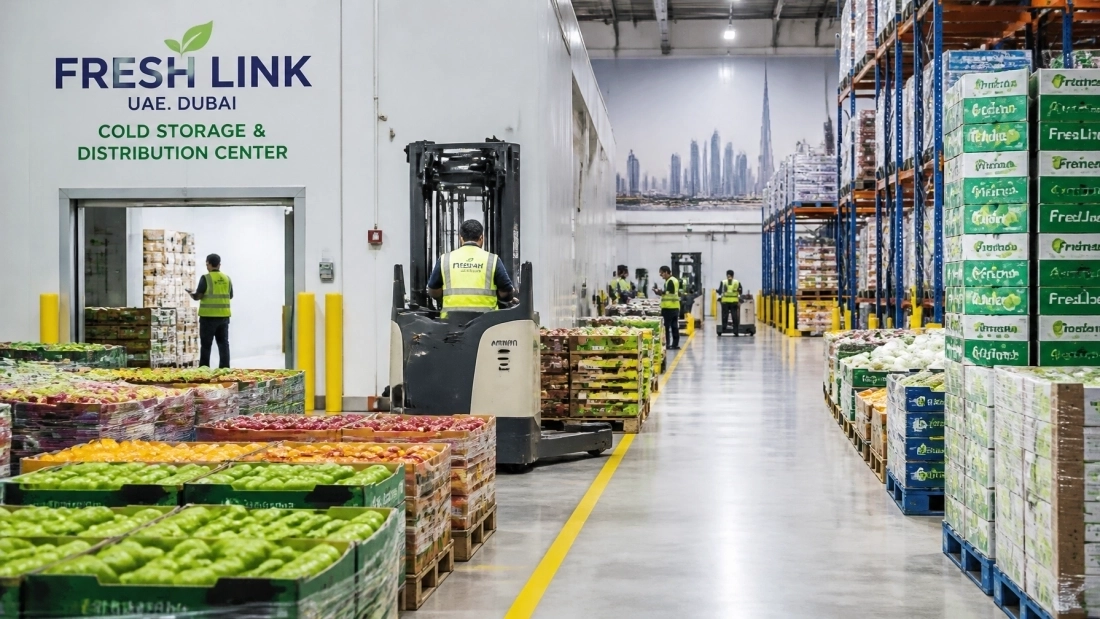
Mid-August presents a practical operating window for international exporters and UAE-based B2B buyers sourcing fresh produce. New-crop Indian onions at Dubai’s Al Aweer Central Market are currently working around an indicative level of AED 1.95 per kilogram, subject to grade, packaging, arrival timing, and daily market conditions.
For exporters, the opportunity is not limited to onions. The wider wholesale fruits and vegetables Dubai market continues to depend on reliable sourcing, accurate documentation, efficient logistics, and rapid distribution. Mayil Global supports international suppliers through a transparent 3% commission distribution model and provides an alternative immediate Cash & Carry container purchase route for suitable shipments.
Mid-August Market Conditions at Al Aweer
Al Aweer Central Market remains a primary wholesale hub for fruits and vegetables entering Dubai and moving into supermarkets, restaurants, retailers, catering companies, and regional distribution channels.
The current onion market provides a useful reference point for shipment planning:
- New-crop Indian onions in 18 kg packaging are trading near AED 1.90–2.00/kg.
- The working market reference is approximately AED 1.95/kg.
- An 18 kg bag represents an indicative wholesale value of approximately AED 34.20–35.10 before quality, handling, transport, and negotiation adjustments.
- Historical price data indicates a much wider range, demonstrating that the current stability is not a guaranteed floor or ceiling.
- Selected fresh produce categories can experience intraday swings of up to 30%, particularly when arrivals, quality, ambient heat, or buyer demand change quickly.
The Al Aweer onion price reference should be used as a market indicator rather than a fixed commercial quotation. Exporters should confirm the final price against the expected arrival date and the actual condition of the shipment.
What the AED 1.95/kg Reference Means
A stabilized benchmark allows exporters to model container economics more effectively. It does not remove market risk.
The final realized value depends on:
- Onion grade, size, origin, and crop.
- Packaging format and net weight accuracy.
- Moisture condition and visible product quality.
- Vessel arrival and customs clearance timing.
- Daily buyer demand at Al Aweer.
- Storage, handling, transportation, and distribution costs.
- The selected commercial model.
Mayil Global’s 3% commission model gives exporters a structured route into the UAE wholesale market. The commission is applied to executed sales under an agreed distribution arrangement. Exporters requiring immediate liquidity can instead request a Cash & Carry container purchase, subject to product, quality, and volume approval.

Importing Onions to Dubai: Timing and Handling Requirements
The timing of importing onions Dubai shipments must be coordinated across sourcing, documentation, vessel schedules, customs clearance, and market placement.
Onions generally require dry handling, suitable ventilation, and protection from condensation. Poor loading conditions can lead to fungal growth, skin deterioration, sprouting, and reduced market value.
Onion Import Checklist
1. Confirm the specification
Before purchase or loading, define:
- Variety and origin.
- Crop and harvest period.
- Bulb size and grade.
- Packaging format, such as 18 kg bags.
- Net and gross weight.
- Target arrival date.
- Required storage and transport conditions.
Clear specifications reduce disputes between exporters, importers, distributors, and final B2B buyers.
2. Inspect before loading
The shipment should be checked for firm bulbs, dry outer skins, acceptable uniformity, and the absence of visible rot, excessive sprouting, fungal growth, or physical damage.
Mayil Global applies quality control across sourcing, handling, storage, and distribution. This approach helps supermarkets, restaurants, and wholesale buyers receive consistent product rather than unmanaged spot cargo.
3. Use suitable packaging and equipment
Breathable mesh bags, ventilated sacks, or other approved packaging can support airflow during transit and storage. The container selection should reflect the route, transit duration, cargo condition, and required environmental control.
4. Plan rapid market placement
Once cleared, onions should move promptly to Al Aweer or directly to an approved B2B buyer. Extended exposure to heat during port handling, truck transfers, or loading dock operations can reduce quality.
How to Export Food to Dubai: The Compliance Sequence
Understanding how to export food to Dubai requires more than booking a container. Exporters must coordinate origin-country requirements with UAE import, customs, food-control, and market-entry procedures.
The exact documentation depends on the product, origin, transport mode, and importer structure. The UAE importer, customs broker, and freight forwarder should confirm the current requirements before shipment.
1. Confirm the UAE importer or distribution partner
International exporters generally require a UAE-licensed importer or local distribution partner to coordinate import procedures, customs clearance, food-control requirements, and final market placement.
The partner should have the appropriate commercial activity, customs capability, and food-import experience. A compliant local structure is essential for entering the wholesale fruits and vegetables Dubai market efficiently.
Mayil Global connects international suppliers with UAE B2B distribution channels and supports market access for fresh fruits, vegetables, premium spices, rice, and farm-fresh eggs.
2. Prepare the export documentation
A fresh produce shipment commonly requires:
- Commercial invoice.
- Detailed packing list.
- Certificate of origin.
- Phytosanitary certificate.
- Health or fitness certificates where applicable.
- Fumigation documentation where required.
- Correct HS classification.
- Bill of lading.
- Container and seal details.
- Net and gross weights.
- Product and packaging specifications.
- Arabic-English labeling information where applicable.
Descriptions should be specific. “Fresh onions, new crop, 18 kg bags” provides better customs and logistics clarity than a general description such as “food products.”
3. Complete FIRS and ZAD requirements
Food importers and applicable products must be registered through the relevant Dubai food-control systems, including FIRS/ZAD requirements where applicable.
Registration details should match the commercial invoice, packing list, certificate of origin, product description, packaging, and declared quantities. Product registration and permit requirements should be completed before the shipment departs.
4. Obtain the required agricultural permits
Agricultural products such as onions may require a UAE import permit and supporting phytosanitary documentation. The importer and exporter must confirm the requirements with the relevant UAE authorities before vessel departure.
Incorrect or incomplete permits can result in clearance delays, additional storage charges, demurrage, inspection issues, or cargo rejection.
5. Submit shipping instructions on time
Shipping Instructions and manifest information should be completed at least 72 hours before vessel departure from the applicable load port, based on the relevant carrier and UAE advance cargo requirements.
The filing should accurately reflect:
- Shipper and consignee.
- Notify party and agent.
- Port of receipt and loading.
- Port of discharge.
- Final delivery location.
- Container and seal numbers.
- Cargo description.
- HS code.
- Package count.
- Net and gross weight.
The UAE advance cargo manifest guidance provides additional background on advance filing procedures.

Moving Produce from Jebel Ali to Al Aweer
Sea freight through Jebel Ali remains the standard route for full-container volumes from major sourcing markets. It supports regular replenishment when vessel schedules, documentation, customs clearance, and delivery planning are coordinated correctly.
The operating sequence is straightforward:
- Confirm buyer demand and product specification.
- Approve the exporter, importer, and distribution structure.
- Complete FIRS/ZAD and permit requirements where applicable.
- Prepare commercial and phytosanitary documentation.
- Submit Shipping Instructions before the 72-hour deadline.
- Load and monitor the container.
- Coordinate customs and food-control clearance.
- Transfer cargo to Al Aweer or directly to approved B2B buyers.
- Complete sales and settlement under the agreed commercial model.
Alternative land corridors through Oman or Saudi Arabia may provide flexibility when sea schedules are unsuitable. These routes require additional planning for cross-border permits, customs declarations, truck authorization, border inspections, and summer heat exposure.
Air freight is more suitable for urgent replenishment, premium produce, smaller volumes, or high-value products that require rapid delivery.
Mayil Global’s 3% Commission Distribution Model
Mayil Global’s 3% commission distributor model is designed for exporters seeking structured UAE market access without building a full local sales and distribution operation.
Under the model, Mayil Global coordinates distribution through suitable UAE B2B channels. The commercial framework can support:
- Supermarkets and retailers.
- Restaurants and catering businesses.
- Wholesale distributors.
- Al Aweer market channels.
- Direct institutional buyers.
- Regional re-export opportunities where appropriate.
The core advantages include:
Transparent commercial structure
A defined 3% commission provides exporters with a clear basis for calculating expected net proceeds. Contractual terms should specify the commission scope, sales reporting, handling costs, quality claims, and treatment of unsold or distressed stock.
Aligned distribution incentives
A commission linked to executed sales aligns the distributor’s activity with market placement, pricing discipline, and timely inventory movement.
Reduced local operating burden
Exporters can use Mayil Global’s local market knowledge, sourcing network, quality-control processes, logistics coordination, and B2B relationships instead of managing each UAE function independently.
Consistent reporting
An effective distribution agreement should provide clear information on quantities received, quantities sold, achieved prices, deductions, and settlement timing.
Immediate Cash & Carry Container Purchases
Some exporters prioritize immediate liquidity over consignment distribution. Mayil Global’s Cash & Carry model provides an alternative for suitable commodities, grades, and container volumes.
A direct container purchase can help exporters:
- Reduce payment-cycle exposure.
- Release working capital for the next shipment.
- Avoid prolonged inventory ownership.
- Simplify the transaction through a direct B2B buyer.
- Transfer market and resale risk after the purchase is completed.
The 3% commission route and Cash & Carry route serve different commercial objectives. Exporters should select the structure based on their cash-flow requirements, risk tolerance, shipment quality, and target market conditions.

Mid-August Export Action Plan
Exporters planning onions or other fresh produce shipments should complete the following actions:
- Confirm product grade, packaging, origin, and target arrival date.
- Review the current Al Aweer market reference near AED 1.95/kg for new-crop onions.
- Allow for daily pricing changes and potential intraday volatility in sensitive produce categories.
- Confirm the UAE importer, buyer, or Mayil Global distribution route.
- Choose the 3% commission model or request an immediate Cash & Carry purchase.
- Complete product registration, permits, certificates, and customs information.
- Submit accurate Shipping Instructions at least 72 hours before departure.
- Protect product quality through dry loading, ventilation, suitable equipment, and monitored handling.
- Arrange customs clearance and final delivery before the container arrives.
- Confirm settlement terms and reporting requirements in writing.
For additional guidance, review Mayil Global’s food export guide, onion export model, products and supply categories, and sourcing and logistics capabilities.
Conclusion: Converting Mid-August Supply into Dependable Wholesale Value
The mid-August onion market is providing a more stable working reference near AED 1.95/kg, but exporters must continue to account for daily price movement, product quality, documentation, logistics costs, and summer handling conditions.
Successful wholesale fruits and vegetables Dubai operations depend on disciplined sourcing, verified buyers, strict quality control, compliant import procedures, and organized distribution.
Mayil Global supports these requirements through farm-direct sourcing, hygienic handling, efficient logistics, and a transparent 3% commission distribution model. For exporters requiring immediate liquidity, the Cash & Carry container purchase model offers a direct alternative.
The operating objective remains clear: source consistently, comply accurately, protect product quality, and move every container into the UAE market through a dependable B2B distribution structure. Contact Mayil Global to discuss onion shipments, fresh produce containers, and wholesale distribution requirements in the UAE.