

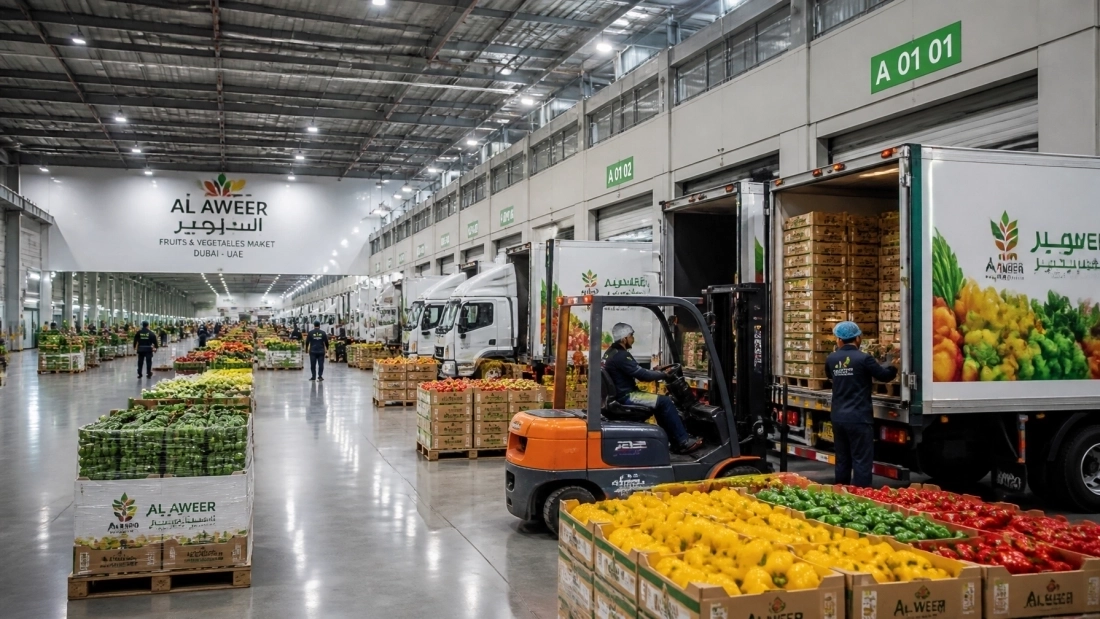
Daily series entry: 21 September 2026
This forward-looking October 10 briefing reviews the latest Al Aweer market movement, current UAE export news, onion procurement conditions, and the compliance requirements exporters must follow when learning how to export food to Dubai.
The 19 September 2026 board reversed part of the sharp correction recorded on 17 September. The market is now showing a clear split: cucumber and leafy vegetables rebounded strongly, selected gourds and ginger remain firm, while several individual specifications continued to weaken.
For international suppliers, the commercial requirement remains unchanged: confirm the product specification, verify the UAE buyer, calculate usable landed cost, and complete regulatory checks before loading. Mayil Global supports qualifying exporters as a verified buyer for exporters in the UAE, using a transparent 3 percent commission distributor UAE model and an immediate cash-and-carry container purchase route.
1. Al Aweer Market Updates: Rebound After the 17 September Correction
The 17 September board recorded 46 gainers and 76 fallers. The correction was particularly severe across cucumbers, cabbage, lettuce, capsicum, cauliflower, garlic, and several onion origins.
The 19 September board recorded a strong technical rebound in several lines:
| Product | 19 September movement |
|---|---|
| Green capsicum | +336.7% |
| Cucumber | +144.0% |
| Cabbage | +130.8% |
| Lettuce | +125.0% |
| Iceberg | +108.5% |
| Green chilli G4 | −30.0% |
| Long brinjal purple | −28.6% |
| Garlic | −12.0% |
| Leaf of arum | −10.5% |
| Strawberry, 10 × 250 gm | −9.1% |
The scale of the rebound indicates that the earlier fall was not uniform across all trade channels. Exporters should not treat the latest increase as a permanent price level. Grade, origin, arrival timing, packaging, and buyer segment continue to determine executable value.
Earlier correction remains relevant
The 17 September board showed:
- Cucumber down 57.1% for Iran and 46.0% for UAE.
- Cabbage down 38.1%.
- Lettuce down 36.8%.
- White cucumber down 36.4%.
- Green capsicum down 33.2%.
- Green chilli G4 down 28.6%.
- Cauliflower down 25.5%.
- Jordan rock melon down 24.4%.
- China normal garlic down 21.9%.
- Indian shallots down 16.6%.
This sequence reinforces the need for daily market intelligence. A product can move from oversupply to shortage quickly when arrivals change or when foodservice and retail buyers replenish inventory.

2. Gourd and Ginger Firmness: Specification Matters
The gourd complex is splitting by specification rather than moving as one category.
On 17 September, Oman-origin:
- Snake gourd increased 33.6% to AED 2.86/kg.
- Ridge gourd increased 24.8% to AED 3.57/kg.
- Wax gourd increased 20.1% to AED 2.57/kg.
- Bottle gourd and bitter gourd declined 12.4% to AED 5.00/kg.
This divergence demonstrates why exporters must present a complete offer. “Gourds” is not a sufficient commercial description. Buyers require variety, size, grade, carton weight, harvest date, origin, and expected arrival condition.
China ginger increased 17.4% to AED 9.64/kg, while Indian garlic increased 4.3% to AED 7.58/kg. Yemen pomegranate increased 23.1% to AED 4.00/kg, and Rwanda Hass avocado increased 4.2% to AED 12.50/kg.
The opportunity for exporters is clear, but market entry depends on consistent sourcing, quality control, hygienic packaging, and organized logistics. These controls protect the buyer’s usable yield and support long-term distribution.
3. UAE Export News: Armenia Opens a 40-Tonne Weekly Produce Corridor
Armenia began exporting fresh fruits and vegetables to the UAE in early September 2026 under a memorandum of understanding signed on 27 August 2026 with Dubai-based digital marketplace Watermelon Ecosystem.
The initial programme provides for up to 40 tonnes per week, with planned increases as the corridor develops. The arrangement creates a new origin option for UAE wholesalers, supermarkets, restaurants, and retailers.
Armenian exporters should prepare offers covering:
- Product and variety.
- Grade and size.
- Carton or crate format.
- Weekly available volume.
- Harvest and packing dates.
- Shelf life at arrival.
- Phytosanitary and health documentation.
- Target arrival date and delivery location.
The programme does not remove the need for a verified local importer. A UAE buyer must confirm the product specification, registration, clearance process, and commercial model before shipment.
The India–UAE APEDA–Gulfood 2027 memorandum also continues to support agricultural export development, including opportunities for Indian producers, MSMEs, and food businesses. Exporters can review relevant trade-fair information through APEDA.
Iran-origin intelligence is not executable
Industry reports indicate that more than 200 containers of Iranian fruits and vegetables have been returned. This figure should be treated as an industry report, not as an official statistic.
Iran-origin lines remain non-executable under the UAE trade suspension effective 19 August 2026. They are for market intelligence only and must not be used for procurement, shipment planning, container budgeting, or executable negotiations.
4. Importing Onions Dubai: Origin Cost Map and Crop Timing
Current reference points for importing onions Dubai include:
| Origin and specification | Indicative reference |
|---|---|
| India new crop, 18 kg | AED 3.35/kg |
| Sudan pink, approximately 50 mm | AED 2.75/kg |
| Egypt, 20 kg PPE bag | AED 2.20/kg |
| Turkey red onion | AED 2.30/kg |
| Yemen onion | AED 2.25/kg |
| Iran | Non-executable |
India’s Maharashtra crop is delayed by approximately one to one-and-a-half months. Only 30–40% of the old Garwa pink crop remains, and only 10–15% of that balance is export-suitable.
Nashik prices have moved from approximately USD 31–42 to USD 42–52 per quintal. The sharpest price window is expected between 25 September and 30 October.
As of this briefing, India has no current onion export ban, minimum export price, or export duty. Exporters should continue monitoring DGFT notifications and applicable quality requirements. APEDA’s fresh onion information provides a useful reference point.
Usable-cost calculation
A nominal product price does not represent the final cost of saleable inventory.
For a 20,000 kg shipment:
- Product cost: 20,000 kg × AED 3.35 = AED 67,000
- Freight, clearance, handling, and other landed costs: AED 38,000
- Total landed cost: AED 105,000
- Arrival loss: 12%
- Saleable quantity: 17,600 kg
- Usable cost: AED 105,000 ÷ 17,600 = AED 5.97 per saleable kg
This method is essential for exporters, wholesalers, and restaurant procurement teams. It accounts for shrinkage instead of comparing origin price directly with a headline wholesale rate.
Diwali falls in November 2026. Buyers should consider forward purchasing three to five weeks ahead for basmati and premium rice, pulses, spices, dates, nuts, premium fruit packs, onions, garlic, and ginger.
5. How to Export Food to Dubai: FIRS, ZAD, and Shelf Life
All food imports must be registered through the federal ZAD platform. For Dubai, every SKU must also be registered with Dubai Municipality’s Food Import and Re-Export System, or FIRS, before arrival. FIRS data feeds into ZAD and must match the physical product, label, invoice, and shipment documentation.
Key requirements include:
- Arabic-English labelling.
- MOCCAE import permits where applicable.
- Phytosanitary certificates for fresh produce.
- Health certificates for relevant food categories.
- Consistent HS codes across documents.
- Commercial invoice and packing list.
- Certificate of origin.
- Bill of lading or airway bill.
- Product, ingredient, allergen, and storage information.
- Correct production and expiry dates.
Imported goods must generally arrive with at least 50% of total shelf life remaining. For highly perishable products with a total shelf life of three months or less, at least two-thirds of the validity period should remain on arrival. Non-compliant consignments are typically rejected.
Mayil Global recommends planning within a 50–70% remaining-shelf-life range, depending on product risk, transport time, inspection, and onward distribution requirements.
Dubai Municipality inspection and sampling at Jebel Ali typically takes two to five working days. Exporters should include this time in the shelf-life and delivery calculation.
A 5% GCC customs duty reference plus VAT should be included in landed-cost planning, subject to classification and applicable exemptions. Qualifying Indian goods may be eligible for zero-duty treatment under India–UAE CEPA, subject to origin rules and documentation.

6. Mayil Global’s 3% Commission and Cash-and-Carry Routes
A Dubai trading house publicly advertises a 5% commission. Mayil Global positions its distribution service at a transparent 3% commission on agreed realised sale value, subject to signed commercial terms.
AED 100,000 settlement illustration
If the agreed realised sale value is AED 100,000:
- Realised sale value: AED 100,000
- Mayil Global commission at 3%: AED 3,000
- Balance before separately agreed costs or adjustments: AED 97,000
This illustration is not a quotation. The final agreement must define product condition, accepted deductions, logistics charges, inspection results, payment timing, and settlement documentation.
Immediate cash-and-carry approval stages
The immediate container purchase route follows six approval stages:
- Exporter offer review: product, origin, volume, grade, packaging, price, and availability.
- Technical and compliance review: certificates, shelf life, HS code, label, and import eligibility.
- Buyer and market validation, confirmed UAE demand and realistic wholesale positioning.
- Pre-shipment inspection: quantity, condition, temperature, packaging, and documentation.
- Commercial approval: written purchase terms, payment structure, and delivery responsibilities.
- Container acceptance and settlement: receiving inspection, acceptance record, and agreed payment release.
7. Exporter Offer Checklist
Exporters should submit the following information in one complete offer:
- Product:
- Origin:
- Variety and grade:
- Size or count:
- Packing format:
- Net weight per carton or bag:
- Available quantity:
- Weekly supply capacity:
- Harvest date:
- Packing date:
- Shelf life at arrival:
- Target arrival date:
- Loading location:
- Incoterm:
- HS code:
- Asking price:
- Certificates available:
- Product photos and inspection report:
- Preferred commercial route: 3% commission or cash-and-carry
Incomplete offers delay buyer verification and commercial approval.
8. UAE Buyer Checklist
Supermarkets, restaurants, retailers, and wholesale distributors should confirm:
- Required product and specification.
- Weekly or monthly volume.
- Acceptable origins.
- Packaging and labelling requirements.
- Delivery location and receiving hours.
- Cold-storage capacity.
- Required shelf life at receipt.
- Payment terms and credit approval.
- Forecast requirements for Diwali and other seasonal demand.
- Whether the requirement is for immediate delivery, forward purchasing, or container-level procurement.
Mayil Global supplies wholesale fruits and vegetables Dubai buyers through farm-direct sourcing, inspection at every stage, hygienic handling, proper storage, and organized distribution.
Data Note and Disclaimer
All Al Aweer prices and percentage movements in this briefing are indicative market references for planning and may change by origin, grade, size, packaging, timing, quantity, and negotiation. The onion usable-cost example is an illustration and does not constitute a quotation.
Armenia’s 40-tonne weekly programme is reported under the 27 August 2026 MoU and may increase as the corridor develops. Reports concerning returned Iranian containers are treated as industry intelligence, not official statistics. Iran-origin lines remain non-executable under the UAE suspension effective 19 August 2026 and must not be used for procurement, shipment planning, container budgeting, or negotiations.
For product sourcing, verified buyer review, the 3% commission distributor UAE model, or immediate cash-and-carry container purchases, contact Mayil Global. Explore Mayil Global products, sourcing and logistics, and the company’s 3% commission distribution model.