

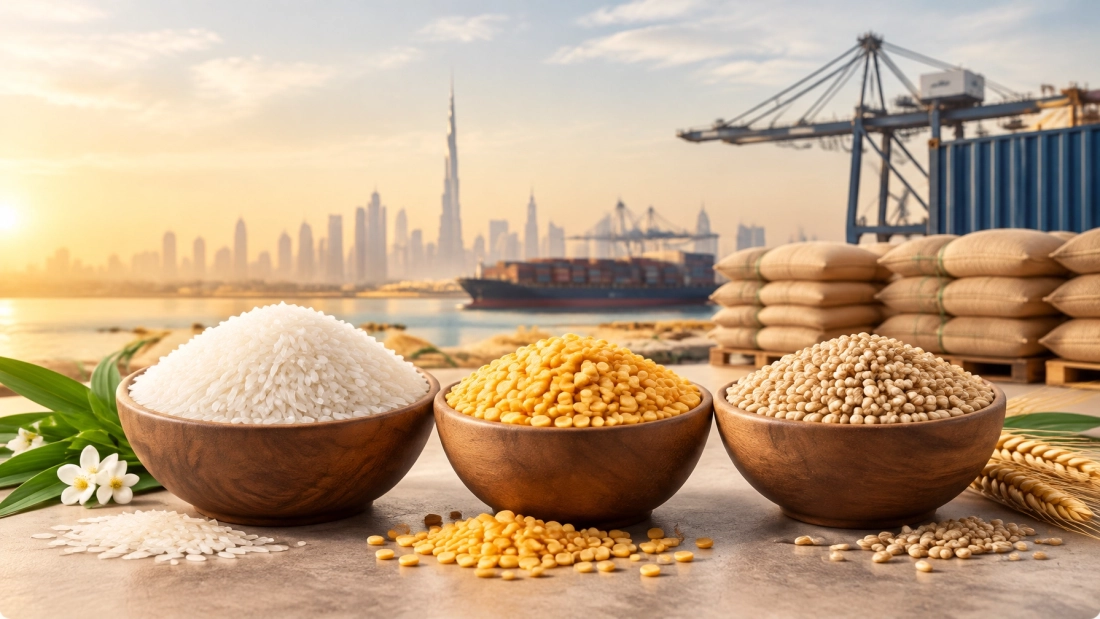
Mayil Global continues its daily Rice, Pulses, and Grains Export Series with 3% Commission Model with a focused guide to exporting Jasmine Rice, Chana Dal, and Barley to Dubai.
Dubai’s wholesale food market requires dependable sourcing, consistent specifications, compliant documentation, and efficient logistics. Exporters also need a reliable local distribution partner that can connect international suppliers with supermarkets, restaurants, retailers, and wholesale distributors.
Mayil Global provides this market-access function through a transparent 3% commission model. The model gives exporters a structured route into the UAE while supporting Dubai-based buyers with consistent quality and organized supply.
The Mayil Global 3% Commission Model
The 3% commission model is designed for exporters that want to access UAE buyers without establishing their own local office, warehouse, or distribution network.
The operating process is straightforward:
- The exporter provides the product specifications, available quantity, packaging details, origin, and shipping schedule.
- Mayil Global reviews the product against current Dubai buyer requirements.
- Quality expectations, commercial terms, delivery responsibilities, and documentation are confirmed.
- Mayil Global connects the exporter with suitable B2B buyers and coordinates local distribution.
- The agreed 3% commission is applied transparently to the transaction, along with any pre-approved local costs.
This structure helps exporters retain greater control over product value. It also reduces the uncertainty created by multiple intermediaries and undisclosed trading margins.
For suppliers searching for a 3 percent commission distributor uae, Mayil Global provides a defined commercial route supported by local market knowledge, wholesale relationships, and organized logistics.
Immediate Cash-and-Carry Container Purchases
Some exporters require immediate liquidity rather than a longer distribution cycle. Mayil Global also supports immediate cash-and-carry container purchases for suitable products and agreed commercial conditions.
This option can help exporters:
- Release working capital more quickly.
- Reinvest in the next shipment.
- Maintain payments to farms, mills, and processors.
- Reduce exposure to delayed settlement.
- Move full-container inventory efficiently.
- Avoid managing secondary distribution in Dubai.
The most suitable structure depends on the product, volume, pricing, documentation, and payment terms. Exporters can discuss either the 3% commission route or a cash-and-carry container transaction with Mayil Global.
Product Focus: Jasmine Rice
Jasmine rice serves Dubai’s retail, foodservice, catering, and wholesale sectors. Buyers generally require dependable aroma, appearance, cooking performance, packaging, and supply continuity.
Before a shipment is offered, exporters should define the product clearly. A Jasmine Rice specification sheet should include:
- Country of origin.
- Variety and grade.
- Grain length and appearance.
- Broken grain percentage.
- Moisture level.
- Foreign matter tolerance.
- Packaging format and bag size.
- Available container quantity.
- Private-label or supplier-branding requirements.
- Shipment readiness and delivery terms.
Supermarkets may require consumer-ready packs, while restaurants, caterers, and wholesale distributors may prefer larger commercial bags. Confirming the intended buyer before packing helps prevent repacking, additional handling, and avoidable cost.
Mayil Global’s role is to align international supply with specific Dubai demand. The 3% commission creates a predictable distribution cost while allowing exporters to maintain visibility over their pricing and product position.

Product Focus: Chana Dal
Chana Dal, also known as split Bengal gram, is used extensively by restaurants, caterers, food manufacturers, supermarkets, and wholesale distributors.
Commercial buyers assess more than price. They require a consistent product that meets agreed standards for cleanliness, size, color, moisture, and cooking performance.
Exporters should prepare details covering:
- Chana Dal variety and country of origin.
- Purity and foreign matter limits.
- Moisture specification.
- Broken, damaged, or discolored kernels.
- Insect damage and infestation controls.
- Packaging format and pallet configuration.
- Shelf life and recommended storage conditions.
- Laboratory reports and supporting certificates.
Mayil Global uses supplier verification and inspection at every stage to establish a clear quality reference before shipment. Samples, product photographs, certificates, and specifications should be reviewed before the container is loaded.
This process supports transparent buying decisions and reduces the risk of disputes after arrival. It also gives Dubai-based businesses a more dependable standard when comparing supply from different origins.
For international pulse exporters, Mayil Global functions as a local market-access partner. For UAE buyers, it provides a structured channel for sourcing Chana Dal through a professional wholesale distribution process.
Product Focus: Barley
Barley may be supplied for human consumption, food processing, or animal feed. The intended use must be established before pricing, documentation, labeling, and shipment planning.
Key specifications may include:
- Barley type and grade.
- Grain size and test weight.
- Moisture level.
- Purity and foreign matter.
- Intended use.
- Packaging requirements.
- Container loading plan.
- Storage and handling conditions.
- Required certificates and laboratory reports.
Food-grade barley and feed-grade barley must not be treated as interchangeable products. The exporter and buyer should confirm the grade, application, label description, and regulatory requirements before the shipment is finalized.
Mayil Global coordinates these details between the supplier and Dubai buyer. This supports accurate procurement for supermarkets, food manufacturers, restaurants, retailers, and wholesale distributors.
Quality Control from Source to Market
Quality control is a non-negotiable part of food distribution. Mayil Global works with trusted farms, mills, processors, and global suppliers to support consistent supply and product integrity.
The process includes five operational stages.
1. Verified Sourcing
Sourcing begins with reviewing the supplier, product origin, production capacity, specifications, and documentation. Farm-direct sourcing and established global supplier relationships help support continuity during changing market conditions.
2. Pre-Shipment Specification Review
The exporter and buyer confirm the exact product, grade, quantity, packaging, and delivery schedule. These details provide a written reference for the shipment.
3. Inspection and Documentation
Inspection is carried out according to the product and transaction requirements. Supporting documentation may include a commercial invoice, packing list, bill of lading, certificate of origin, health certificate, laboratory report, and phytosanitary documentation where applicable.
4. Hygienic Packaging
Rice, pulses, and grains must be packed to protect them from moisture, contamination, damage, and poor handling. Secure packaging also supports efficient loading, storage, and distribution.
5. Storage and Distribution
After arrival in the UAE, proper storage and organized logistics help preserve product condition. Mayil Global’s sourcing and logistics operations are designed to support reliable handling and timely B2B delivery.

Export Documentation and Dubai Compliance
Exporters must confirm all requirements with the UAE importer, relevant authority, and logistics provider before loading the shipment. Requirements can vary according to the product classification, packaging, origin, and intended use.
Standard commercial documentation generally includes:
- Commercial invoice.
- Detailed packing list.
- Certificate of origin.
- Bill of lading or airway bill.
- HS code and product description.
- Import permit where applicable.
- Health or food safety certificate where applicable.
- Phytosanitary documentation where applicable.
- Laboratory or Certificate of Analysis reports.
The UAE import requirements and documentation guide explains the standard trade documentation expected for imports, including food-related certificates.
Packaged products may also require product registration and compliant Arabic and English labeling. Product names, country of origin, net weight, dates, batch information, storage conditions, and importer details should be checked before production.
Exporters researching how to export food to dubai should treat compliance as part of the initial commercial process, not as an activity completed after shipment. Mayil Global’s guide to exporting food to Dubai provides additional guidance on documentation, verified buyers, and market entry.
Benefits for Dubai-Based Wholesale Buyers
The 3% commission structure is also relevant to local UAE buyers. By reducing unnecessary intermediary layers and improving coordination with exporters, it can support competitive supply and better commercial visibility.
Dubai-based supermarkets, restaurants, retailers, and wholesale distributors can benefit from:
- Direct access to international sourcing channels.
- Clear product specifications before purchase.
- Consistent supply of rice, pulses, and grains.
- Hygienic handling and secure packaging.
- Organized storage and delivery.
- Container-volume purchasing options.
- Support for recurring procurement requirements.
- A single B2B distribution contact.
A supermarket may require retail-ready Jasmine Rice. A restaurant may need recurring commercial quantities of Chana Dal. A distributor may require full-container Barley with defined technical specifications. Mayil Global coordinates these requirements through a structured wholesale process.
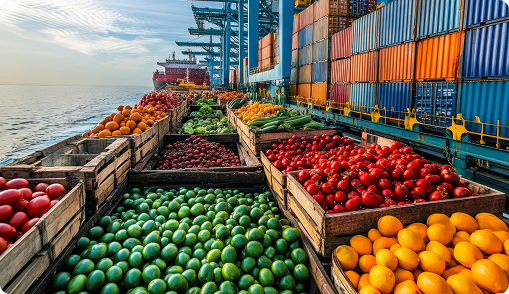
Businesses can review Mayil Global’s product range, which includes quality rice, fresh produce, premium spices, and farm-fresh eggs.
Why Exporters Choose a Verified UAE Distribution Partner
Exporters need more than a buyer introduction. They require market access, specification control, documentation coordination, local distribution, and settlement transparency.
Mayil Global supports exporters as a verified buyer for exporters uae by coordinating with suitable B2B customers and organizing the local distribution process. The company’s extensive sourcing network supports access to international supply while its UAE presence supports market execution.
The 3% commission model is designed for long-term relationships. Exporters can test demand, receive market feedback, and develop repeat business without immediately building their own UAE infrastructure. Buyers receive dependable supply supported by inspection, hygiene, and organized logistics.
Start the Next Shipment
Exporting Jasmine Rice, Chana Dal, and Barley to Dubai requires dependable sourcing, accurate specifications, strict quality control, compliant documentation, and reliable distribution.
Mayil Global combines these functions with a transparent 3% commission model and an option for immediate cash-and-carry container purchases. International exporters gain a clear route to Dubai buyers. UAE supermarkets, restaurants, retailers, and wholesale distributors gain access to a professional food supply partner.
For exporters seeking a 3 percent commission distributor uae, or buyers searching for bulk rice suppliers dubai and a reliable wholesale food buyer dubai, Mayil Global provides dependable supply, consistent quality, and operational clarity.
Contact Mayil Global to discuss Jasmine Rice, Chana Dal, Barley, container availability, quality requirements, and the most suitable distribution model.