


Data Note: The September 15 Reference Dataset
This October 8, 2026 briefing uses Al Aweer board data dated 15 September 2026, board movements recorded between 17 and 19 September 2026, and GCC wholesale intelligence for Weeks 37–38.
All Al Aweer prices are indicative market references. They are not fixed quotations, guaranteed prices, confirmed offers, or binding purchase commitments. Actual transaction values depend on origin, grade, size, packaging, crop condition, moisture, availability, freight, customs, inspection, storage, wastage, shelf life, and negotiation.
Compliance note: Iran-origin lines remain intelligence only and are non-executable under the UAE trade suspension effective 19 August 2026, until UAE authorities formally announce a change. They must not be used for procurement, shipment planning, container budgeting, or executable negotiations.
Global Food Week 2026 Exporter Briefing
Global Food Week 2026 runs from 6–8 October 2026 at ADNEC Centre Abu Dhabi under the theme “Global Partnerships for a Resilient Food Future.” The event is held under the patronage of Sheikh Mansour bin Zayed and brings together agri-producers, manufacturers, distributors, retailers, innovators, investors, and public-sector stakeholders.

For exporters already shipping to Dubai or evaluating the UAE market, the event is a live commercial opportunity to:
- Meet UAE and GCC buyers face-to-face.
- Verify buyer identity, trade licences, and purchasing authority.
- Present compliant product specifications and certificates.
- Discuss volumes, delivery windows, Incoterms, and payment terms.
- Convert market interest into written commercial terms.
Event interest is not a confirmed order. Exporters should arrive with product specifications, certificates, available supply capacity, shelf-life data, inspection records, and a defined commercial offer.
New sectors include animal feed and a dedicated honey exhibition. The Shop at the Show B2C platform also expands the event’s market-facing activity. For B2B exporters, however, the priority remains buyer verification, documentation, supply consistency, and written terms.
UAE Quality and Food Security Shift
The UAE is accelerating efforts to take national products to international markets. At the same time, the National Project for UAE Good Agricultural Practices (UAE GAP) is being reinforced as a domestic quality and food-safety benchmark.
The operating implications for exporters are direct:
- Documented Good Agricultural Practices are increasingly important.
- Farm-level traceability supports repeat programme approval.
- Residue records and input controls must be available.
- Cold-chain procedures should be documented and auditable.
- Product specifications must align with UAE buyer and regulatory requirements.
- Quality claims should be supported by certificates and inspection evidence.
The promotion of UAE products at WorldFood Moscow 2026, including activity supported by Ajman Chamber, reflects the UAE’s broader export orientation. Separately, the AD Ports Group, BUA Group, and MAIR Group MoU explores sugar refining and agro-industrial development at Khalifa Port, including a corridor for grains, pulses, animal feed, and related commodities.
The market is therefore developing in two directions: UAE import demand is diversifying, while quality expectations are rising. Exporters that can provide reliable supply, traceability, residue documentation, and controlled logistics will be better positioned for long-term programmes.
Executive Market Position
Al Aweer remains a major wholesale hub for supermarkets, restaurants, retailers, caterers, and regional distributors.
The latest intelligence shows four operational signals:
- Cucumber and related vegetable lines are firming.
- Ginger is showing selective upward movement by origin.
- White seedless grapes and several onion lines have corrected sharply.
- Indian onion supply requires forward planning because the seasonal supply window remains restricted.
The market should be read by specification rather than by headline movement. Buyers must compare origin, grade, size, packaging, crop condition, freight mode, arrival date, and saleable yield before approving a shipment.
Al Aweer Market Movers
| Category | Product and origin | Movement | Reference |
|---|---|---|---|
| Leading gainer | Cucumber, Iran | +45.9% | AED 1.22 to AED 1.78/kg; non-executable |
| Gainer | Ridge gourd, Oman | +33.6% | AED 2.14 to AED 2.86/kg |
| Gainer | Snake gourd, Oman | +33.6% | AED 2.14 to AED 2.86/kg |
| Gainer | Zucchini, UAE | +28.6% | AED 1.75 to AED 2.25/kg |
| Gainer | Pomegranate, Yemen | +23.1% | AED 3.25 to AED 4.00/kg |
| Gainer | White cucumber, UAE | +20.0% | AED 2.00 to AED 2.40/kg |
| Gainer | Wax gourd, Oman | +20.1% | AED 2.14 to AED 2.57/kg |
| Gainer | Ginger, China | +12.6% | AED 5.71 to AED 6.43/kg |
| Gainer | Ginger, India | +9.2% | AED 3.14 to AED 3.43/kg |
| Leading faller | White seedless grapes | −51.1% | AED 12.86 to AED 6.29/kg |
| Faller | Pomegranate, specification not matched to Yemen line | −22.3% | AED 7.50 to AED 5.83/kg |
| Faller | White onion | −24.8% | AED 1.33 to AED 1.00/kg |
| Faller | Yellow capsicum | −20.0% | AED 6.25 to AED 5.00/kg |
| Faller | Brown/red onion, Iran | −18.0% | AED 2.44 to AED 2.00/kg; non-executable |
| Faller | Brown onion | −11.6% | AED 1.89 to AED 1.67/kg |
Cucumber Recovery Watch
The latest board shows cucumber rising 45.9%, white cucumber rising 20.0%, and zucchini rising 28.6% after a sharp multi-week correction in cucumber and leafy lines.
This is a recovery signal to monitor, not a confirmed trend. Buyers should compare:
- Grade and firmness.
- Size and length.
- Local or imported origin.
- Packing format.
- Harvest and loading date.
- Arrival condition and expected shelf life.
One board movement does not establish a sustained price direction. Mayil Global’s sourcing and quality-control process focuses on specification verification, inspection, hygienic handling, and organised distribution before supply is allocated.
Ginger and Grape Position
Chinese ginger moved from AED 5.71 to AED 6.43/kg, while Indian ginger moved from AED 3.14 to AED 3.43/kg on the cited gainers list. Other Indian ginger references were reported around AED 6.29–6.57/kg, demonstrating the impact of grade, pack, or product line differences.
White seedless grapes corrected from AED 12.86 to AED 6.29/kg. This is a material correction and increases the importance of arrival timing, cold-chain control, and sales allocation. Grape buyers should not compare a premium specification with a lower-grade or different-origin reference.
Importing Onions to Dubai: Origin Comparison and Procurement Playbook
The onion market is the central planning issue for the October supply window.
Maharashtra red onion crop timing has been delayed by approximately one to one-and-a-half months because of weather. Full-scale arrivals are expected only after November. Only 30–40% of the old Garwa pink crop remains, and only 10–15% of that balance is expected to be export-suitable.
Nashik and Maharashtra prices moved from approximately USD 31–42 per quintal last month to USD 42–52 per quintal this month, an increase of approximately 25–30%. The sharpest price window is expected between 25 September and 30 October. If demand exceeds exportable supply, prices could reach approximately USD 84–94 per quintal.
India currently has no onion export ban, minimum export price, or export duty in force. The export duty withdrawn on 1 April 2025 remains a relevant reference, but exporters must continue monitoring India’s DGFT notifications.
Executable Onion Alternatives
- Egypt: The most practical mainstream alternative through October. Stored spring harvests support steady exports. Fresh onions have been quoted around EUR 0.90/kg FOB Cairo.
- Turkey: A viable alternative for red-onion programmes and shorter regional replenishment routes.
- Pakistan: Facing high onion prices and elevated transport costs.
- India: Available, but exposed to crop timing, limited export-suitable balance, and higher procurement risk.
Freight to Oman, Kuwait, Qatar, Bahrain, or the UAE can reach approximately USD 26,000–31,500 per shipment. Freight cost alone does not determine the best origin.
Usable-Cost Method
Usable cost = Total landed cost ÷ Saleable kilograms after arrival
Total landed cost should cover:
- Purchase price.
- Inland transport and export handling.
- Freight, insurance, and customs.
- Port clearance, inspection, storage, and local delivery.
- Trimming, sprouting, moisture loss, rot, and rejected bulbs.
Worked Onion Example
- Quantity: 20,000 kg Indian onions.
- Reference value: AED 3.35/kg.
- Product value: AED 67,000.
- Freight, clearance, handling, and other landed costs: AED 38,000.
- Total landed cost: AED 105,000.
- Arrival losses: 12%.
- Saleable quantity: 17,600 kg.
- Usable cost: AED 105,000 ÷ 17,600 kg = AED 5.97 per saleable kilogram.
This calculation is more useful than comparing the original purchase price with a Dubai board price. Buyers should approve onions against expected saleable yield and confirmed distribution channels.
GCC Wholesale Intelligence: Weeks 37–38
| Product | Indicative wholesale reference |
|---|---|
| Forelle pears | US$26.67–29.33 |
| Vermont Beauty pears | US$24.00–26.13 |
| Philippine bananas | US$13.87 |
| Ecuadorian bananas | US$14.67–15.47 |
| Indian bananas | US$11.47–12.80 |
| Australian carrots | US$15.47–17.33 |
| UAE lemons | US$17.70 |
| UAE Valencias | US$22.88–23.48 |
| Navel oranges | US$21.24–21.79 |
| Nova mandarins | US$10.13–10.67 |
| Nadorcott mandarins | US$16.00–18.67 |
South African citrus remains under pressure from cumulative arrivals and variable transit quality. Jeddah clearance delays are affecting delivery timing, working capital, and landed cost.
Egypt-origin board references include custard apple at AED 13.75/kg, black seedless grapes at AED 8.57/kg, globe seed grapes at AED 6.57/kg, red seedless grapes at AED 7.71/kg, white seedless grapes at AED 7.14/kg, guava at AED 6.00/kg, Keitt mango at AED 6.29/kg, Kent mango at AED 7.14/kg, Egyptian pomegranate at AED 2.57/kg, Valencia oranges at AED 3.27–3.67/kg, and strawberries at AED 22.00/kg.
Africa–Gulf Cold Chain: Testing Commercial Viability
Kenya’s UAE horticultural trade demonstrates the importance of controlled post-harvest logistics. The UAE was Kenya’s third-largest horticultural export destination by value in 2024, accounting for approximately 7.4% of exports. Kenya exported approximately 23,100 tonnes of avocados to the UAE, worth about US$27.7 million. Pineapple exports approached 19,000 tonnes, valued at approximately US$13.1 million.
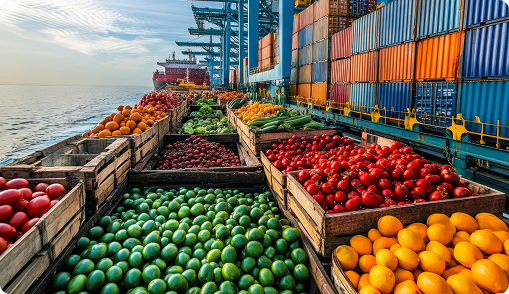
UN estimates place post-harvest food loss in sub-Saharan Africa at approximately 19.95%, the highest regional rate. For selected fresh-produce categories, air freight can represent 30–50% of landed cost, with additional pressure during Ramadan, Eid, and peak horticultural seasons.
The weakest links are usually:
- Farm-level cooling and pre-cooling.
- Road transport and consolidation.
- Airport handling and storage.
- Air freight and Gulf last-mile delivery.
The commercial test is landed cost plus saleable shelf life, not freight price alone. Regional cold-storage collection hubs, refrigerated road transport, shared digital temperature records, and auditable cold-chain procedures improve repeat buying.
Mayil Global’s 3% Commission and Immediate Cash-and-Carry Models
Mayil Global is a verified buyer and distribution partner for exporters supplying the UAE. It also operates as a wholesale supplier for UAE supermarkets, restaurants, retailers, and distributors.
Under the approved 3% commission distributor UAE model, Mayil Global applies a transparent 3% commission on the agreed realised sale value, subject to a written agreement.
The agreement should define:
- Product and specification.
- Buyer and sales channel.
- Agreed sale value.
- Inspection and receiving responsibility.
- Delivery and handling responsibility.
- Claims process.
- Settlement timing.
A Dubai trading house publicly advertises a 5% commission model. Mayil Global positions its distributor model at a transparent 3% commission, subject to written commercial terms.
AED 100,000 Realised-Sale Illustration
| Item | Amount |
|---|---|
| Realised sale value | AED 100,000 |
| Mayil Global 3% commission | AED 3,000 |
| Agreed inspection and receiving | AED 1,200 |
| Local delivery and handling | AED 1,800 |
| Clearance and storage | AED 2,500 |
| Approved quality claim or wastage deduction | AED 1,500 |
| Illustrative exporter settlement | AED 90,000 |
Actual deductions, responsibility, claim procedures, supporting documents, and payment timing must be stated in the signed agreement.
Immediate Cash-and-Carry Container Purchase
The immediate cash-and-carry option is subject to product verification, buyer approval, specification matching, document review, inspection, arrival condition, and agreed payment terms.
The six-stage approval process is:
- Product submission: Exporter submits product, origin, quantity, price, and loading details.
- Buyer and specification verification: Mayil Global confirms demand, buyer identity, grade, size, packing, and route.
- Document review: Certificates, invoice details, HS code, and import requirements are checked.
- Pre-loading inspection: Product condition, quantity, packaging, moisture, and batch details are inspected.
- Arrival and receiving: Shipment is inspected on arrival and received through an organised UAE supply chain.
- Settlement: Payment and any agreed deductions are processed according to the signed terms.
Cash-and-carry does not remove customs, food-safety, labelling, product-registration, inspection, or import-permit requirements.
How to Export Food to Dubai: Nine Compliance Steps
-
Register the UAE importer. Confirm that the UAE importer holds a valid trade licence covering the relevant food activity and has approved premises for storage and handling.
-
Register products through ZAD and Dubai Municipality FIRS. Product registration must be completed before port clearance and sale. There is no general category exemption. The applicable federal and emirate-level systems must be verified before shipment.
-
Prepare Arabic-English labels. Labels should show product identity, country of origin, net weight, production and expiry dates, storage conditions, ingredients where applicable, and required declarations.
-
Protect remaining shelf life. Target approximately 50–70% remaining shelf life on arrival, subject to product category, buyer specification, transport mode, and UAE requirements.
-
Obtain certificates and permits. Obtain phytosanitary certificates for applicable plant products and health certificates for applicable food consignments. Confirm any required MOCCAE import permits before loading.
-
Use consistent customs information. Apply the same HS code across the commercial invoice, packing list, and customs declaration. Use the general 5% GCC customs duty reference plus VAT while verifying the exact tariff treatment. For qualifying Indian goods, assess India-UAE CEPA zero-duty eligibility using the applicable rules of origin and a valid CEPA Certificate of Origin.
-
Complete pre-shipment inspection. Retain photographs, batch details, inspection records, product specifications, and temperature records.
-
Plan for Dubai Municipality inspection. Sampling and testing at Jebel Ali may typically require 2–5 working days. Storage and demurrage can accrue during inspection or document delays.
-
Clear, store, and distribute hygienically. Products must move through an organised UAE supply chain with suitable storage, hygienic handling, and controlled local delivery.
Standard Exporter Offer Structure
Each exporter submission should include:
- Product and variety.
- Country and region of origin.
- Grade, size, and tolerance.
- Crop or production date.
- Quantity and container type.
- Packaging and net weight.
- Incoterm and loading location.
- Freight mode and estimated arrival.
- Remaining shelf life.
- Certificates and HS code.
- Target price and payment terms.
- Preferred route: 3% commission distribution or immediate cash-and-carry purchase.
Fill-In Exporter Checklist
- Product:
- Variety:
- Origin and production region:
- Grade and size:
- Acceptable tolerance:
- Crop or production date:
- Available quantity:
- Container type:
- Packaging and net weight:
- Loading location:
- Earliest loading date:
- Freight mode:
- Estimated arrival:
- Remaining shelf life:
- Certificates available:
- HS code:
- Target price:
- Payment terms:
- Preferred route:
- Pre-loading inspection availability:
- Contact and company registration details:
UAE Buyer Checklist
- Confirm origin, grade, size, packaging, and arrival condition.
- Compare executable origins only.
- Calculate full landed cost and expected wastage.
- Confirm product registration and required certificates.
- Verify delivery frequency and receiving capacity.
- Use written specifications for recurring supply.
- Maintain alternative origins for essential products.
- Confirm inspection, claims, and settlement procedures.
- Work with a supplier that provides quality control, hygienic handling, and organised logistics.
Gulfood 2027 Opportunity Note
Gulfood 2027 is scheduled for 15–19 March 2027. India has been confirmed as the Official Partner Country for a second consecutive year following the APEDA–InD Events MoU.
The programme is expected to focus on MSMEs, Farmer Producer Organisations, startups, commodity boards, and government institutions. This is an opportunity for exporters to build buyer relationships and present compliant supply programmes. It is not a confirmed order, guaranteed market allocation, or binding purchase commitment.
Mayil Global Wholesale Supply
Mayil Global supplies fresh fruits, vegetables, premium spices, quality rice, and farm-fresh eggs to supermarkets, restaurants, retailers, and wholesale distributors in the UAE.
The company supports dependable supply through farm-direct sourcing, trusted global suppliers, inspection at every stage, hygienic packaging, appropriate storage, and organised logistics.
Review the Mayil Global product range, sourcing and logistics process, or contact Mayil Global to discuss verified buyer access, 3% commission distribution, immediate cash-and-carry container purchases, or wholesale supply in the UAE.
Conclusion
The October 8 market position shows firmness in cucumber, related vegetable lines, and selected ginger references, while grapes, capsicum, and onion lines have corrected or remain exposed to specification and seasonal risk.
For onion buyers, the priority is usable cost, not purchase price alone. For exporters, the priority is verified demand, complete documentation, inspection, shelf-life protection, and written commercial terms.
Global Food Week 2026 provides a timely platform for exporters to meet UAE buyers, but event interest must be converted into verified specifications and documented commitments. The UAE GAP quality shift further demonstrates that traceability, food safety, residue records, and auditable cold-chain performance are becoming core requirements for repeat business.
Mayil Global supports exporters through a transparent 3% commission distribution model and approved immediate cash-and-carry container purchases, while supplying UAE B2B buyers through controlled sourcing, quality control, hygienic handling, and organised distribution.
Sources
- Al Aweer Prices Board
- Al Aweer Movers
- Al Aweer Onion Price References
- Al Aweer Cucumber Price References
- Al Aweer Egypt-Origin References
- Dubai Municipality: Food Traders and Establishments
- MOCCAE Import Permit Services
- Global Food Week 2026 Official Site
- Abu Dhabi Media Office: Global Food Week 2026
- WAM: Global Food Week 2026 Registration
- AD Ports Group, BUA Group and MAIR Group MoU
- UAE Trade Regulations, Trade.gov
- Mayil Global Products
- Mayil Global Sourcing and Logistics
- Mayil Global Contact
Disclaimer: All Al Aweer prices and GCC wholesale references are indicative, non-binding market references and not fixed quotations, guaranteed prices, confirmed offers, or binding purchase commitments. Actual transaction values depend on origin, grade, size, packaging, crop condition, moisture, availability, freight, customs, inspection, storage, wastage, shelf life, and negotiation. Iran-origin lines are intelligence only and non-executable under the UAE trade suspension effective 19 August 2026 until UAE authorities formally announce a change. Exporters and buyers must verify current registration requirements, ZAD and FIRS status, certificates, phytosanitary and health requirements, customs treatment, VAT, HS codes, CEPA eligibility, import permits, product labels, demurrage exposure, and all commercial terms before shipping or purchasing.