

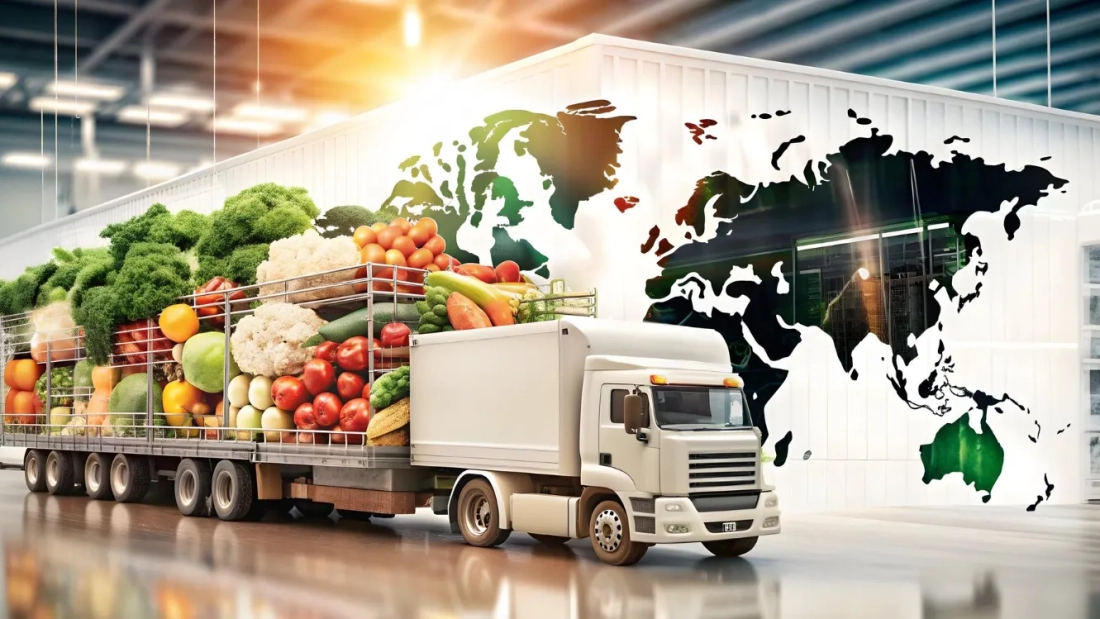
October is a critical shipping window for exporters entering Dubai. Q4 demand increases across supermarkets, restaurants, retailers and wholesale distributors, while procurement teams assess supply reliability for the coming season. Exporters planning shipments into the UAE should therefore compare their container economics against current Al Aweer market references before committing cargo.
This guide explains how to export food to Dubai using five practical Al Aweer benchmark checks, a pre-shipment compliance checklist and two commercial routes available through Mayil Global.
Planning note: The prices below are indicative wholesale references based on the latest available August–September 2026 Al Aweer data. They are not fixed offers, confirmed purchase prices or guaranteed October quotations. Actual prices vary by grade, pack size, origin, timing, freight, quality and market demand.
UAE Trade Context: Diversification Is Increasing
The UAE continues to operate as a major food import and re-export hub. Non-oil foreign trade reached approximately AED 1.9 trillion in the first half of 2026, according to reported government figures. This scale is supporting broader sourcing diversification across Asia, Africa, Europe and the Americas.
The UAE’s trade relationship with Armenia has expanded significantly, creating a growing Eurasian corridor for agricultural and food-related trade. Honduras is also being assessed by international suppliers as a potential Latin American corridor, although exporters should verify product-specific demand, logistics feasibility and buyer requirements before treating it as an established route.
The 19 August 2026 UAE Ministry of Foreign Affairs announcement stating that all trade, commercial exchanges and financial transactions with Iran are halted until further notice has also changed procurement planning. All Iran-origin price lines must now be treated as non-executable market intelligence only. Exporters should not base October shipments on Iran-origin products without formal legal and compliance clearance.
These developments are central to current UAE export news and ongoing Al Aweer market updates. They will also influence sourcing conversations ahead of Gulfood 2027.
Five Al Aweer Checks Before You Ship
1. Map the onion origin cost before importing onions to Dubai
Onions are an important reference product because Al Aweer receives multiple origins and pack formats at the same time. Before shipping, compare your proposed cost with the following indicative mid-September planning references:
| Origin | Indicative specification | Logistics reference | Indicative Al Aweer price |
|---|---|---|---|
| Egypt | 20 kg PPE bag | Sea | AED 2.15/kg |
| Yemen | Mesh, approximately 1 kg | Road | AED 2.50/kg |
| Turkey | Red onion | Road | AED 2.25/kg |
| India new crop | 18 kg pack | Sea | AED 3.60–3.80/kg |
| Sudan | Pink onion, approximately 50 mm | Road | AED 3.10–3.20/kg |
| Iran | White onion reference | Sea | Non-executable |
The current cost map shows that India new-crop onions can command a premium against mainstream Egyptian, Yemeni and Turkish lines. Sudanese pink onions also occupy a specification-led segment where colour and size affect the price.
For exporters, the correct comparison is not simply FOB price versus Al Aweer price. Include ocean freight, port charges, customs duty, inland transport, inspection, wastage and financing costs. A lower origin price does not necessarily produce the lowest landed cost.
The latest Al Aweer onion reference data should be reviewed alongside a confirmed specification and arrival date. Iran-origin onion lines must be excluded from executable October planning because of the trade suspension.
2. Test cucumber against short shelf-life risk
Cucumber requires a different calculation from onions. It is a short-shelf-life product, and the commercial result depends on transit time, temperature control, arrival condition and sell-through speed.
Recent Al Aweer references include:
- UAE cucumber in carton format: approximately AED 1.75/kg
- Reported working average: approximately AED 2.26/kg
- Observed range: approximately AED 1.47–3.90/kg
- Reference benchmark on 28 August: approximately AED 2.78/kg
These figures should be used to establish a maximum landed-cost threshold. The exporter should calculate:
Expected Al Aweer realization – freight – clearance – handling – expected shrink = acceptable shipment cost
A cucumber container that arrives two or three days late can lose value even when the original purchase price is competitive. Confirm the receiving schedule with a verified buyer of that particular product, rather than simply asking whether there is a buyer in Dubai.
For short-shelf-life lines, Mayil Global’s sourcing and logistics process focuses on inspection, hygienic handling, storage coordination and timely distribution to UAE B2B customers.
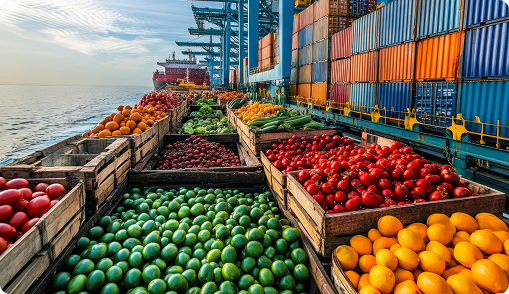
3. Compare garlic and ginger by pack format, not only by kilogram
Garlic and ginger prices can appear competitive until pack size, grade and origin are normalized. Exporters should compare the product on a per-kilogram basis and confirm whether the UAE buyer requires mesh bags, cartons, loose bulk or retail-ready packaging.
Indicative references include:
- Garlic, 3 kg pack: approximately AED 16 per pack, or AED 5.33/kg
- China normal garlic: approximately AED 3.57–4.64/kg
- China pure white garlic: approximately AED 5.00–5.71/kg
- India garlic: approximately AED 6.06–6.67/kg
- Ginger, 3 kg pack: approximately AED 7 per pack, or AED 2.33/kg
- India ginger: approximately AED 3.14/kg
- China ginger: approximately AED 4.64–5.71/kg
- Selected 4 kg ginger packs: approximately AED 30–34 per pack, or AED 7.50–8.50/kg
The spread reflects origin, visual quality, moisture, size, curing, packaging and buyer segment. A restaurant supply buyer may prioritize a consistent food-service pack, while a supermarket may require barcode-ready cartons and a stronger presentation standard.
Before shipping, confirm the following:
- Net weight per pack.
- Number of packs per carton or pallet.
- Grade and size specification.
- Required country-of-origin marking.
- Moisture and storage requirements.
- The verified buyer of that particular product and pack.
4. Separate banana origin from brand tier
Bananas illustrate why origin and brand tier must be evaluated separately. Indian G9 bananas and branded Ecuadorian Cavendish lines do not compete on identical commercial terms.
Recent indicative references include:
- Indian G9 green banana, 13 kg bag: approximately AED 37, or AED 2.85/kg
- Indian G9 yellow banana, 13 kg bag: approximately AED 45, or AED 3.46/kg
- YB banana, 4 kg pack: approximately AED 16, or AED 4.00/kg
- Branded Ecuadorian bananas: approximately AED 6.15–6.69/kg, depending on brand
Premium brands such as Dole, Del Monte and other branded lines may achieve higher wholesale values because of brand recognition, ripening consistency, carton presentation and established supermarket demand. However, the higher market reference also comes with stricter expectations around quality, packaging, ripeness and supply continuity.
Exporters should identify whether the target channel is:
- Commodity wholesale.
- Restaurant and catering supply.
- Supermarket private label.
- Branded retail distribution.
- Re-export to another GCC market.
This distinction is important for both wholesale fruits and vegetables Dubai procurement and October container planning.
5. Calculate the airfreight-versus-local supply spread
Airfreight should be treated as a product-specific supply solution, not a general alternative to sea freight. It can be appropriate for high-value, highly perishable or shortage-sensitive products. It is usually unsuitable for low-margin commodities unless the local market spread supports the additional cost.
The current Al Aweer data provides local comparison points, including:
- Cucumber average: approximately AED 2.26/kg
- Cucumber reference range: approximately AED 1.47–3.90/kg
- Indian G9 banana: approximately AED 2.85–3.46/kg
- Premium branded bananas: approximately AED 6.15–6.69/kg
No single published airfreight rate should be assumed for October. Obtain a product-specific quote and compare:
Airfreight landed cost + clearance + handling + shrink
against
Al Aweer local replacement cost and expected B2B selling value
This check is especially relevant for exporters of specialty fruits, premium herbs, urgent replenishment lines and selected high-value food products. It is less likely to work for standard onions, bulk rice or routine vegetables unless there is a temporary supply gap.
Pre-Shipment Checklist for Dubai
Before loading a container, exporters and their UAE partners should verify the following:
- Product registration: Confirm that each SKU is registered through Dubai Municipality’s Food Import and Re-Export System, or FIRS, with the federal ZAD food product data system where applicable.
- Arabic labelling panel: Ensure the label includes equivalent Arabic information for the product name, ingredients, net weight, origin, dates, storage conditions, allergens, batch details and importer information.
- Remaining shelf life: Plan for approximately 50–70% of declared shelf life remaining on arrival, depending on the product category and applicable UAE or GCC standard. Confirm the exact requirement before production.
- Certificates: Arrange health or sanitary certificates for applicable food products and phytosanitary certificates for fresh fruits, vegetables, grains and other plant products.
- HS codes: Confirm the correct HS classification before preparing the commercial invoice, packing list and customs declaration.
- Duty and VAT: Budget for approximately 5% GCC customs duty plus 5% UAE VAT, subject to the exact product, HS code, origin and applicable exemptions.
- Quality documentation: Maintain inspection records, packing specifications, certificates of analysis where relevant and traceability information.
- Buyer confirmation: Secure a verified buyer of that particular product, origin, grade and pack format before dispatch.
Dubai Municipality’s food safety work emphasizes laboratory testing, regulatory oversight and international safety standards. Exporters should review the authority’s food safety resources and coordinate with a licensed customs broker.
Mayil Global’s Two Commercial Routes
Route 1: The 3 percent commission distributor UAE model
Mayil Global provides a transparent 3 percent commission distributor UAE route for exporters that want market access, distribution support and local B2B sales coordination without a high traditional brokerage margin.
Illustrative calculation:
- Gross sale value of container: AED 100,000
- Mayil Global commission at 3%: AED 3,000
- Balance to exporter before agreed recoverable costs and taxes: AED 97,000
The calculation is illustrative. The final agreement should define the commission base, approved expenses, inspection terms, settlement timing, documentation and responsibility for logistics.
This model is suitable for exporters seeking a verified buyer for exporters UAE and wanting to build repeat distribution rather than complete a single spot transaction. Mayil Global supports market placement, sales facilitation, quality control, regulatory coordination and distribution across supermarkets, restaurants and wholesale channels.
Route 2: Immediate cash-and-carry container purchase
The second route is an immediate cash-and-carry container purchase, subject to product acceptance, inspection, compliance and agreed valuation.
The operating process is straightforward:
- Coordinate arrival and movement from the port.
- Inspect the container for quality, quantity, packaging and compliance.
- Establish a market-based valuation.
- Complete the purchase and immediate settlement according to the agreed terms.
The cash-and-carry food wholesale Dubai model is designed for exporters that prioritize liquidity and do not want to wait through extended credit cycles. It can support reinvestment in the next harvest, production run or container.

Final Shipping Decision
The October shipping window should be managed through verified market data, not general demand assumptions. Compare origin cost, pack format, shelf life, freight mode, buyer specification and expected Al Aweer realization before loading.
For exporters of onions, garlic, ginger, bananas, fresh vegetables, premium spices and rice, Mayil Global combines sourcing, quality control, hygienic handling, logistics and B2B distribution. Exporters can choose the transparent 3% commission route or the immediate cash-and-carry container purchase route, depending on their working-capital and market-access requirements.
The objective remains consistent: delivering dependable supply, consistent quality and commercially clear distribution for UAE buyers and international exporters.
For products including fresh produce and premium food products, contact Mayil Global with the product, origin, pack size, volume, shipment window and preferred commercial route.