

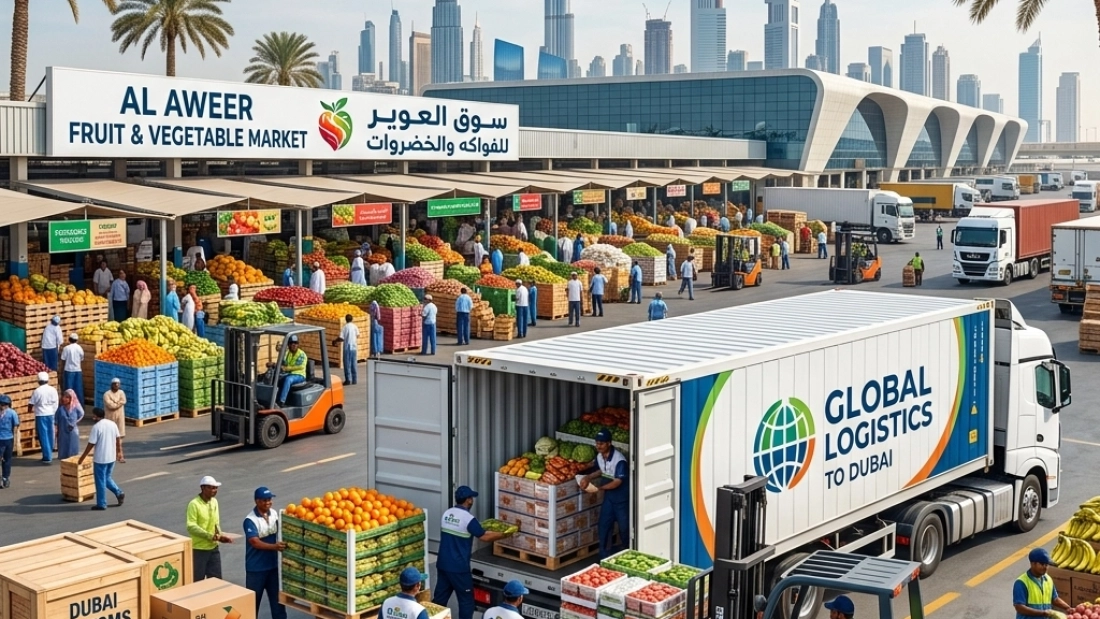
Dubai has established itself as the premier global gateway for the food trade, serving not only the growing domestic demand of the United Arab Emirates but also acting as a re-export powerhouse for the GCC, Africa, and the Indian subcontinent. For international exporters, the Al Aweer Fruits and Vegetables Market (also known as the Ras Al Khor Market) is the epicentre of this trade. Navigating this landscape requires more than just high-quality produce; it demands a deep understanding of local regulations, logistics, and, most importantly, a strategic partnership with a reliable distributor.
At Mayil Global, we specialize in bridging the gap between global suppliers and the Dubai market. By leveraging our innovative 3% commission model and our robust Cash & Carry wholesale infrastructure, we provide exporters with the transparency and liquidity needed to scale operations in the UAE.
Navigating the Dubai Food Market: A Strategic Overview
The UAE imports approximately 80% to 90% of its food requirements. This dependency creates a massive opportunity for global exporters. However, the market is highly competitive and quality-sensitive. Understanding how to export food to dubai begins with recognizing that the market is segmented into high-end retail, HORECA (Hotels, Restaurants, and Catering), and the massive wholesale volume handled through Al Aweer.
Al Aweer is designed for high turnover. It is a fast-moving environment where price discovery happens daily based on supply arrival and product quality. To succeed here, exporters must move beyond the traditional "ship and pray" mentality and adopt a data-driven approach to sourcing and logistics.

Understanding Regulatory Requirements for UAE Imports
Compliance is the foundation of a successful export business. The Dubai Municipality (DM) and the Ministry of Climate Change and Environment (MOCCAE) maintain rigorous standards to ensure food safety and security.
1. Product Registration and Labeling
Every packaged food item must be registered through the Dubai Municipality’s "FIRS" (Food Import and Re-export System). Labels must be clear, providing essential information in Arabic (mandatory) and English. This includes:
- Product name and brand.
- Country of origin.
- Ingredients list in descending order.
- Production and expiry dates.
- Net weight and storage conditions.
2. Health and Phytosanitary Certificates
For fresh produce, a Phytosanitary Certificate issued by the competent authority in the exporting country is mandatory. This document certifies that the shipment is free from regulated pests and conforms to the UAE's health standards. For animal-origin products, Halal certification from recognized bodies is non-negotiable.
3. Customs Clearance
Dubai Customs operates with high efficiency. Utilizing a partner who understands sourcing and logistics ensures that your documentation: including the Bill of Lading, Commercial Invoice, Packing List, and Certificate of Origin: is processed without delays that could compromise the shelf life of perishable goods.
The Al Aweer Market: The Pulse of Wholesale Fruits and Vegetables
The Al Aweer market is where the majority of wholesale fruits and vegetables in Dubai are traded. It is a hub characterized by its refrigerated warehouses, auction halls, and specialized loading docks.
Success in Al Aweer depends on two factors: Timing and Quality. The market operates on a 24-hour cycle, with peak trading occurring in the early morning hours. Exporters who can consistently deliver graded, well-packaged produce that survives the journey through the Jebel Ali port or Dubai World Central (DWC) airport will always find a buyer.

Maximizing Profits: The Mayil Global 3% Commission Advantage
The traditional distribution model in Dubai often involves hidden costs, high margins, and delayed payment cycles that stifle an exporter's growth. Mayil Global was founded to disrupt this lack of transparency.
Our 3% commission-based distribution model is designed specifically for high-volume exporters. Instead of taking a large, opaque cut of the sales price, we charge a flat 3% commission on the gross sales value. This ensures:
- Total Transparency: You know exactly what your goods sold for and exactly what our fee is.
- Higher Margins: By reducing intermediary costs, more profit returns to the exporter.
- Aligned Interests: Our goal is to sell your produce at the highest possible market price, as our success is tied directly to yours.
For a detailed breakdown of how this benefits you, read our guide on the 3% commission strategy for daily liquidity.
Liquidity and Scaling: The Cash & Carry Model
One of the biggest hurdles for exporters is the "liquidity gap": the time between shipping the container and receiving payment. In a volatile market like Al Aweer, waiting 30 or 60 days for payment can prevent you from purchasing the next harvest.
Mayil Global addresses this through our Cash & Carry wholesale model. We are active buyers of full container loads. For verified suppliers who meet our quality standards, we offer immediate purchase options. This provides the exporter with instant cash flow to reinvest in their next shipment.
Whether you are importing onions to dubai or shipping bulk rice, our ability to buy and distribute through our own network provides a level of security rarely found in the open market. Learn more about how our Cash & Carry model solves liquidity gaps.

Key Commodities: Exporting Onions, Ginger, and Potatoes
While Dubai imports a vast variety of food, certain commodities drive the bulk of the wholesale volume. At Mayil Global, we have specialized desks for these high-demand items.
1. Onions
The demand for onions in the UAE is constant. Exporters from India, Egypt, and Pakistan find a ready market in Al Aweer. We help exporters manage the price fluctuations common in this commodity while ensuring their margins are protected through our 3% model. For more, see our specific guide on exporting onions to Dubai.
2. Ginger and Garlic
Sourced primarily from China and Africa, ginger is a staple in the UAE. Navigating the quality requirements for ginger: ensuring it is dry and free from mold: is critical. We assist ginger exporters in securing profits by providing direct access to wholesale buyers. Read more about securing ginger export profits.
3. Potatoes and Tomatoes
These are high-turnover items where shelf life is the primary concern. Our logistics network ensures that containers are moved from the port to our cold storage facilities in Al Aweer with minimal exposure to heat. Explore our strategies for potato exports and tomato distribution.

Documentation and Shipping: Ensuring Seamless Logistics
To succeed in the UAE, your logistics must be as robust as your product. The cold chain must never be broken.
- Sea Freight: Most bulk commodities arrive via Jebel Ali Port in refrigerated containers (reefers). It is essential to monitor temperature settings (typically 2-4°C for most vegetables) and humidity levels.
- Air Freight: For high-value perishables like berries or exotic herbs, air freight via DXB is the standard.
- Packaging: Cartons must be export-grade and stackable. Ventilation holes are critical for fresh produce to prevent ethylene buildup.
Mayil Global provides guidance on the best shipping routes and packaging standards to ensure your goods arrive in "Market Ready" condition. You can view our full range of logistics services here.
Why Partner with Mayil Global?
Exporting to a new market is a significant investment of time and capital. Reducing risk is paramount. Mayil Global acts as your "boots on the ground" in Dubai. Our professional approach to food distribution and wholesale is built on three pillars:
- Reliability: We maintain strict adherence to international food safety standards.
- Efficiency: Our distribution network in Al Aweer ensures your products are sold quickly to the right buyers.
- Profitability: Our 3% commission model is the most competitive in the UAE market, ensuring you retain the lion's share of your hard-earned revenue.
If you are a global exporter looking for a verified buyer or a transparent distribution partner in the UAE, the path to success leads through Al Aweer with Mayil Global.
Take the Next Step
The Dubai market waits for no one. Whether you have a container ready to ship or are just beginning to explore the UAE market, our team is ready to assist.
- Explore our full product range.
- Learn about our company mission.
- Contact us today to discuss your next shipment.
By aligning with Mayil Global, you are not just finding a distributor; you are securing a strategic advantage in one of the world's most lucrative food hubs. Let us help you turn the challenges of exporting into a streamlined, profitable reality.