

Daily edition: 6 October 2026
Market reference: Al Aweer board data for 15 September 2026 and 17 September board movements
Executive Market Position
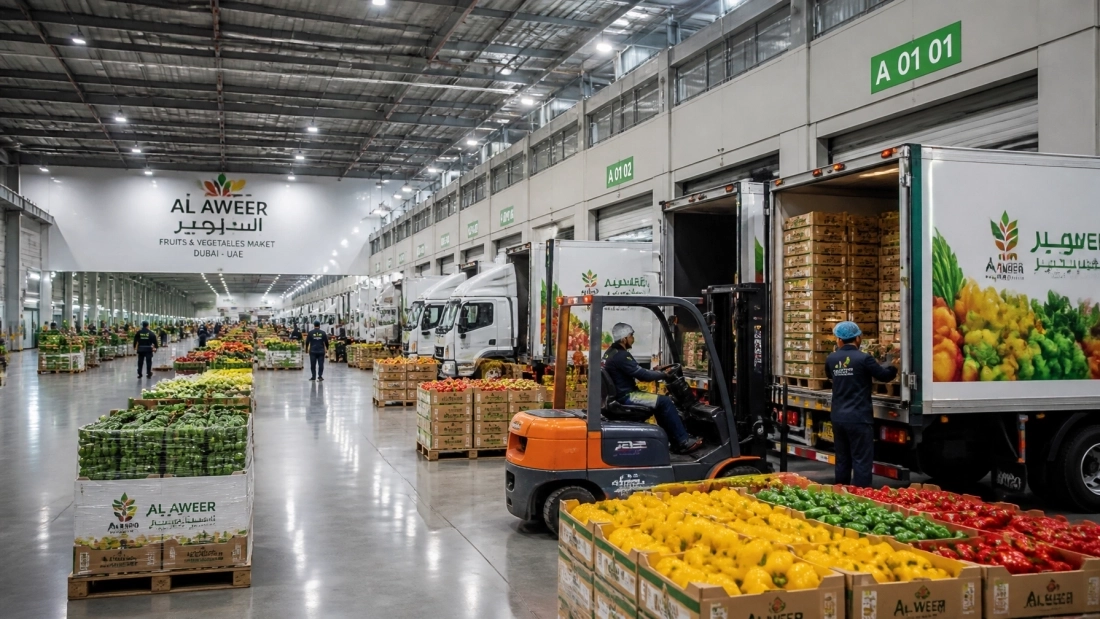
Al Aweer market data for mid-September shows a divided market. Gourds, pomegranate, and ginger strengthened sharply, while cucumbers, cabbage, lettuce, and selected leafy products recorded substantial declines.
The movement reflects changes in supply, origin availability, grade, transport mode, and buyer demand. It does not represent a uniform market direction. Buyers should compare like-for-like specifications and should not treat a board movement as a fixed quotation.
For international exporters, the current requirement is operational certainty. Product must be matched with a verified UAE buyer, compliant documentation, suitable logistics, and an agreed settlement route. Mayil Global supports this process through a 3% commission-based distributor UAE model and immediate cash-and-carry container purchase options for approved shipments.
Al Aweer Board Movements: 17 September
The strongest listed gainers were concentrated in gourds, fruit, and ginger.
| Product | Movement | Board reference |
|---|---|---|
| Snake Gourd | +33.6% | AED 2.14 to AED 2.86/kg, Oman |
| Ridge Gourd | +24.8% | AED 2.86 to AED 3.57/kg, Oman |
| Pomegranate | +23.1% | AED 3.25 to AED 4.00/kg, Yemen |
| Wax Gourd | +20.1% | AED 2.14 to AED 2.57/kg, Oman |
| Ginger | +17.4% | AED 8.21 to AED 9.64/kg, China |
The largest declines were recorded in cucumber and leafy categories.
| Product | Movement | Board reference |
|---|---|---|
| Cucumber | −57.1% | Iran line; intelligence only |
| Cucumber, second line | −46.0% | UAE line |
| Cabbage | −38.1% | Iran line; intelligence only |
| Lettuce | −36.8% | Iran line; intelligence only |
| White Cucumber | −36.4% | UAE line |
Iran-origin lines remain non-executable for procurement, shipment planning, or container pricing under the UAE trade suspension effective 19 August 2026. They may be retained as historical market intelligence, but they must not be used as commercial offers.
The gourd complex is showing stronger market support, while cucumber and leafy supply is under pressure. Buyers should confirm grade, size, packing, crop availability, and delivery timing before acting on any movement.
GCC Wholesale Intelligence: Week 37
The broader GCC wholesale picture remains mixed.
- Pears: Prices increased by approximately US$4–6. Forelle references were around US$26.67–29.33, while Vermont Beauty references were around US$24.00–26.13.
- Bananas: Prices declined by approximately US$4. Philippine bananas were around US$13.87, Ecuadorian bananas around US$14.67–15.47, and Indian bananas around US$11.47–12.80.
- Australian carrots: Increased by approximately US$4 to US$15.47–17.33.
- UAE lemons: Increased by approximately US$2 to US$17.70.
- UAE Valencias: Increased by approximately US$2 to US$22.88–23.48.
- Navel oranges: Declined by approximately US$1 to US$21.24–21.79 for UAE references.
- Mandarins: Remained under pressure, with Nova around US$10.13–10.67 and Nadorcott around US$16.00–18.67.
South African citrus is experiencing pressure from cumulative arrivals and variable transit quality. Clearance delays at Jeddah port are also affecting delivery timing, working capital, and final landed cost across GCC channels.
Al Aweer Listing Intelligence
Additional Al Aweer references provide useful commercial signals:
- G4 green chilli offers were approximately AED 35 per box, with CIF references around AED 27/kg.
- India onion CIF references were approximately AED 3.70/kg.
- Semi-husked dry coconut was listed around AED 50 per bag.
- G9 Cavendish banana offers were approximately AED 30 per box FOB.
- Hass avocado ex-Uganda was referenced at approximately AED 16 per 4 kg box.
A Dubai trading house is publicly advertising a 5% commission model. This provides a direct comparison point for exporters evaluating distribution costs. Mayil Global’s positioning is a transparent 3% commission, subject to a written agreement defining product, sales value, inspection, claims, logistics, and settlement terms.
Syria’s Gulf Produce Surge
Syria exported approximately 10,000 tonnes of fruit and vegetables in 400 refrigerated trucks over 10 days, according to the Damascus Fruit and Vegetable Exporters’ Committee as reported by FreshPlaza.
The UAE and Saudi Arabia were identified as the principal Gulf destinations. Jordanian produce remains a major competitor. Delays at the Jaber crossing can increase transport cost, reduce remaining shelf life, and disrupt agreed delivery windows.
For Syrian exporters, the commercial requirement is not only production capacity. Exporters must also provide:
- Consistent grading and packing.
- Refrigerated transport and temperature control.
- Correct phytosanitary and health documentation.
- Accurate origin and HS code information.
- A verified buyer or approved distribution route in the UAE.
Strong volumes require equally strong distribution control. Mayil Global evaluates origin, specifications, documentation, quality, and buyer demand before approving a shipment.
Transparency Protects the Supply Chain
Turkish authorities detained or issued detention warrants for approximately 40 fresh produce company executives in a price manipulation investigation. Reports identified concerns involving allegedly understated supply, overstated costs, forged producer receipts, and related financial offences.
The case reinforces a practical requirement for every exporter and buyer: documented, transparent pricing protects the transaction.
A compliant transaction should retain:
- Supplier quotation and specification.
- Commercial invoice and packing list.
- Origin and phytosanitary documentation.
- Inspection photographs and quality reports.
- Freight and clearance cost records.
- Commission or resale terms.
- Written claims and settlement procedures.
Transparent documentation supports buyer confidence and reduces disputes across the supply chain.
Importing Onions Dubai: Origin Cost Map

For importing onions Dubai, the origin price is only one component of the commercial decision.
| Origin | Transport and pack reference |
|---|---|
| India | Sea freight, new-crop onion |
| Egypt | Sea freight, 20 kg PPE bag |
| Yemen | Road freight, mesh bag |
| Turkey | Road freight, red onion |
| Sudan | Road freight, pink onion |
Usable-Cost Method
The usable cost should be calculated as:
Usable cost per kilogram = Total landed cost ÷ saleable kilograms after arrival
Total landed cost may include:
- Product value.
- Inland transport and export handling.
- Sea or road freight.
- Insurance and documentation.
- Customs, clearance, inspection, and port charges.
- Storage and local delivery.
- Financing and handling expenses.
- Expected wastage, shrinkage, or quality deductions.
This method is more reliable than comparing CIF references alone. A lower origin price can become a higher usable cost if moisture, sprouting, poor ventilation, transit delay, or arrival claims reduce saleable volume.
Iran-origin onion lines remain intelligence only and must not be included in executable planning under the 19 August suspension.
The 3% Commission Distributor UAE Model
Mayil Global provides a structured 3 percent commission distributor UAE model for international and local exporters supplying supermarkets, restaurants, retailers, and wholesale distributors.
Worked Settlement Illustration
Assume:
- Agreed gross sales value: AED 100,000
- Mayil Global commission at 3%: AED 3,000
- Exporter settlement before separately agreed deductions: AED 97,000
The final settlement must be calculated against the signed agreement. The agreement should specify whether freight, clearance, inspection, storage, VAT, wastage, claims, and delivery costs are deducted before or after commission.
The 3% model provides a clear alternative to less transparent intermediary structures. It supports dependable buyer access while keeping the commercial cost visible from the start.
Immediate Cash-and-Carry Container Purchases
Approved exporters may also use an immediate cash-and-carry route.
Operating Stages
- Product submission: Provide origin, variety, grade, quantity, packing, price, and loading date.
- Buyer and specification verification: Match the shipment with an approved UAE wholesale requirement.
- Document review: Check invoice, packing list, certificate of origin, phytosanitary certificate, health certificate where applicable, and HS code.
- Pre-loading inspection: Confirm condition, quantity, packaging, and photographs.
- Arrival and receiving: Coordinate clearance, inspection, unloading, and storage.
- Settlement: Complete payment according to the agreed cash-and-carry terms.
Cash-and-carry improves liquidity and can reduce receivables exposure. It does not remove food safety, customs, labelling, inspection, or import approval obligations.
How to Export Food to Dubai
Exporters asking how to export food to Dubai should follow a controlled sequence.
- Register the UAE importer and activity. The importer must hold the relevant trade licence and customs registration.
- Register products through ZAD and FIRS where applicable. Dubai Municipality’s food trader guidance provides regulatory resources.
- Confirm Arabic-English labelling. Labels should show product name, country of origin, net weight, packer/exporter, importer, lot information, and applicable dates.
- Maintain remaining shelf life. As a commercial planning standard, target 50–70% of remaining shelf life on arrival, depending on product and buyer requirements.
- Prepare certificates. Fresh produce generally requires a phytosanitary certificate. Health certificates, pesticide residue analysis, and other certificates may apply by product or origin. The UAE agricultural consignment release service lists required documents.
- Keep HS codes consistent. The HS code must match the invoice, packing list, customs declaration, product description, and preferential-duty claim.
- Confirm customs and VAT. Use the standard 5% GCC customs duty reference where applicable, plus UAE VAT. Product-specific exemptions, preferential treatment, and CEPA eligibility must be verified before quoting.
- Check CEPA eligibility. Qualifying Indian goods may benefit from India–UAE CEPA treatment, which provides zero-duty access across approximately 97% of tariff lines subject to product rules and documentation.
- Inspect and ship. Maintain hygienic handling, suitable temperature control, and complete pre-shipment records.
India’s confirmation as Official Partner Country for Gulfood 2027, 15–19 March 2027, following the APEDA–InD Events MoU, increases the commercial focus on Indian agricultural and processed-food exporters entering the UAE and wider GCC markets.
Standard Offer Structure
Every exporter offer should include:
- Product and variety.
- Country and region of origin.
- Grade, size, and crop period.
- Quantity and packaging.
- Incoterm and freight mode.
- Loading date and expected arrival.
- Remaining shelf life.
- Certificates and HS code.
- Price and currency.
- 3% commission or cash-and-carry route.
Signed Exporter Checklist
- Product specification approved.
- UAE buyer or distributor verified.
- Price and commission terms signed.
- Inspection and claims procedure agreed.
- Documents reviewed before loading.
- Packaging and labels approved.
- Freight and arrival window confirmed.
- Settlement method documented.
Signed Buyer Checklist
- Supplier identity verified.
- Origin and grade confirmed.
- Landed and usable cost calculated.
- Inspection standard agreed.
- Receiving capacity confirmed.
- Shelf-life requirement documented.
- Delivery and payment terms signed.
- Alternative origin assessed where necessary.
Mayil Global Wholesale Supply

Mayil Global supplies fresh fruits, vegetables, premium spices, rice, and farm-fresh eggs to supermarkets, restaurants, retailers, and wholesale distributors across the UAE.
Our operating model combines farm-direct sourcing, global supplier relationships, inspection at every stage, hygienic packaging, proper storage, and organised distribution. These controls support dependable supply, consistent quality, and long-term B2B relationships.
Review the Mayil Global product range, learn about sourcing and logistics, or contact the trade desk to discuss a verified buyer, a 3% commission distribution arrangement, or an immediate cash-and-carry container purchase.
Sources and Disclaimer
- Al Aweer board movements
- FreshPlaza: Syria exports 10,000 tons of fruit and vegetables in 10 days
- UAE agricultural consignment release requirements
- Dubai Municipality food trader guidance
- Gulfood official website
- Mayil Global products
- Mayil Global sourcing and logistics
Disclaimer: Al Aweer and GCC figures are indicative market references based on the stated September 2026 datasets and board movements. They are not fixed quotations, guaranteed prices, or binding offers. Actual value depends on origin, grade, size, packaging, freight, clearance, inspection, wastage, storage, taxes, availability, and negotiation. Iran-origin lines are intelligence only and are non-executable under the UAE suspension effective 19 August 2026. Importers and exporters must verify current regulations, customs treatment, CEPA eligibility, certificates, product registration, and commercial terms before proceeding.