

Data Note: The September 8 Reference Dataset
This September 26 briefing uses the latest available Al Aweer market dataset dated 8 September 2026. The dataset contains 160 listings from 23 origins, normalised to AED per kilogram for comparison.
All prices are indicative market references. They are not fixed quotations, confirmed offers, or binding purchase prices. Actual transaction values depend on origin, crop, grade, size, packaging, moisture, availability, freight, clearance, storage, wastage, and negotiation.
Important compliance note: Iran-origin listings are retained only as historical market references. They are non-executable for planning because the UAE trade suspension with Iran became effective on 19 August 2026. Iran-origin prices must therefore be excluded from procurement, container budgeting, and shipment decisions unless UAE authorities formally announce an applicable change.
Executive Market Position
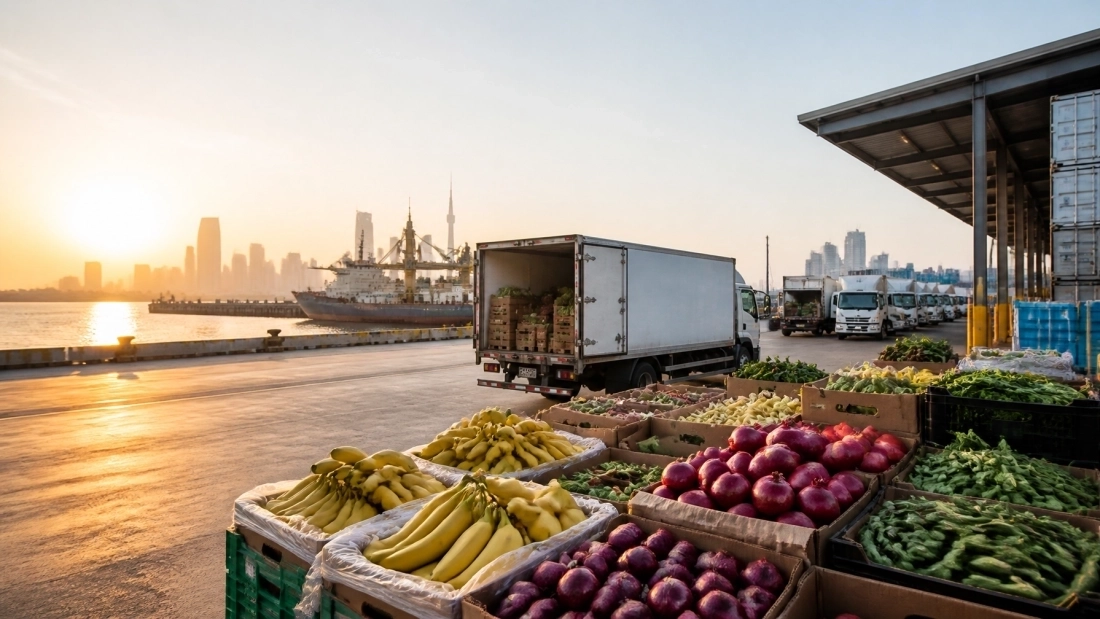
Al Aweer continues to operate as a major wholesale hub for wholesale fruits and vegetables Dubai, serving supermarkets, restaurants, retailers, caterers, and regional distributors.
The September 8 dataset indicates a market influenced by:
- Origin rotation and seasonal supply changes.
- Road, sea, and air freight differences.
- Grade, size, packaging, and arrival condition.
- Daily changes in supply and demand.
- Increased importance of compliance and verified distribution channels.
For late-September procurement, buyers should not use a single historical price as a purchase commitment. They should define the specification, verify the supplier, calculate landed cost, and confirm the arrival window before approving a container.
Al Aweer Market Movers
The daily movers report shows that 52 commodity quotes changed between 7 and 8 September 2026. The following table highlights the leading movements reported for that trading period.
| Category | Product and origin | Movement | Reference |
|---|---|---|---|
| Top gainer | Elephant Yam (Suran), India | +25.2% | AED 2.22 to AED 2.78/kg |
| Gainer | Dry Semi Husked Coconut, India | +15.8% | AED 2.92 to AED 3.38/kg |
| Gainer | Watermelon, Iran | +14.3% | AED 1.75 to AED 2.00/kg; non-executable |
| Gainer | Bangla Bottle Gourd, Oman | +14.2% | AED 5.00 to AED 5.71/kg |
| Gainer | Pomegranate, India | +12.5% | AED 4.00 to AED 4.50/kg |
| Top drop | Ridge Gourd, Oman | −16.7% | Indicative daily mover |
| Top drop | Snake Gourd, Oman | −16.7% | Indicative daily mover |
| Drop | Radish, UAE/local | −12.5% | Indicative daily mover |
| Drop | Strawberry, imported | −11.8% | Indicative daily mover |
| Drop | Bitter Gourd, Pakistan | −11.2% | Air-freight, 4 kg carton reference |
The movers demonstrate why procurement teams should compare like-for-like products. A price change may reflect a new origin, different pack format, a grade change, or a change in transport mode rather than a broad market movement.
Importing Onions Dubai: Origin Comparison and Procurement Playbook

The September 8 onion references show a wide spread between origins and specifications. The comparison is useful for importing onions Dubai, but each line must be reviewed against its commercial and compliance status.
September 8 Onion Origin Matrix
| Origin | Product reference | Transport and pack | Indicative price |
|---|---|---|---|
| Yemen | Onion | Road, 1 kg mesh bag | AED 2.50/kg |
| Egypt | Onion | Sea, 20 kg PPE bag | AED 2.15/kg |
| India | New-crop onion | Sea, 18 kg | AED 3.60/kg |
| Sudan | Pink onion | Road | AED 3.20/kg |
| Turkey | Red onion | Road | AED 2.25/kg |
| Iran | Brown onion | Sea, 9 kg mesh bag | AED 2.00/kg; non-executable |
| Iran | White onion | Sea, 9 kg mesh bag | AED 1.11/kg; non-executable |
| Iran | Red Shirazi | Sea, 65 mm+ reference | AED 1.70/kg; non-executable |
| Iran | Red Tabrezi | Sea, by weight | AED 1.80/kg; non-executable |
The executable comparison should focus on Yemen, Egypt, India, Sudan, and Turkey. The Iranian prices must not be used to underwrite a shipment or negotiate an executable purchase.
Practical Onion Procurement Guidance
1. Confirm size and grade
Specify bulb diameter, variety, colour, crop status, visual condition, and acceptable defect tolerance. Sudan pink onions, for example, may target a specific size profile, while Indian new-crop onions may be purchased for origin preference and freshness.
2. Match the pack to the sales channel
A 20 kg PPE bag may suit wholesale redistribution and restaurant supply. Smaller mesh bags may support retail handling but can increase packaging and labour costs. Confirm whether the buyer requires branded, plain, ventilated, or palletised packaging.
3. Check moisture and condition
Excess moisture increases the risk of rot, sprouting, claims, and reduced shelf life. Require pre-loading photographs, packing information, moisture controls, and an agreed inspection standard.
4. Calculate landed cost
The market reference is not the landed cost. Include product value, inland transport, ocean or road freight, insurance, customs, clearance, inspection, handling, storage, financing, wastage, and final delivery.
5. Protect the arrival window
Sea freight may offer lower transport cost but requires longer planning. Road supply may provide faster replenishment where routes are operational and compliant. Confirm the loading date, estimated arrival, receiving hours, and remaining shelf-life requirement before approval.
6. Allocate the shipment before loading
An onion container should have a defined channel, such as supermarkets, restaurants, wholesale distributors, or cash-and-carry buyers. A confirmed buyer reduces exposure to price deterioration after arrival.
Mayil Global’s 3% Commission and Immediate Cash-and-Carry Models
Mayil Global supports exporters supplying wholesale fruits and vegetables in Dubai through structured distribution, sourcing, quality control, and logistics.
Under the approved 3% commission distributor model, Mayil Global applies a transparent commission of 3% of the agreed gross sales value, subject to the written commercial agreement. The agreement should define the product, specification, buyer, sales value, delivery responsibility, inspection method, claims procedure, and settlement terms.
Benefits for Exporters
- Transparent commercial cost: A fixed 3% commission supports clearer margin planning.
- UAE buyer access: Exporters can present product to supermarkets, restaurants, retailers, and wholesale distributors through an organised B2B channel.
- Operational coordination: Product specifications, documents, inspection, receiving, and distribution are reviewed before execution.
- Reduced intermediary uncertainty: The exporter can structure the transaction without relying on unclear or variable resale margins.
- Better shipment allocation: Product can be matched with demand before loading where the buyer and specification are approved.
The second option is Immediate Cash-and-Carry container purchase. Approved exporters can discuss direct container purchase, subject to product verification, documentation, inspection, market demand, container condition, and agreed payment terms.
This model can benefit exporters by:
- Improving liquidity after arrival or allocation.
- Reducing dependence on long credit cycles.
- Supporting faster funding for the next shipment.
- Simplifying the commercial route for suitable products.
- Connecting container supply with UAE wholesale demand.
Cash-and-carry purchasing does not remove UAE food safety, customs, labelling, or import requirements. Every transaction remains subject to compliance and quality approval.
Learn more about Mayil Global’s products and sourcing and logistics process.
How to Export Food to Dubai: Nine Steps
Exporters asking how to export food to Dubai should follow a controlled process.
1. Define the product
State the product, variety, origin, crop, grade, size, packaging, quantity, and expected shelf life.
2. Verify the buyer
Confirm the UAE buyer’s legal identity, trade activity, receiving location, purchasing authority, payment terms, and distribution channel.
3. Confirm compliance
Review Dubai Municipality, UAE import, food safety, labelling, and plant or animal health requirements before committing stock.
4. Confirm the HS code
Assign the correct HS code and verify applicable customs duties, restrictions, permits, and certificates.
5. Prepare documents
Typical documents may include the commercial invoice, packing list, bill of lading or airway bill, certificate of origin, health certificate, phytosanitary certificate for applicable plant products, and other product-specific certificates.
6. Select the freight mode
Choose sea, road, or air according to product shelf life, cost, route availability, and required arrival date.
7. Approve specifications
Obtain written approval for grade, size, packaging, labelling, quantity, temperature or storage requirements, and acceptable tolerances.
8. Inspect before loading
Inspect quality, packaging integrity, moisture, quantity, batch information, and documentation before loading. Retain photographs and inspection records.
9. Clear and distribute
The UAE importer coordinates clearance, inspection, receiving, storage, and final distribution. Products must move through hygienic handling and organised logistics.
Exporters should review the latest requirements with their UAE importer and Dubai Municipality food trader guidance. The U.S. Trade.gov UAE trade regulations guide provides additional market-entry context.
Verified Buyer Submission Checklist
Exporters submitting a product to Mayil Global should provide:
- Product name and variety.
- Country and region of origin.
- Crop or production period.
- Available quantity and container capacity.
- Grade, size, and quality specification.
- Packaging format and net weight.
- Loading location and earliest loading date.
- Expected arrival date and freight mode.
- Health, phytosanitary, origin, and other applicable documents.
- Target price, payment expectations, and preferred 3% commission or cash-and-carry route.
Action Checklist for Exporters
- Exclude Iran-origin supply from current UAE planning.
- Quote against a complete specification, not only a product name.
- Calculate landed cost before confirming the sales price.
- Verify the importer and buyer before loading.
- Protect shelf life through suitable freight and storage.
- Agree inspection, claims, and settlement terms in writing.
- Submit complete documents to accelerate buyer review.
Action Checklist for UAE Buyers
- Confirm origin, grade, size, pack, and arrival condition.
- Compare executable origins only.
- Check the full landed cost and expected wastage.
- Confirm delivery frequency and receiving capacity.
- Use written specifications for recurring supply.
- Maintain alternative origins for essential products.
- Work with a distributor that provides quality control, hygienic handling, and organised logistics.
Conclusion
The September 8 Al Aweer dataset provides a practical reference for September procurement, but it does not replace same-day confirmation. Onion prices differ materially by origin, transport mode, pack format, size, and crop.
For importing onions Dubai, buyers should prioritise executable origins, inspect before loading, calculate landed cost, and allocate supply to a confirmed channel. Exporters seeking wholesale fruits and vegetables in Dubai can use Mayil Global’s 3% commission distributor model for transparent market coordination or explore Immediate Cash-and-Carry container purchases for approved shipments.
Mayil Global supplies fresh fruits, vegetables, premium spices, rice, and farm-fresh eggs through farm-direct sourcing, global supplier relationships, strict quality control, hygienic handling, storage, and organised distribution. Contact Mayil Global to discuss verified buyer access, export distribution, or wholesale supply in the UAE.
Sources
- Al Aweer Prices : September 8, 2026 market report
- Al Aweer daily movers
- Why Al Aweer prices change
- Mayil Global products
- Mayil Global sourcing and logistics
- Mayil Global onion export and distribution model
- Dubai Municipality: Food Traders and Establishments
- Trade.gov: United Arab Emirates Trade Regulations
Disclaimer: All Al Aweer prices in this article are indicative references based on the 8 September 2026 dataset and are normalised to AED/kg. They are not fixed quotations, guaranteed prices, or binding offers. Iran-origin listings are non-executable for current UAE planning because of the trade suspension effective 19 August 2026. Buyers and exporters must verify current market prices, applicable UAE restrictions, product registrations, certificates, customs requirements, and commercial terms before proceeding.