

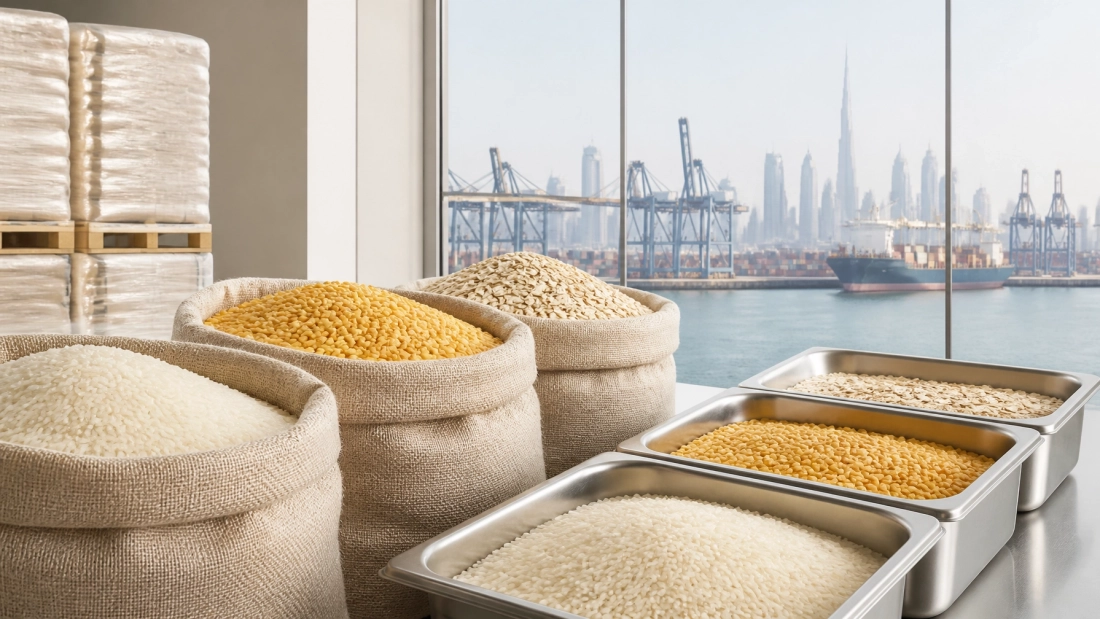
Dubai is a major food distribution hub serving supermarkets, restaurants, retailers, caterers, and wholesale distributors across the UAE and wider GCC. For international exporters, the market offers strong opportunities for specialty rice, pulses, and grains. However, successful market entry requires more than shipping a container.
Exporters must coordinate product specifications, food safety documentation, packaging, quality control, logistics, local buyer access, and settlement terms. Dubai-based buyers require dependable supply, consistent quality, and transparent commercial arrangements.
Mayil Global supports this process through farm-direct sourcing, a global supplier network, strict inspection at every stage, and a transparent 3% commission-based distribution model. The company also supports immediate Cash & Carry container purchases for exporters seeking faster liquidity.
Why These Products Fit the Dubai Wholesale Market
Seeraga Samba rice, Toor Dal, and oats serve different but complementary B2B demand segments in Dubai.
Seeraga Samba Rice
Seeraga Samba is a premium, short-grain aromatic rice associated with South Indian cuisine. Its texture, fragrance, and cooking performance make it suitable for biryani, specialty rice dishes, restaurants, catering kitchens, and retail channels serving South Asian consumers.
Unlike high-volume commodity rice, Seeraga Samba is generally positioned as a differentiated product. Buyers require clear information on:
- Rice variety and country of origin
- Grain appearance and cleanliness
- Broken grain percentage
- Moisture level
- Packaging size
- Crop and packing dates
- Cooking characteristics
- Available container volume
Defining these specifications before shipment helps reduce quality disputes and supports accurate pricing.
Toor Dal
Toor Dal, also known as pigeon peas, is a core pulse used in Indian foodservice and household cooking. Dubai supermarkets, ethnic retailers, restaurants, caterers, and wholesale distributors require steady access to clean, properly packed Toor Dal throughout the year.
Commercial buyers typically assess:
- Purity and foreign matter
- Moisture level
- Colour and uniformity
- Presence of damaged or discoloured grains
- Cleaning and sortexing standards
- Packaging strength
- Shelf life and storage requirements
Mayil Global coordinates sourcing and inspection to ensure the product specification is agreed before the shipment enters the distribution process.
Oats
Oats serve retail, foodservice, hospitality, institutional, and health-focused product segments. Depending on the buyer requirement, exporters may supply rolled oats, instant oats, steel-cut oats, or other defined formats.
UAE wholesale buyers commonly evaluate:
- Oat format and grade
- Flake size and consistency
- Moisture and bulk density
- Microbiological quality
- Foreign matter control
- Packaging and shelf life
- Labelling and allergen information
Supplying clear product data enables a supermarket or foodservice buyer to select the correct oat format for its customers and operating model.

Mayil Global’s 3% Commission Distribution Model
Mayil Global operates as a market-access and distribution partner for international exporters supplying food products to the UAE. The agreed distribution fee is a transparent 3% commission on the applicable realized sale value, subject to the commercial terms confirmed for each shipment or partnership.
For exporters searching for a 3 percent commission distributor UAE, this model provides a defined route into the Dubai wholesale market without requiring an immediate investment in a local sales office, warehouse operation, or independent distribution team.
Key commercial benefits include:
- Predictable distribution cost
A clearly stated 3% commission allows exporters to calculate expected market returns more accurately. Additional statutory, logistics, inspection, storage, and handling costs should be itemized separately under the agreed terms.
- Access to UAE B2B buyers
Mayil Global connects suitable products with supermarkets, restaurants, retailers, caterers, and wholesale distributors. This gives exporters access to buyers that require recurring supply rather than one-time transactions.
- Reduced market-entry overhead
Exporters can use Mayil Global’s local coordination and distribution capabilities instead of immediately establishing their own UAE infrastructure.
- Improved reporting visibility
A structured distribution process should provide information on received quantities, product condition, buyer orders, sales values, applicable deductions, and settlement status.
- Aligned commercial interests
A commission-based structure connects the distributor’s performance to the successful movement of the shipment. This supports active buyer coordination, product placement, and repeat order development.
The 3% commission model is a central Mayil Global USP. It supports cost control for exporters while helping Dubai buyers access a more organized wholesale supply channel.
Sourcing Through a Global Supply Network
Dependable supply requires more than one supplier or one origin. Mayil Global works with trusted farms, mills, processors, and international suppliers across multiple markets.
This global supply network supports:
- Farm-direct and supplier-direct sourcing
- Alternative origins when availability changes
- Regular replenishment planning
- Product matching according to buyer specifications
- Better continuity for supermarkets and distributors
- Reduced dependence on a single source
The company’s sourcing and logistics system is designed to maintain product quality from origin through storage, handling, and UAE distribution.
For Seeraga Samba rice, sourcing may focus on suitable Indian origins and mills with the required cleaning, grading, packaging, and documentation capability. Toor Dal and oats require the same specification-based sourcing discipline, with additional attention to crop condition, processing format, shelf life, and food safety documentation.
Quality Control at Every Stage
Food safety, hygiene, and quality control are non-negotiable in the export supply chain. Mayil Global applies inspection procedures across sourcing, packaging, loading, storage, and distribution.
Origin and Supplier Review
The process begins by reviewing the supplier, product availability, processing capability, and relevant certificates. Product samples and specifications should be approved before a full-container commitment.
Pre-Shipment Inspection
Before loading, the exporter and buyer should confirm:
- Product identity and grade
- Net and gross weight
- Packaging condition
- Batch and lot details
- Moisture and cleanliness
- Foreign matter and infestation control
- Container cleanliness
- Seal and loading records
For rice and pulses, buyers may request laboratory analysis covering microbiological parameters, pesticide residues, contaminants, and other applicable food safety requirements.
Hygienic Handling and Storage
Rice, Toor Dal, and oats must be protected from moisture, pests, contamination, and excessive heat. Food-grade packaging, clean storage areas, palletized handling, stock rotation, and controlled loading procedures help preserve quality after arrival.
Dubai importers should also verify current requirements with the Dubai Municipality Food Safety Department before finalizing a shipment.

Export Documentation and Packaging Requirements
Exporters must prepare documentation that matches the physical shipment and the UAE importer’s requirements. Depending on the product, origin, packaging format, and trade terms, the documentation may include:
- Commercial invoice
- Packing list
- Certificate of origin
- Bill of lading
- Certificate of analysis
- Phytosanitary or health documentation where applicable
- Fumigation documentation where required
- Product registration or conformity documents
- Halal documentation where required by the product or buyer
Prepacked products should carry accurate product names, country of origin, net weight, production or packing dates, best-before information, storage conditions, and importer details. Retail-facing products may also require Arabic and English labelling, nutrition information, barcode details, and allergen declarations.
Packaging should be selected according to the buyer channel. Wholesale customers may require 20 kg, 25 kg, or 50 kg food-grade bags, while supermarkets may require smaller retail formats. Mayil Global aligns packaging requirements with the intended distribution route.
Immediate Cash & Carry Container Purchases
Some exporters prefer immediate payment and direct container sales rather than commission-based consignment distribution. Mayil Global supports this requirement through an immediate Cash & Carry container purchase model for qualifying shipments.
Under agreed commercial terms, Mayil Global evaluates:
- Product and variety
- Origin and supplier
- Grade and quality
- Container quantity
- Arrival timing
- Documentation status
- Market demand
- Packaging and storage requirements
The parties then agree on the purchase terms before the transaction proceeds.
Cash & Carry benefits for exporters include:
- Faster access to working capital
- Lower exposure to extended buyer credit
- Reduced dependence on downstream collections
- Faster reinvestment into the next shipment
- Simplified local market entry
- Improved planning for regular container supply
Exporters should confirm in writing whether a shipment will follow the 3% commission route or the Cash & Carry purchase route. Price, inspection, documentation, delivery, and payment responsibilities must be clearly defined.
Benefits for Dubai-Based Wholesale Buyers
A wholesale food buyer Dubai businesses can depend on requires more than a competitive quotation. Buyers need a supply partner that maintains consistent specifications, communicates clearly, and delivers according to schedule.
Supermarkets
Supermarkets benefit from reliable replenishment, compliant labelling, stable pack sizes, and consistent product presentation. Seeraga Samba rice, Toor Dal, and oats can be supplied according to retail or bulk distribution requirements.
Restaurants and Caterers
Restaurants require predictable cooking performance and regular availability. Consistent rice and pulse specifications support menu planning, food-cost control, and operational continuity.
Wholesale Distributors
Distributors require container-scale quantities, documentation accuracy, organized receiving, and dependable delivery coordination. Mayil Global’s global supply network supports recurring procurement across multiple food categories.
Businesses evaluating bulk rice suppliers Dubai can also review Mayil Global’s related guidance on bulk rice distribution and the Cash & Carry model.
A Transparent Export-to-Distribution Process
Mayil Global follows a structured process for exporters and UAE wholesale buyers.
-
Confirm the requirement
Define product, grade, packaging, quantity, destination, and required delivery window. -
Source the product
Match the requirement with trusted farms, mills, processors, and international suppliers. -
Approve specifications and samples
Confirm quality parameters and documentation before loading. -
Select the commercial model
Choose the transparent 3% commission distribution structure or immediate Cash & Carry container purchase. -
Coordinate logistics
Manage shipment planning, receiving, inspection, storage, and local distribution according to agreed terms. -
Develop recurring supply
Use shipment performance and buyer feedback to establish a dependable replenishment schedule.
This process gives exporters greater transparency while providing UAE businesses with a stable wholesale procurement route.
Conclusion
Exporting Seeraga Samba rice, Toor Dal, and oats to Dubai requires disciplined sourcing, accurate documentation, strict quality control, hygienic handling, and organized logistics. The products must reach the market with the specifications, packaging, and compliance records required by UAE buyers.
Mayil Global’s 3% commission model gives international exporters a predictable distribution structure and access to UAE B2B buyers. Its global supply network supports dependable sourcing across multiple origins, while inspection at every stage protects consistent quality.
For exporters seeking a 3 percent commission distributor UAE, the model provides a practical route into Dubai. For supermarkets, restaurants, retailers, and distributors, Mayil Global functions as a wholesale supply partner focused on dependable availability, transparent coordination, and long-term commercial relationships.
To discuss Seeraga Samba rice, Toor Dal, oats, or immediate container purchasing, contact Mayil Global.