

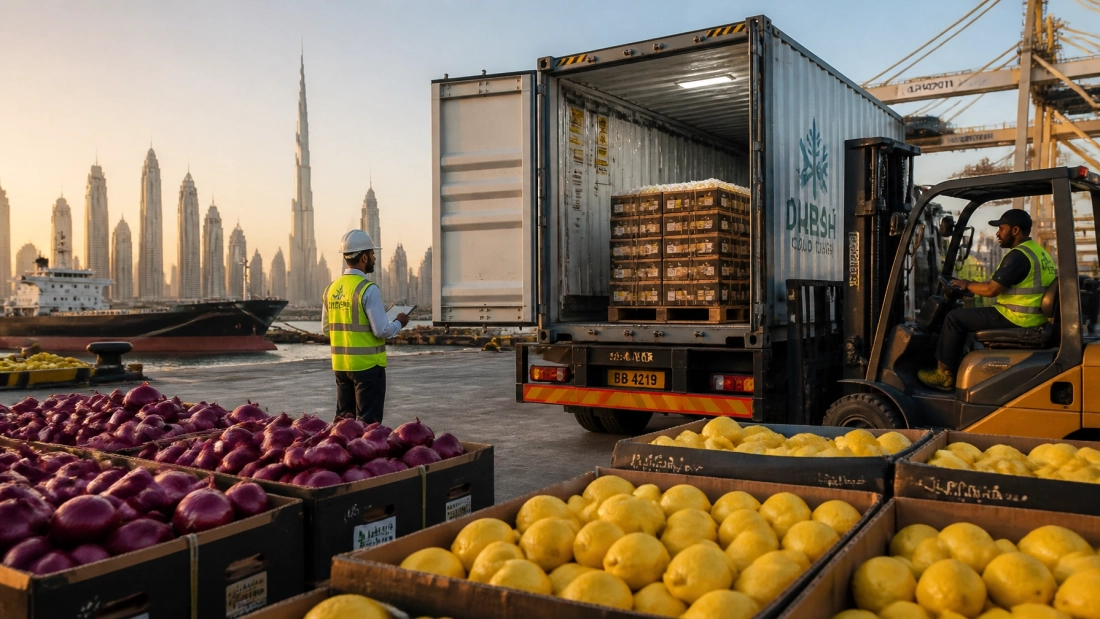
For global exporters, the United Arab Emirates represents one of the most lucrative and consistent food markets in the world. Importing approximately 80% to 90% of its food requirements, the UAE, and specifically Dubai, serves as the primary gateway for the distribution of fresh produce and dry staples across the Middle East. However, the complexity of regulatory compliance and the volatility of payment cycles in traditional wholesale markets often present significant barriers to entry.
The objective of this guide is to provide a comprehensive operational roadmap on how to export food to dubai while ensuring a reliable, transparent, and accelerated payment structure. By leveraging strategic distribution models such as the 3% commission framework and Cash & Carry container purchases, exporters can mitigate financial risk and maximize operational efficiency.
1. Understanding the Regulatory Framework for UAE Imports
To successfully navigate the process of importing onions dubai or any other food commodity, exporters must align their operations with the stringent standards set by the UAE authorities. The regulatory environment is managed primarily by the Dubai Municipality (DM) and the Ministry of Climate Change and Environment (MOCCAE).
Registration and Compliance via FIRS
The first step in the export process is ensuring that your local partner in the UAE is a licensed food importer. At Mayil Global, we maintain active registration with the Food Import and Re-export System (FIRS), which is the electronic platform managed by the Dubai Municipality for the control of all food shipments.
- Product Registration: Every individual food product must be registered in the FIRS database. This includes submitting detailed ingredient lists, packaging samples, and shelf-life data.
- Labeling Requirements: Compliance with UAE labeling laws is non-negotiable. Labels must be in Arabic (or bilingual Arabic/English) and must clearly state the product name, brand, ingredients, country of origin, net weight, and production/expiry dates.
- Health and Phytosanitary Certificates: Shipments of fresh produce require original phytosanitary certificates issued by the competent authority in the country of origin.
Failure to meet these technical requirements often leads to shipment delays or rejection at the port, which directly impacts the exporter's liquidity.
2. Navigating the Al Aweer Central Market
The Al Aweer Central Fruits and Vegetables Market is the epicenter of the wholesale fruits and vegetables dubai trade. Operating 24 hours a day, it is a high-volume hub where prices are discovered in real-time based on supply arrival and buyer demand.

Price Discovery and Volatility
Exporters must understand that prices in Al Aweer are not fixed. They fluctuate daily based on:
- Arrival Volumes: A sudden influx of containers can depress prices quickly.
- Quality Grade: Higher-grade, well-packaged produce consistently commands a premium.
- Market Timing: Strategic arrival of containers to coincide with periods of low local supply is critical for maximizing margins.
Traditional trading in Al Aweer often involves multiple intermediaries, each taking a significant margin, which can leave the original exporter with minimal profit and long waiting periods for payment.
3. The Strategy for Faster Payments: 3% Commission vs. Cash & Carry
The primary concern for any exporter is cash flow. The traditional "consignment" model often leads to "wait-and-see" payment terms that can span several weeks. Mayil Global has engineered two distinct models to solve this liquidity gap for international suppliers.
The 3% Commission Model
Unlike traditional distributors who may take margins between 10% and 25%, Mayil Global operates on a transparent 3% commission-based distribution model.
- Operational Transparency: We handle the customs clearance, logistics, and sales through our B2B network.
- Maximized Returns: By charging a flat 3% fee on the sales value, the exporter retains a significantly higher portion of the revenue.
- Direct Reporting: Exporters receive detailed sales reports, ensuring they know exactly what price their goods fetched in the market.
For more details on how this protects your margins, see our guide on The 3% Commission Strategy for Exporters.
The Cash & Carry Container Purchase
For exporters who prioritize immediate liquidity over potential market upside, our Cash & Carry wholesale model is the most effective strategy. Under this arrangement, Mayil Global purchases entire containers: ranging from onions and potatoes to premium rice and spices: upon arrival and inspection in Dubai.
- Immediate Payment: This eliminates the need for the exporter to wait for the goods to be sold to end-retailers or restaurants.
- Risk Transfer: Mayil Global assumes the market risk and inventory management responsibilities within the UAE.
- Steady Supply Chain: This model allows exporters to reinvest their capital immediately into their next shipment, facilitating a continuous and scalable supply chain.
4. Operational Excellence in Logistics and Quality Control
Ensuring that products maintain their quality from the farm to the Dubai warehouse is essential for securing the best possible wholesale prices.

Cold Chain Management
At Mayil Global, we prioritize a seamless cold chain. Our logistics network utilizes refrigerated containers (reefers) and temperature-controlled storage facilities to ensure that fresh produce, such as wholesale vegetables, remains in peak condition.
Strict Inspection Protocols
We perform rigorous quality inspections at every stage:
- At Source: Verification of grading and packaging standards at the farm or packing house.
- Upon Arrival: Inspection at Jebel Ali Port or Al Aweer to ensure no transit damage or temperature deviations occurred.
- Post-Storage: Monitoring during the distribution phase to ensure supermarkets and restaurants receive only farm-fresh products.
5. Targeting the Right B2B Buyers in the UAE
A successful export strategy doesn't end at the port; it ends when the product reaches the final B2B consumer. Mayil Global maintains an extensive distribution network across the UAE, supplying:
- Supermarkets and Retail Chains: Who require consistent quality and regular supply schedules.
- Restaurants and HORECA: Who demand premium ingredients and timely daily deliveries.
- Wholesale Distributors: Who look for bulk volumes of staples like rice, spices, and eggs.
By positioning your products through a reliable partner like Mayil Global, you gain access to a global supply network that understands the nuances of the local market.

Conclusion: Securing Your Position in the Dubai Market
The UAE remains a land of opportunity for food exporters, provided they utilize a strategy that prioritizes transparency and liquidity. Whether you are exporting onions to dubai or shipping premium rice, the choice of your distribution partner will determine your success.
The Mayil Global 3% commission model and Cash & Carry container purchase options are designed to provide the financial stability exporters need to scale their operations. By focusing on operational excellence, regulatory compliance, and fast payment cycles, we ensure that our partners can navigate the complexities of the Dubai market with confidence.
Ready to optimize your export operations?
Contact Mayil Global today to discuss how our distribution models can help you get paid faster and grow your business in the UAE.
- Website: mayilglobal.com
- Contact Us: Get in touch with our trade desk
- Explore Our Products: View our wholesale catalog