

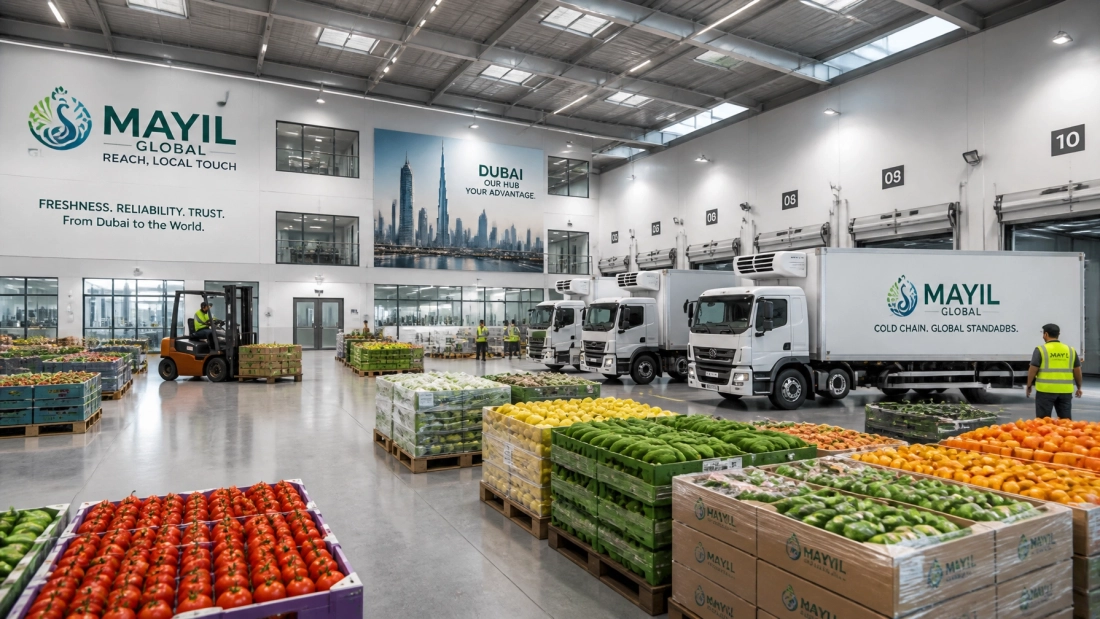
The United Arab Emirates serves as the primary re-export hub for the Middle East and North Africa (MENA) region. At the center of this multi-billion dollar food trade is the Al Aweer Central Fruit and Vegetable Market in Dubai. For global exporters, the challenge is not merely producing high-quality crops but navigating the complexities of the Dubai market to find a verified buyer who ensures consistent liquidity and fair market value.
As a leading wholesale supplier of fresh produce in the UAE, Mayil Global provides a structured pathway for international shippers to enter the market with confidence. Whether you are importing onions to Dubai or supplying premium fruits, understanding the operational standards of Al Aweer is essential for long-term profitability.
The Landscape of Al Aweer: The Hub of Food Distribution
Al Aweer, also known as the Ras Al Khor Market, is the largest wholesale hub for fresh produce in the region. It operates as a high-velocity ecosystem where thousands of tonnes of fruits and vegetables are traded daily. The market serves supermarkets, luxury hotels, restaurants, and wholesale distributors across the UAE and neighboring GCC countries.
For an international exporter, Al Aweer represents a massive opportunity but also a sophisticated environment. Trade here is fast-paced, and price fluctuations are constant. Success in this market requires a partner who understands wholesale fruits and vegetables in Dubai from a logistics and pricing perspective.
The Challenge of Finding a Verified Buyer
The primary risk for global exporters is the lack of transparency in the "consignment sales" model often found in traditional markets. Many exporters ship containers without a guaranteed price, leaving them vulnerable to market volatility and "hidden" fees from middle-men.
To mitigate these risks, exporters must seek a verified buyer that offers:
- Transparent Fee Structures: Avoiding hidden costs that erode margins.
- Verified Logistics: Ensuring the cold chain remains intact from the port to the market.
- Financial Stability: Ensuring immediate payment or structured liquidity options.
Mayil Global addresses these concerns through a modernized B2B approach, positioning itself as a reliable bridge between global farms and the UAE’s demanding retail sector.

The Mayil Global Advantage: The 3% Commission Model
One of the most significant barriers for exporters is the high commission often charged by market agents. Mayil Global has revolutionized this by offering a transparent 3% commission-based distribution model.
How the 3% Commission Strategy Works:
- Direct Access: We provide global exporters direct access to the UAE market.
- Minimized Overhead: By capping our commission at 3%, we ensure that the lion's share of the profit remains with the producer.
- Liquidity Management: We focus on providing daily liquidity, allowing exporters to reinvest in their next shipment immediately.
This model is specifically designed for high-volume commodities where margins are tight. You can learn more about how this strategy secures your profit in our detailed guide on the 3% commission strategy and daily liquidity.
Exporting Onions and Staple Vegetables to Dubai
Onions are one of the most consistently demanded commodities in the UAE. However, importing onions to Dubai requires strict adherence to quality and packaging standards. Onions must be uniform in size, free from sprouting, and packed in well-ventilated mesh bags (typically 10kg or 25kg).
At Mayil Global, we specialize in the high-volume distribution of staples, including onions, potatoes, and tomatoes. Our dedicated onion export guide highlights how our commission model and Cash & Carry options maximize returns for onion shippers from India, Pakistan, Egypt, and beyond.

How to Export Food to Dubai: A Step-by-Step Guide
Navigating the regulatory framework of the UAE is mandatory for any successful shipment. Here is a professional overview of how to export food to Dubai for global exporters.
1. Documentation and Compliance
Every shipment must be accompanied by a standard set of documents to pass through Dubai Customs and Dubai Municipality inspections:
- Commercial Invoice & Packing List: Detailing the HS codes and quantity.
- Certificate of Origin: Validated by the chamber of commerce in the exporting country.
- Phytosanitary Certificate: Issued by the agricultural authority, ensuring the produce is free from pests.
- Health Certificate: Confirming compliance with food safety standards.
2. Registration with FIRS
All food products must be registered in the Food Import & Re-export System (FIRS) managed by Dubai Municipality. Mayil Global assists its partners in ensuring all product registrations are compliant before the container leaves the port of origin.
3. Port Logistics and Cold Chain
Upon arrival at Jebel Ali Port or Port Rashid, containers are subjected to food safety checks. Maintaining the cold chain during this transition is critical. Mayil Global manages sourcing and logistics to ensure that produce is moved swiftly in refrigerated trucks to our temperature-controlled facilities.

Cash & Carry: Empowering Local B2B Buyers
While we provide a pathway for global exporters, Mayil Global also serves the local UAE market through a robust Cash & Carry wholesale model. This is specifically designed for:
- Supermarkets: Needing daily fresh inventory without long-term credit constraints.
- Restaurants: Seeking premium quality at wholesale prices.
- Retail Distributors: Looking for a reliable source of bulk products.
Our Cash & Carry model ensures that we have the liquidity to purchase containers outright from exporters, providing them with immediate cash flow: a rare and valuable advantage in the Al Aweer market environment.
Quality Control as a Non-Negotiable Pillar
In the B2B food sector, reliability is built on quality control. Mayil Global employs a strict inspection protocol at every stage:
- At Origin: We work with farms that follow GAP (Good Agricultural Practices).
- At Arrival: Every shipment is inspected for color, size, and defects.
- At Distribution: Hygienic handling and packaging ensure that the produce reaching the end-user meets international safety standards.
Establishing Long-Term Partnerships
The Al Aweer market is built on relationships. However, in the modern era, these relationships must be backed by corporate standards and transparent data. Mayil Global is committed to building long-term partnerships with exporters who value operational excellence and consistent supply.
By choosing a partner that offers a 3% commission model and has a deep understanding of the wholesale fruits and vegetables market in Dubai, global exporters can transition from being "just another shipper" to a preferred supplier in one of the world's most lucrative food hubs.
Conclusion
Exporting to Dubai’s Al Aweer market does not have to be a high-risk venture. With the right documentation, a clear understanding of logistics, and a verified partner like Mayil Global, exporters can secure their margins and scale their operations.
If you are ready to export your first container or are looking for a more transparent distribution partner in the UAE, contact us today to discuss our 3% commission model and how we can facilitate your entry into the Dubai wholesale market.