

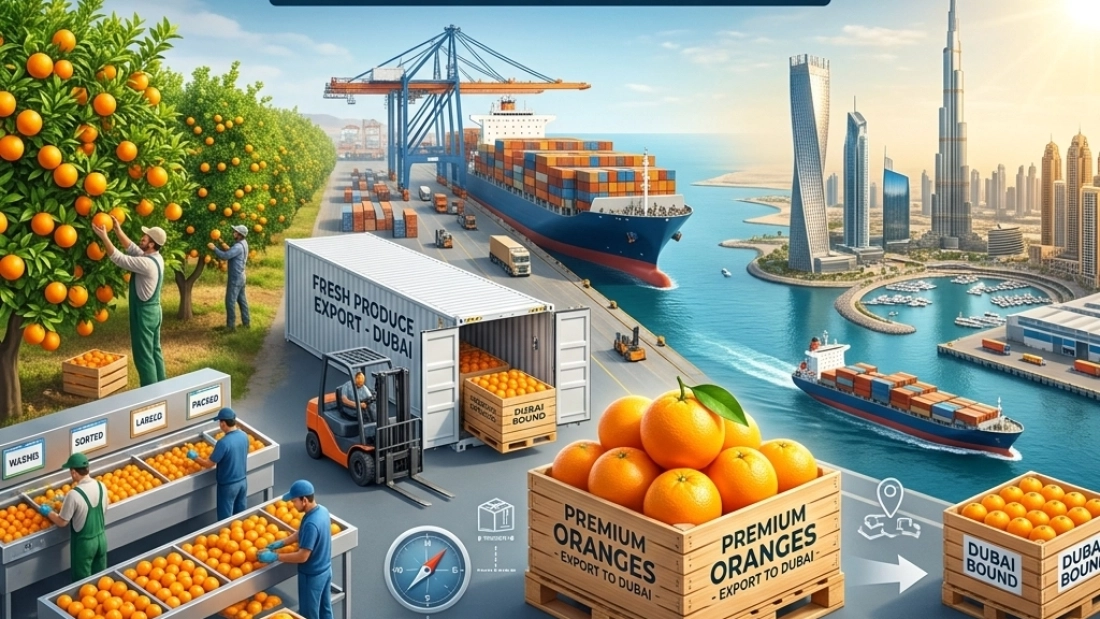
Dubai is the primary gateway for the fresh produce trade in the Middle East. With a rapidly growing population and a status as a global tourism hub, the demand for high-quality citrus: specifically oranges: remains consistently high year-round. However, for international exporters, the challenge is not just finding a market; it is navigating the complexities of the supply chain while ensuring profit margins are not eroded by excessive middleman fees.
If you are looking for an orange buyer in Dubai, you need a partner who understands the technical requirements of the UAE market and offers a transparent financial model. At Mayil Global, we have redesigned the distribution process to favor the exporter, offering a fixed 3% commission model and immediate Cash & Carry options to solve the liquidity gaps that often plague the Aweer Market trade.
Step 1: Secure Legal Compliance and Mandatory Documentation
Exporting oranges to the UAE requires strict adherence to both international and local regulatory standards. The UAE Ministry of Climate Change and Environment (MOCCAE) oversees the import of all agricultural products to ensure food safety and biosecurity.
Essential Documentation
To avoid delays at Jebel Ali Port or Dubai World Central, every shipment must be accompanied by the following:
- Import Export Code (IEC): Your primary identifier for customs.
- Phytosanitary Certificate: Issued by your local agricultural authority, confirming the oranges are free from pests and diseases.
- Certificate of Origin: Authenticated by your local Chamber of Commerce to verify the product's source.
- Commercial Invoice and Packing List: Detailed records of the variety, weight, and value of the shipment.
- Health Certificate: Confirming the produce is fit for human consumption.
Failure to provide accurate documentation can lead to shipment rejection or costly storage fees. By understanding the 3% commission strategy, exporters can better allocate their budget toward ensuring high-quality documentation and compliance from the start.
Step 2: Select the Right Orange Varieties for the UAE Market
Not all oranges are created equal in the eyes of Dubai buyers. The market is segmented into juicing oranges and table (eating) oranges. Understanding these preferences is key to maximizing your sales volume.

Popular Varieties in Dubai
- Valencia Oranges: Highly sought after for their high juice content and sweetness. They are the staple for the UAE’s extensive hospitality and catering sector.
- Navel Oranges: Preferred as table fruit due to being seedless and easy to peel. They command a premium price in retail environments.
- Mandarins and Clementines: Increasingly popular for their convenience and snackability among families.
Timing your export is equally important. When local or regional supplies are low, Southern Hemisphere shippers (from countries like South Africa or Egypt) can capitalize on higher price points. At Mayil Global, we provide our partners with real-time market insights to help them decide exactly when to ship their containers for maximum return.
Step 3: Implement Rigorous Cold Chain and Logistics Management
Oranges are living organisms that continue to respire after harvest. Maintaining the "cold chain" is the most critical technical aspect of your export operation. Any fluctuation in temperature can lead to mold growth, weight loss, or rind breakdown.
Technical Specifications for Citrus Shipping
- Temperature Control: Oranges should typically be transported in refrigerated ("Reefer") containers set between 3°C to 7°C (37°F to 45°F).
- Ventilation: Proper airflow is essential to remove the carbon dioxide and ethylene gas produced by the fruit, which can accelerate ripening and spoilage.
- Humidity: Relative humidity should be maintained at 85-90% to prevent the fruit from drying out.
Using advanced monitoring systems in your containers allows you to track these variables in real-time. For more information on how logistics impact your bottom line, see our guide on exporting onions and other perishables, which shares many of the same cold-chain principles.

Step 4: Export-Grade Packaging and Labeling Standards
Packaging is your first line of defense against mechanical damage during the long sea voyage to Dubai. Furthermore, the UAE has specific labeling requirements that must be met for a shipment to clear customs.
Packaging Requirements
- Ventilated Cartons: Use double-walled, corrugated fiberboard boxes. These must have sufficient holes to allow the cold air from the reefer unit to circulate through the fruit.
- Palletization: Oranges should be securely palletized and shrink-wrapped (while maintaining airflow) to prevent shifting during transit.
- Labeling: Labels must be clear and, ideally, bilingual (English and Arabic). They must include:
- Product Name and Variety
- Country of Origin
- Net Weight
- Class/Grade
- Packer/Exporter Name and Address
- Date of Packing
High-quality packaging not only protects the fruit but also enhances the brand value in the eyes of local wholesalers and retailers.
Step 5: Partnering with Mayil Global to Maximize Profits
The traditional model of exporting fruit to Dubai involves high-commission agents who often take 10% to 15% of the gross sale, while providing very little transparency regarding the final price achieved in the market. This traditional approach leaves the exporter carrying all the risk with diminished rewards.
The 3% Commission Advantage
Mayil Global has disrupted this model by offering a flat 3% commission on distribution. This allows the exporter to retain 97% of the market value of their oranges. By reducing the intermediary cost, we ensure that the profit stays where it belongs: with the shipper.
Exporters are increasingly switching to our 3% commission model because it offers a clear, predictable cost structure that makes financial planning much simpler.

Cash & Carry for Immediate Liquidity
One of the biggest pain points for international shippers is the delay in payment. In the traditional Aweer Market setup, you might wait weeks or even months to receive funds after your container has been sold.
Mayil Global solves this through our Cash & Carry model. For qualified shipments, we offer immediate liquidity, purchasing the container directly or facilitating rapid turnover through our wholesale network. This allows you to reinvest your capital into your next shipment immediately, rather than having it tied up in accounts receivable. You can learn more about how this speeds up payments in the Aweer Market here.
Why Mayil Global is the Right Choice for Your Orange Exports
When you are looking for an orange buyer in Dubai, you are looking for more than just a transaction; you are looking for a reliable extension of your business. Mayil Global provides a bridge between global producers and the lucrative UAE market by focusing on operational excellence and financial transparency.
Our Commitment to Quality and Transparency
We operate with a "boots on the ground" approach in the Dubai wholesale markets. Our team monitors the arrival of your containers, ensures they are stored in optimal conditions, and manages the sales process with full disclosure.
Our professional B2B focus means we prioritize long-term relationships over short-term gains. Whether you are shipping Valencias from Egypt or Navels from South Africa, our infrastructure is designed to handle bulk volumes with precision.

Taking the Next Step
The Dubai market offers immense opportunities for orange exporters who can consistently deliver quality. By following these five steps: legal compliance, variety selection, cold chain management, superior packaging, and partnering with a transparent distributor like Mayil Global: you can secure your margins and grow your export business.
If you are ready to experience a more profitable way to export, explore our detailed explanation of the 3% commission model and see how we are transforming the food distribution landscape in the UAE.
For further information or to discuss your upcoming shipments, visit mayilglobal.com and connect with our procurement team. We are committed to building a more efficient, transparent, and profitable supply chain for fresh produce exporters worldwide.