

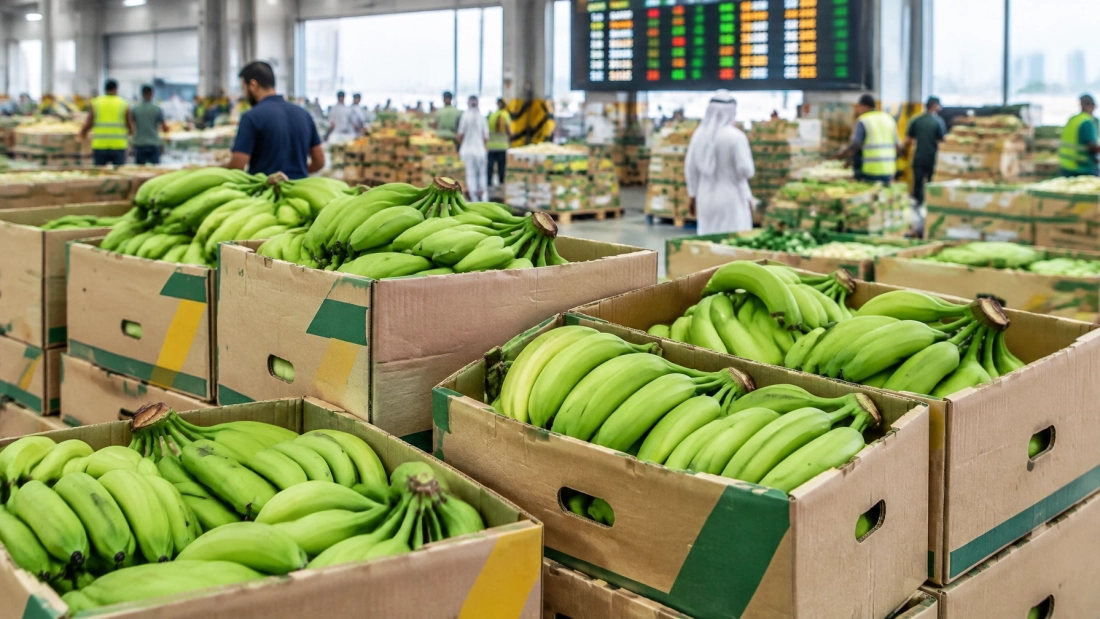
What a falling floor means when capacity is rising
Two signals from the past week frame the commercial question for fruit exporters.
On Thursday 19 November 2026, Hamriyah Free Zone Authority in Sharjah launched a Smart Food Industries Zone backed by AED 1.5 billion of investment across 1.2 million square metres. The zone is intended for food manufacturing, packaging and storage companies. More than 80 global factories and companies are expected within two years, with about 3,000 jobs. Plans include fully automated chilled and frozen warehouses using smart inventory management systems, advanced food safety and quality testing laboratories, and direct connections to Hamriyah Port, international airports and the motorway network. An organic waste recycling facility, rooftop solar and incentives including 100 per cent foreign ownership, tax and customs exemptions, and expedited industrial licensing are also part of the announcement.
On 18 November, Fruitnet’s GS Intelligence Week 46 GCC wholesale update reported broad downward pressure on wholesale floors amid an unseasonal mid-November slowdown in stock movement. Multi-origin competition pushed Royal Gala prices down by an average of US$2 to US$3.50 and Granny Smith down US$3 to US$6. Australian carrots fell US$4 to US$8 across regional cities, settling at US$16 to US$20. Late-season citrus arrivals pulled Cambria Navels down US$6 to US$8 and Valencias down US$4 to US$7 across Middle Eastern markets. South African pears held firm. The report also listed apple origins including Italy, South Africa, Serbia, Turkey, Chile, France, Portugal and Moldova, and noted Nadorcott and Tango mandarins in the UAE.
The tension is direct: regional processing and cold-storage capacity is being added at scale while the near-term wholesale floor is falling. Capacity does not create demand on its own. For exporters, the price achieved depends on how clearly the product is defined and how reliably it can be delivered, not on how hopeful the market is.
That pricing mechanism is the subject of this analysis. The focus is not another market briefing. It is what the Al Aweer board indicates buyers are paying for in a banana carton, a citrus count and an origin.
The banana shelf is a price ladder
For anyone tracking wholesale fruits and vegetables Dubai prices, the Al Aweer board for 20 November 2026 shows several distinct banana offers. It is not one commodity with one price. Origin, brand, ripening state, variety and pack format separate products aimed at different buyers.
AED per kg, indicative quotes, 20 November 2026. All prices below are converted from package quotes.
| Product | Origin and route | Pack | Price |
|---|---|---|---|
| G9 Cavendish, green | India, sea | 13 kg carton | AED 2.69 |
| G9 Cavendish, yellow | India, sea | 13 kg carton | AED 3.23 |
| Banana YB | India, sea | 4 kg carton | AED 6.50 |
| RK Banana (Elaichi) | India, sea | 4 kg carton | AED 8.25 |
| Del Monte banana | Ecuador, sea | 13 kg carton | AED 5.62 |
| Lavida banana | Ecuador, sea | 13 kg carton | AED 5.62 |
| Dole banana | Ecuador, sea | 13 kg carton | AED 6.00 |
| Al Bakrawe banana | Ecuador, sea | 13 kg carton | AED 6.00 |
| Extraban banana | Ecuador, sea | 13 kg carton | AED 5.77 |
| Romantica banana | Ecuador, sea | 13 kg carton | AED 5.77 |
| Terioca banana | Ecuador, sea | 13 kg carton | AED 5.77 |
| Banana leaf, 50 pieces | India, sea | 4 kg carton | AED 6.75 |
What the brand spread buys
Within Ecuadorian 13 kg cartons shipped by sea, the quoted brand range is AED 5.62 to AED 6.00 per kg. That is a narrow band of under 7 per cent. The price difference is not a simple taste ranking. It reflects what a defined brand programme can specify and make accountable: consistent finger length and count per carton, an agreed ripening stage on arrival, a named party responsible for claims, and predictable retail pack-out.
These are process guarantees. They help a retailer plan a shelf offer and help the exporter define what the buyer is receiving. A brand is commercially useful when its specification is supported by consistent execution.
Origin separates buyer programmes
The Indian G9 green carton at AED 2.69 per kg is roughly half the price of the Ecuadorian branded cartons at AED 5.62 to AED 6.00. That is not evidence that one is better. These are different products for different buying programmes.
The Indian G9 carton suits price-led volume programmes and high-turnover outlets where ripening is handled locally. The Ecuadorian branded carton suits retail programmes where the label on the fruit carries a promise the retailer can advertise. For supermarkets and wholesale buyers, the right choice depends on the required specification, selling format and customer proposition.
The green-to-yellow step is a service
The board’s most instructive comparison is between Indian G9 Cavendish green at AED 2.69 and yellow at AED 3.23 per kg. The difference is about AED 0.54 per kg, roughly a fifth of the green price, for the same fruit, origin and sea route.
What changes is ripening. Controlled temperature and ethylene management in a ripening chamber can time the fruit to a retail window. That is a service, and the board indicates that it is being paid for.

An exporter who ships green fruit and hands it to a distributor leaves that value-adding step to somebody else. An exporter who ships green fruit into a partner that can ripen on schedule may be able to negotiate a share of the resulting value. A ripening programme is a commercial arrangement with a destination operator. It is not something a farm can perform at origin for a sea container.
Pack format changes the buyer
The 4 kg YB and RK Elaichi lines at AED 6.50 and AED 8.25 per kg show how variety and pack format can carry more price than origin. A 4 kg carton is not interchangeable with a 13 kg carton. It serves a different customer, likely specialist and ethnic retail, and is priced accordingly. Banana leaf, also supplied in a 4 kg carton, is another distinct product rather than a substitute for dessert bananas.
The yellow G9 quote was up 4.9 per cent from AED 3.08 on the previous board. That is a one-day movement, not a contract term. This board is an indicative quote set for one day. Grade, count, arrival condition and payment terms can all move the real number.
Citrus: the parity anomaly
Valencia oranges offer a clean comparison of count and origin. The cartons are 15 kg, but the count changes the fruit size and the price. The road-versus-sea comparison also tests whether buyers are paying a premium for a faster route.
AED per kg, indicative quotes, 20 November 2026.
| Product | Origin and route | Pack count or format | Price |
|---|---|---|---|
| Valencia orange | South Africa, sea | 15 kg, 88 pc | AED 2.67 |
| Valencia orange | South Africa, sea | 15 kg, 80 pc | AED 3.00 |
| Valencia orange | South Africa, sea | 15 kg, 72 pc | AED 3.33 |
| Valencia orange | Egypt, road | 15 kg, 88 pc | AED 2.67 |
| Valencia orange | Egypt, road | 15 kg, 80 pc | AED 2.93 |
| Valencia orange | Egypt, road | 15 kg, 72 pc | AED 3.33 |
| Lemon | South Africa, sea | 15 kg carton | AED 2.33 |
| Lemon, 113 pc | Egypt, road | 15 kg carton | AED 3.33 |
| Grapefruit | South Africa, sea | Not specified | AED 3.50 |
| Grapefruit | Turkey, road | Not specified | AED 4.00 |
Count is a price lever
At the ends of the Valencia count ladder, both origins are at parity: 88-piece fruit is AED 2.67 per kg and 72-piece fruit is AED 3.33. Across that two-step change, the price rises AED 0.66, an average of AED 0.33 per step, or about 12 per cent of the lower price.
The 80-piece quotes are close but not identical: South Africa is AED 3.00 and Egypt AED 2.93. The Egyptian ladder therefore does not rise in exact AED 0.33 increments at each rung. The broader signal remains clear: buyers are paying for calibre and count. An exporter who can hold a consistent count across shipments is selling a feature the market prices explicitly.

Faster freight does not always earn a premium
The parity itself matters. Egypt arrives by road, a faster route that is typically dearer per kilo of freight. Yet Egyptian 88-piece Valencia matches South Africa’s sea quote at AED 2.67 per kg, and Egyptian 80-piece fruit at AED 2.93 sits just below South Africa’s AED 3.00.
When a faster route does not earn a premium in a particular line, the market is signalling that buyers are not currently paying extra for the additional days of shelf life in that grade. The road advantage then needs to be sold through continuity, arrival condition and clearance reliability, rather than headline price alone.
Lemons reverse the comparison: Egypt by road at AED 3.33 per kg against South Africa by sea at AED 2.33. The lines are not directly equivalent. The Egyptian quote is for a 113-count pack and a road consignment, while the South African carton is at the tail of its season. This is why exporters should not benchmark a single line against a single competitor line and call it a price level. Compare like pack, like count, like grade and like delivery window. Otherwise, the comparison is noise.
The citrus board should also be read against Fruitnet’s Week 46 update, which reported Navels down US$6 to US$8 and Valencias down US$4 to US$7 across Middle Eastern markets on late-season arrivals. A falling citrus floor rewards whoever clears fastest. Slow clearance can turn a falling market into a loss, so settlement speed is worth real money and should be negotiated as firmly as the headline price.
The onion line, briefly
For buyers searching for importing onions dubai, the same board shows Indian old-crop and new-crop prices rising on the day while Iranian and Egyptian lines held. That is a cue that Indian supply tightened relative to replacement origin.
AED per kg, indicative quotes, 20 November 2026.
| Onion line | Origin and route | Pack or specification | Price |
|---|---|---|---|
| Old Crop | India, sea | 18 kg | AED 3.20, up 14.3% from AED 2.80 |
| New Crop | India, sea | 18 kg | AED 4.40, up 4.8% from AED 4.20 |
| Red Shirazi | Iran, sea | 65 mm+ | AED 2.10 |
| Red Tabrezi | Iran, sea | Not specified | AED 2.20 |
| White Onion | Iran, sea | Not specified | AED 2.78 |
| Brown Onion | Iran, sea | Not specified | AED 3.33 |
| Onion | Egypt, sea | 20 kg PPE bag | AED 3.00 |
| Pink Onion | Sudan, road | About 50 mm | AED 3.30 |
| Red Onion | Turkey, road | Not specified | AED 3.00 |
| Onion | Yemen, road | Not specified | AED 3.90 |
The AED 1.20 gap between Indian old crop and new crop is a quality-and-storage story, not an arbitrage. Old crop is cheaper because it has been held longer and carries more shrink risk. Buyers will test it accordingly. These movements are useful Al Aweer market updates, but a daily board is not a substitute for inspection and agreed specifications.
What the Sharjah zone means for an exporter’s plan
The Smart Food Industries Zone announcement describes AED 1.5 billion of investment across 1.2 million square metres. Automated chilled and frozen warehousing, on-site food safety laboratories and links to Hamriyah Port, airports and the motorway network add regional capacity to process, repack, label and re-export fruit and food products.
There are two commercial readings.
First, the zone could form a future customer cluster. Companies establishing operations there will need consistent raw and fresh inputs. An exporter with a reliable specification, dependable supply and documented quality control can be a natural supplier.
Second, it means more competition for the same consumer demand. Capacity to repack and re-export does not raise household consumption on its own. A supplier whose only differentiator is price may find the next two years harder, not easier. The commercial advantage is a product the buyer can define and rely on, supported by consistent logistics and handling.
This is a market development, not a Mayil Global project or partnership. Exporters assessing UAE export news should treat the zone as a developing part of the supply chain, not as an allocated buyer or guaranteed sales channel.

Costing discipline before quoting
Before quoting into Dubai, an exporter should cost six lines:
- Delivered fruit at origin, including the pack and pallet.
- Freight and its charging basis, whether by weight, container or pallet position.
- Destination cold-chain and ripening service, if the buyer needs it.
- Port, clearance and inland handling.
- Trading margin or commission at the point of sale.
- Settlement terms, including how long the money remains outstanding.
Many exporters quote on the first two lines and are surprised by the last four. Wholesale produce in Dubai is a working-capital business as much as a produce business. A credible answer to how to export food to dubai therefore includes the destination service plan and settlement structure, not only freight and fruit cost.
Mayil Global’s two routes to market
Mayil Global offers two clearly defined routes for exporters, without requiring the exporter to treat an indicative market board as a guaranteed sale price.
1. Flat 3 per cent commission consignment distribution
Mayil Global distributes the exporter’s produce into the UAE market and takes a flat 3 per cent commission. The exporter retains the sale proceeds and knows the distribution cost up front. For an exporter comparing routes, a 3 percent commission distributor uae arrangement should be assessed against the full cost, visibility and settlement terms of the alternative.
2. Immediate Cash & Carry container purchase on arrival
Mayil Global buys the container outright when it lands. The exporter is paid and the market risk transfers. This route offers a different settlement and risk profile from consignment distribution.
Both routes can be compared with the traditional Dubai commission-agent model, where fees can stack across handling, storage and selling, settlement can be delayed, and the exporter may not be able to see how the final price was reached. Exporters looking for a verified buyer for exporters uae should settle the commercial route, responsibility for handling and payment terms before loading.
Mayil Global’s operating approach is built around:
- Sourcing directly from trusted farms and global suppliers.
- Inspecting produce at every stage through strict quality control.
- Handling and packaging hygienically to safety standards.
- Distributing efficiently through organised logistics designed for timely delivery.
- Maintaining a global supply network across multiple countries for steady, reliable supply.
- Storing and handling produce properly from farm to market.
These standards support UAE supermarkets, restaurants and wholesale buyers seeking dependable supply and consistent quality across fresh fruit and vegetables. They also provide exporters with an operating framework for building long-term relationships.
Exporter checklist before loading fruit for Dubai
- Written specification: Confirm variety, count, calibre, pack format and ripening stage on arrival.
- Ripening responsibility: Name who ripens the fruit and who bears the cost of that step.
- Comparable benchmark: Use the same pack, count and grade rather than a headline market number.
- Documented cold chain: Record conditions from packhouse to point of sale, with temperature records travelling with the consignment.
- Settlement structure: Match the working-capital reality by choosing commission distribution or outright sale.
- Buyer relationship: Name a buyer relationship that can continue through a bad shipment.
Exporters can send their specification and target arrival window to Mayil Global to discuss consignment distribution at 3 per cent commission or an outright container purchase on arrival.
Sources
- Al Aweer board report for 20 November 2026 and Al Aweer. Indicative wholesale rates for 20 November 2026, information only. Actual traded prices vary by quality, quantity and negotiation.
- Fruitnet GS Intelligence Week 46 GCC wholesale update.
- Hamriyah Free Zone Authority Smart Food Industries Zone.