

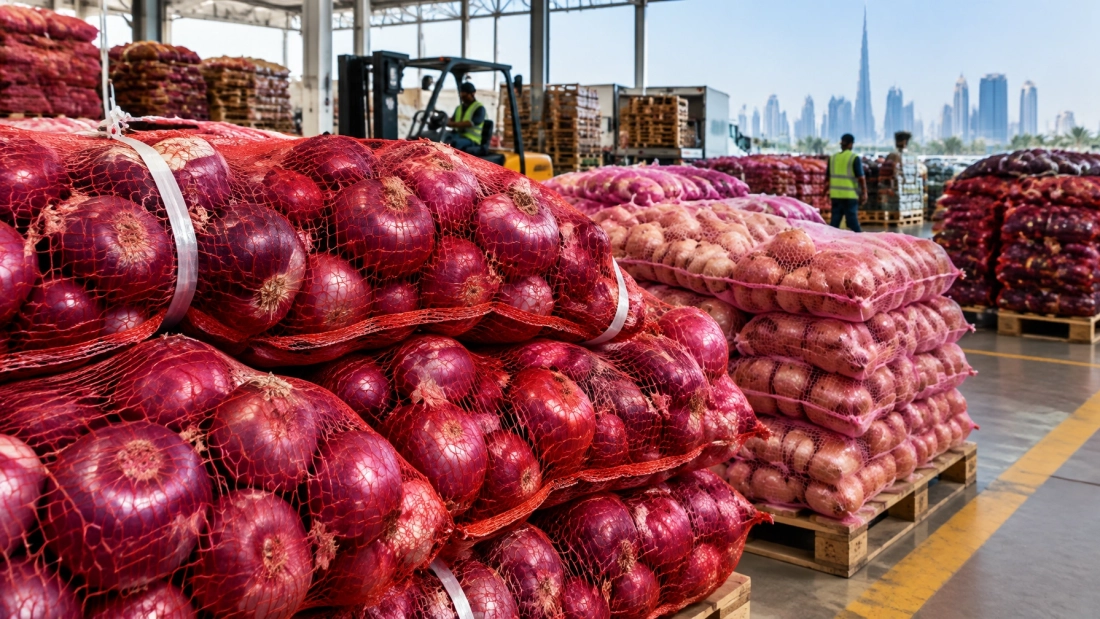
Daily edition: 7 October 2026
Market reference: Al Aweer board data dated 15 September 2026, board movements dated 17 September, and GCC wholesale intelligence for Weeks 37–38.
Executive market position
Al Aweer remains a key trading point for wholesale fruits and vegetables Dubai, serving supermarkets, restaurants, retailers, caterers, and wholesale distributors across the UAE.
The primary market story is onion availability. India is entering a short peak-price window before full new-crop arrivals. Egypt remains the mainstream bulk substitute, while Turkey provides a competitive red-onion alternative. Pakistan is also experiencing high prices and elevated transport costs.
For exporters, the commercial requirement is clear: verify the buyer, confirm the specification, calculate usable landed cost, and agree the distribution model before loading. Mayil Global supports this process through a transparent 3 percent commission distributor UAE model or an approved immediate cash-and-carry container purchase.
Al Aweer board movements: 17 September reference
The 17 September board shows strong origin and commodity rotation.
Leading gainers
| Product and origin | Previous | Latest | Movement |
|---|---|---|---|
| Snake gourd, Oman | AED 2.14/kg | AED 2.86/kg | +33.6% |
| Ridge gourd, Oman | AED 2.86/kg | AED 3.57/kg | +24.8% |
| Pomegranate, Yemen | AED 3.25/kg | AED 4.00/kg | +23.1% |
| Wax gourd, Oman | AED 2.14/kg | AED 2.57/kg | +20.1% |
| Ginger, China | AED 8.21/kg | AED 9.64/kg | +17.4% |
| Zucchini, UAE | AED 1.50/kg | AED 1.75/kg | +16.7% |
| Red seedless grapes, Lebanon/Turkey | AED 9.14/kg | AED 10.57/kg | +15.6% |
| Green peas, Pakistan | AED 10.67/kg | AED 12.00/kg | +12.5% |
| Fresh turmeric root, India | AED 9.14/kg | AED 10.00/kg | +9.4% |
Garlic from India increased from AED 7.27 to AED 7.58/kg. Indian shallots moved in the opposite direction, falling from AED 8.00 to AED 6.67/kg.
Leading fallers and the cucumber watch
| Product and origin | Previous | Latest | Movement |
|---|---|---|---|
| Cucumber, Iran* | AED 2.33/kg | AED 1.00/kg | −57.1% |
| Cucumber, UAE | AED 2.50/kg | AED 1.35/kg | −46.0% |
| Cabbage, Iran* | AED 2.10/kg | AED 1.30/kg | −38.1% |
| Lettuce, Iran* | AED 3.80/kg | AED 2.40/kg | −36.8% |
| White cucumber, UAE | AED 2.75/kg | AED 1.75/kg | −36.4% |
| Green capsicum, Iran* | AED 3.43/kg | AED 2.29/kg | −33.2% |
| Cauliflower, Iran* | AED 4.70/kg | AED 3.50/kg | −25.5% |
| Normal garlic, China | AED 5.71/kg | AED 4.46/kg | −21.9% |
| Brown onion, Iran* | AED 2.44/kg | AED 2.00/kg | −18.0% |
| New-crop onion, India, 18 kg | AED 3.80/kg | AED 3.35/kg | −11.8% |
| Pink onion, Sudan, approximately 50 mm | AED 3.10/kg | AED 2.75/kg | −11.3% |
| Onion, Yemen | AED 2.50/kg | AED 2.25/kg | −10.0% |
| Red onion, Turkey | AED 2.55/kg | AED 2.30/kg | −9.8% |
*Iran-origin lines remain intelligence only and are non-executable under the UAE trade suspension effective 19 August 2026.
The UAE cucumber correction requires monitoring. UAE cucumber fell 46%, creating a lower starting point for a possible recovery if supply tightens, demand improves, or weather affects local production. Buyers should not treat one board movement as a confirmed trend. They should compare grade, size, packing, and arrival condition.
Indian onions: the peak-price window
Indian onion supply is the central planning issue for October.
Weather has delayed the Maharashtra red onion crop by approximately one to one-and-a-half months. Full-scale arrivals are expected only after November. Only 30–40% of the old Garwa pink crop remains, and only 10–15% of that balance is expected to be export-suitable as storage life ends.
Nashik and Maharashtra prices have moved from approximately USD 31–42 per quintal last month to USD 42–52 per quintal this month, an increase of roughly 25–30%. The sharpest price window is expected between 25 September and 30 October. If demand exceeds available export supply, prices could reach approximately USD 84–94 per quintal.
New-crop onions from Andhra Pradesh and Karnataka are arriving, but much of the volume is being absorbed by the Indian domestic market. India currently has no onion export ban, minimum export price, or export duty in force. These restrictions were withdrawn from 1 April 2025. Exporters must continue monitoring India’s DGFT because policy can change quickly.
Freight and transportation to Oman, Kuwait, Qatar, Bahrain, or the UAE can reach approximately USD 26,000–31,500 per shipment. Pakistan is also facing high onion prices and elevated transport costs, reducing its availability as a dependable international substitute.
Egypt and Turkey origin substitution
Egypt offers the most practical mainstream alternative through October. Stored spring harvests are supporting steady exports, with fresh onions quoted around EUR 0.90/kg FOB Cairo. Egyptian fresh FOB indications are steadying.
Turkey is a potential alternative origin if additional imports are required, particularly for red-onion programmes and shorter regional replenishment routes.
The 17 September Al Aweer board shows:
- Egypt onion, 20 kg PPE bag: AED 2.20/kg
- Sudan pink onion, approximately 50 mm: AED 2.75/kg
- Turkey red onion: AED 2.30/kg
- India new-crop onion, 18 kg: AED 3.35/kg
- Yemen onion: AED 2.25/kg
These are market references, not executable offers.
Onion usable-cost method
The correct comparison for importing onions Dubai is not the quoted price per kilogram. It is the usable cost after arrival.
Usable cost = Total landed cost ÷ saleable kilograms after arrival
Include:
- Product purchase price.
- Inland transport and export handling.
- Freight, insurance, and customs.
- Port clearance, inspection, storage, and local delivery.
- Trimming, sprouting, moisture loss, rot, and rejected bulbs.
Worked example
Assume:
- 20,000 kg of Indian onions at AED 3.35/kg: AED 67,000
- Freight, clearance, handling, and other landed costs: AED 38,000
- Total landed cost: AED 105,000
- Arrival losses from trimming, sprouting, moisture, and rot: 12%
- Saleable quantity: 17,600 kg
AED 105,000 ÷ 17,600 kg = AED 5.97 usable cost per saleable kilogram
The same method should be applied to Egypt, Turkey, Sudan, and Yemen. The lowest board price is not necessarily the lowest commercial cost.

GCC Week 37/38 wholesale intelligence
Other categories also show origin and logistics pressure:
- Forelle pears increased to approximately US$26.67–29.33.
- Vermont Beauty pears reached approximately US$24.00–26.13.
- Philippine bananas declined to approximately US$13.87.
- Ecuadorian bananas declined to approximately US$14.67–15.47.
- Indian bananas remained the most competitive at approximately US$11.47–12.80.
- Australian carrots increased to approximately US$15.47–17.33.
- UAE lemons increased to approximately US$17.70.
- UAE Valencias increased to approximately US$22.88–23.48.
- Navel oranges declined to approximately US$21.24–21.79.
- Nova mandarins remained under pressure at US$10.13–10.67.
- Nadorcott mandarins were approximately US$16.00–18.67.
South African citrus remains under pressure because of cumulative arrivals and variable transit quality. Jeddah clearance delays are affecting delivery timing, working capital, and landed cost.
Africa–Gulf cold-chain reality
Kenya’s UAE horticultural trade demonstrates why cold-chain discipline must begin before the airport.
According to the 19 September 2026 Logistics Update Africa feature:
- The UAE was Kenya’s third-largest horticultural export destination by value in 2024, representing 7.4% of exports.
- Saudi Arabia represented 3.7%, Qatar 1.1%, and Oman 0.8%.
- Kenya exported approximately 23,100 tonnes of avocados to the UAE in 2024, worth about US$27.7 million.
- Pineapple exports to the UAE approached 19,000 tonnes, worth approximately US$13.1 million.
- UN estimates place post-harvest food loss in sub-Saharan Africa at 19.95%, the highest regional rate.
- Air freight can represent 30–50% of landed cost for certain fresh produce categories, with further pressure during Ramadan, Eid, and peak horticultural seasons.
The weakest links are ranked as follows:
- Farm-level cooling and pre-cooling.
- Road transport and consolidation.
- Airport handling and storage.
- Air freight and Gulf last-mile delivery.
The commercial test should be landed cost plus saleable shelf life, not freight price alone. Avocados, pineapples, mangoes, and some citrus may be suitable for sea freight when maturity, packhouse controls, and temperature records are reliable. Flowers, premium berries, fresh seafood, and high-value chilled meat remain more air-freight dependent.
Regional cold-storage collection hubs near farms, refrigerated road transport, shared digital temperature records, and auditable cold-chain procedures can improve repeat buying. Cold-chain discipline before the airport determines arrival quality, remaining shelf life, and whether a UAE buyer will reorder.

The Mayil Global 3% distributor model
Mayil Global positions itself as a verified buyer for exporters UAE and a wholesale supplier for UAE supermarkets, restaurants, retailers, and distributors.
Under the 3 percent commission distributor UAE model, Mayil Global applies a transparent 3% commission on the agreed realised sale value, subject to a written agreement.
Settlement illustration
For an AED 100,000 realised sale value:
- Realised sale value: AED 100,000
- Mayil Global commission at 3%: AED 3,000
- Agreed inspection and receiving cost: AED 1,200
- Agreed local delivery and handling: AED 1,800
- Agreed clearance and storage: AED 2,500
- Approved quality claim or wastage deduction: AED 1,500
- Illustrative exporter settlement: AED 90,000
The actual deductions, responsibility, claim process, and payment timing must be stated in the signed agreement. A Dubai trading house publicly advertises a 5% commission model; Mayil Global positions its model at a transparent 3%, subject to written commercial terms.
Immediate cash-and-carry container purchase
For suitable shipments, Mayil Global can also review immediate cash-and-carry container purchases. Approval proceeds through six stages:
- Product submission: exporter submits origin, grade, volume, packaging, price, loading date, and shelf-life details.
- Buyer and specification verification: UAE buyer demand, receiving capacity, specification, and sales channel are confirmed.
- Document review: invoice, packing list, certificates, HS code, origin documents, and permits are checked.
- Pre-loading inspection: quantity, quality, packaging, moisture, temperature, and photographs are verified.
- Arrival and receiving: container condition, inspection outcome, saleable quantity, and receiving records are documented.
- Settlement: payment is released according to the written cash-and-carry agreement and approved receiving result.
Cash-and-carry does not remove customs, food safety, labelling, or product registration requirements.
How to export food to Dubai
Businesses researching how to export food to Dubai should complete the following process before shipment:
- Register the UAE importer and ensure the trade licence includes the relevant food activity.
- Register food products through federal ZAD and Dubai Municipality FIRS before port clearance and sale. There is no general category exemption.
- Prepare Arabic-English labels showing product identity, origin, net weight, dates, storage conditions, and required declarations.
- Target approximately 50–70% remaining shelf life on arrival, subject to product category and buyer specification.
- Obtain phytosanitary certificates for applicable plant products and health certificates for applicable food consignments.
- Confirm any required MOCCAE import permits.
- Use consistent HS codes across the invoice, packing list, and customs declaration.
- Use the general 5% GCC customs duty reference plus VAT, while verifying the exact tariff treatment.
- For qualifying Indian goods, assess India-UAE CEPA zero-duty eligibility using the applicable rules of origin and a valid CEPA Certificate of Origin.
- Complete pre-shipment inspection and retain photographs, batch details, and temperature records.
- Expect Dubai Municipality sampling and testing at Jebel Ali to typically require 2–5 working days. Storage and demurrage can accrue during this period.
- Clear, store, and distribute through an organised, hygienic UAE supply chain.

Standard offer structure
Every exporter offer should state:
- Product and variety
- Country and region of origin
- Grade, size, and tolerance
- Crop or production date
- Quantity and container type
- Packaging and net weight
- Incoterm and loading location
- Freight mode and estimated arrival
- Remaining shelf life
- Certificates and HS code
- Target price and payment terms
- Preferred route: 3% commission distribution or cash-and-carry purchase
Exporter checklist
Exporter name: ____________________
Product: ____________________
Origin: ____________________
Quantity: ____________________
Loading date: ____________________
Documents confirmed: Yes / No
Preferred model: 3% commission / Cash-and-carry
Exporter signature: ____________________
Date: ____________________
UAE buyer checklist
Buyer name: ____________________
Trade licence/activity verified: Yes / No
Product specification approved: Yes / No
Receiving location: ____________________
Target arrival date: ____________________
Inspection standard agreed: Yes / No
Payment terms agreed: Yes / No
Buyer signature: ____________________
Date: ____________________
Gulfood 2027 opportunity
Gulfood 2027 is scheduled for 15–19 March 2027. India has been confirmed as Official Partner Country for a second consecutive year following the APEDA–InD Events MoU, with a focus on MSMEs, Farmer Producer Organisations, startups, commodity boards, and government institutions.
This is an opportunity for Indian exporters to present compliant products to UAE and GCC buyers. It is not a confirmed order. Exporters should prepare verified specifications, certificates, supply capacity, and commercial terms before approaching buyers.
Mayil Global wholesale supply
Mayil Global supplies fresh fruits, vegetables, premium spices, rice, and farm-fresh eggs through global sourcing, quality control, hygienic handling, storage, and organised distribution.
- Review available categories through Mayil Global Products.
- Review the Sourcing and Logistics process.
- Contact the team through Mayil Global Contact Us.
The operating objective remains consistent: dependable supply, consistent quality, transparent commercial terms, and long-term B2B relationships.
Sources
- Al Aweer market board and price references
- Al Aweer market movers
- Al Aweer onion references
- Dubai Municipality Food Traders and Establishments
- MOCCAE UAE import and export services
- India confirmed as Official Partner Country for Gulfood 2027. Press Information Bureau
- Gulfood official website
- UAE trade regulations, Trade.gov
- Mayil Global Products
- Mayil Global Sourcing and Logistics
Disclaimer
All Al Aweer prices and GCC wholesale references in this briefing are indicative, non-binding market references. They are not fixed quotations, guaranteed prices, confirmed offers, or binding purchase commitments. Actual transaction values depend on origin, grade, size, packaging, crop condition, moisture, availability, freight, customs, inspection, storage, wastage, shelf life, and negotiation.
Iran-origin lines are included for market intelligence only and are non-executable under the UAE trade suspension effective 19 August 2026. Exclude these lines from procurement, container budgeting, and shipment decisions unless UAE authorities formally announce a change.
Exporters and buyers must verify current registration requirements, ZAD and FIRS status, certificates, phytosanitary and health requirements, customs treatment, VAT, HS codes, CEPA eligibility, import permits, product labels, demurrage exposure, and all commercial terms before shipping or purchasing.